Article · Field note 39
A coral is an animal and a place
Deep-sea coral is often described in one of two ways: as a colony of small animals or as habitat for other species. Both descriptions are true, but they refer to different scales. A coral colony feeds, grows, and reproduces as a living organism. As it builds branches or a skeleton, it also creates surfaces and spaces that other animals can occupy. Over time, several colonies may form a garden or a larger reef-like structure.
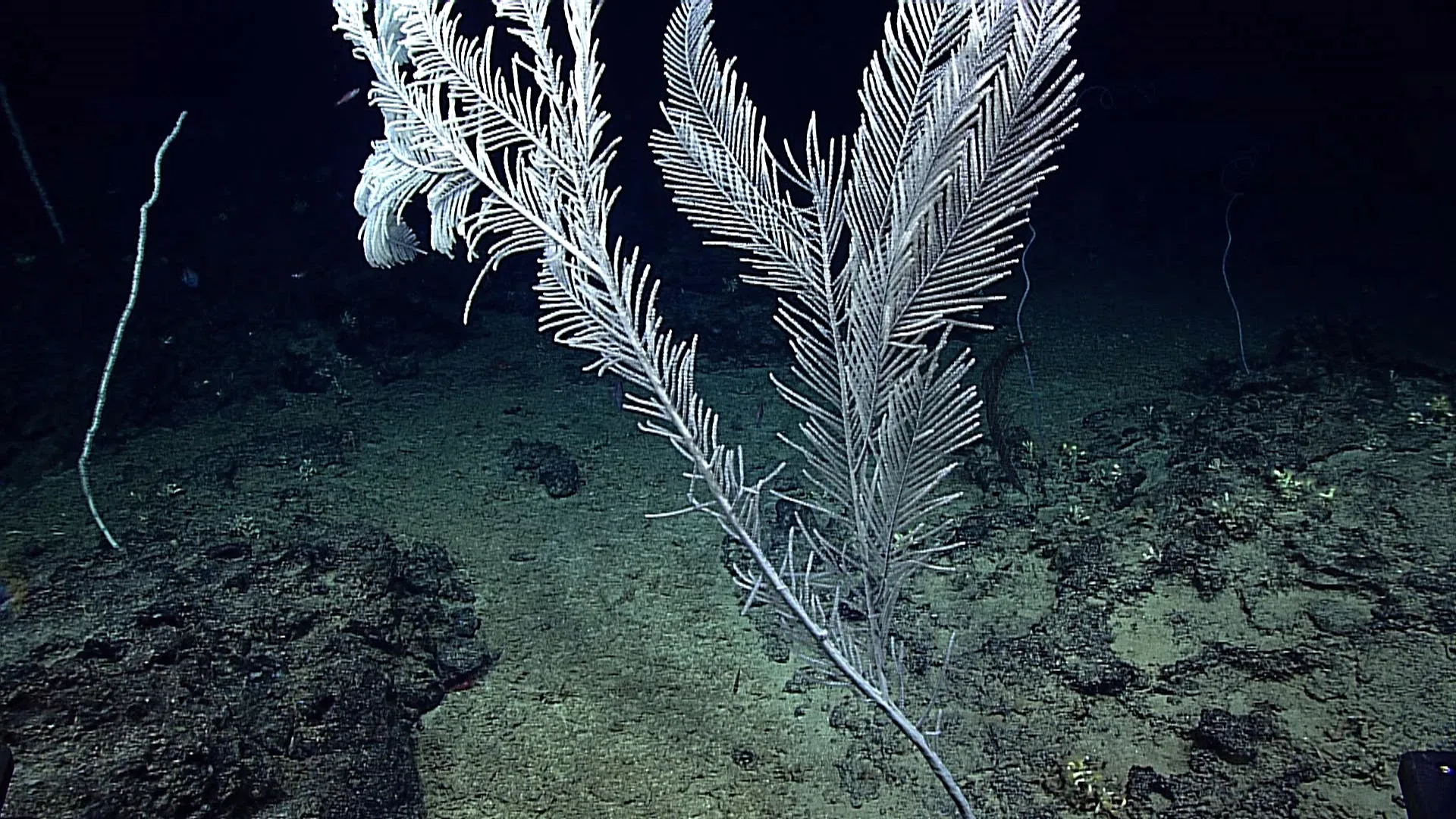
Unlike shallow tropical corals that receive energy from symbiotic algae in sunlight, deep-water corals live where light is dim or absent and capture food from surrounding water. NOAA’s Deep-Sea Coral Habitat page describes tree, feather, column, and fan forms that grow on continental margins, seamounts, and canyons. These structures can support fishes, shrimp, crabs, and other invertebrates.
What structure makes possible
A bare seafloor offers fewer attachment points than a branched colony. Coral branches can create elevated surfaces where animals encounter food carried by current. Crevices and spaces can provide shelter or a stable place to attach. Small invertebrates may live on the colony itself; larger animals may visit the surrounding area. The available roles vary by coral species, colony size, and local community.
NOAA describes deep corals and sponges as foundation species because their physical form contributes to habitat (NOAA fact sheet). The term “foundation species” emphasizes structure, but it does not imply that every associated animal depends exclusively on one coral. Some species use several kinds of seafloor structure; others may be tightly associated with a particular host. Researchers test those relationships through repeated surveys, collections, and observations of animal behavior.
The branches also change how water flows around them. Particles can be intercepted by polyps or by animals living on the coral. Local turbulence may alter what reaches different parts of the colony. A coral garden is thus both a physical object and a small-scale flow environment. The exact effect depends on its height, density, orientation, and the current.
Habitat is not a synonym for nursery
Coral grounds are often said to serve as nursery habitat or spawning grounds, particularly for commercially important fishes. Such descriptions can be accurate in some places, but they need species-specific evidence. A fish observed near a coral may be using the structure for feeding or shelter; it may also be passing through. Demonstrating nursery function requires evidence of life-stage use, survival, growth, or recruitment over time.
Scientists may compare fish density, size distributions, and behavior on coral grounds and nearby habitats. They can use cameras to track presence and sampling to identify species and life stages. Because deep-sea surveys are limited, those data are not equally available for every region. A careful habitat article distinguishes documented associations from ecological benefits that remain plausible or untested.
The distinction matters for management. Protecting a coral site can preserve a unique structure even before researchers know every species that uses it. But claims about fishery benefits should be grounded in surveys, not borrowed from shallow-water reef ecology. Deep-water coral communities have their own histories and physical conditions.
Long-lived structure, slow recovery
Some deep-sea corals grow slowly and can live for centuries or longer. Growth rates differ across species and environmental conditions; a coral colony should not be assigned a single age or growth rate based on its size alone. Still, long-lived structure can be vulnerable to damage that occurs in minutes. Bottom-contact fishing gear can break branches or flatten coral habitat. Recovery may take a long time, and some damaged areas may not return to their previous form under the same conditions.
NOAA documents how trawling can damage deep coral gardens and notes that slow growth complicates recovery on its habitat overview. That source supports the broad concern, while specific assessments require local information about the coral species, disturbance intensity, and habitat conditions. Not all coral structures recover at the same pace.
Physical protection does not eliminate every pressure. Corals can experience changes in temperature, oxygen, and water chemistry. The consequences depend on species and location. A habitat may face more than one stressor, and the interactions among them remain an active research area. Monitoring helps distinguish observed change from projected risk.
Finding a garden on a vast seafloor
Coral gardens are patchy. Hard substrate, suitable currents, food supply, and water chemistry must overlap. Sonar mapping can identify candidate terrain but cannot confirm every coral species. ROV footage reveals organisms along a camera track, while specimens help establish identifications and life histories. A map of predicted suitability is useful for planning surveys, not the same as a map of confirmed coral colonies.
This sampling gap creates an important asymmetry: a known coral garden can be clearly documented, while a nearby area with little survey effort cannot be assumed empty. NOAA’s deep-sea coral maps bring records together, but data density varies by region and method. Every new dive can add observations or change the interpretation of previously mapped habitat.
The colony as a neighborhood
That neighborhood is not frozen in time. Corals grow, break, and compete for space. Associated animals arrive, leave, or change with the season and local food conditions. A still image captures one arrangement. Long-term cameras and repeated surveys show whether the same species return and how the community changes.