Article · Field note 37
A hunt does not need a chase
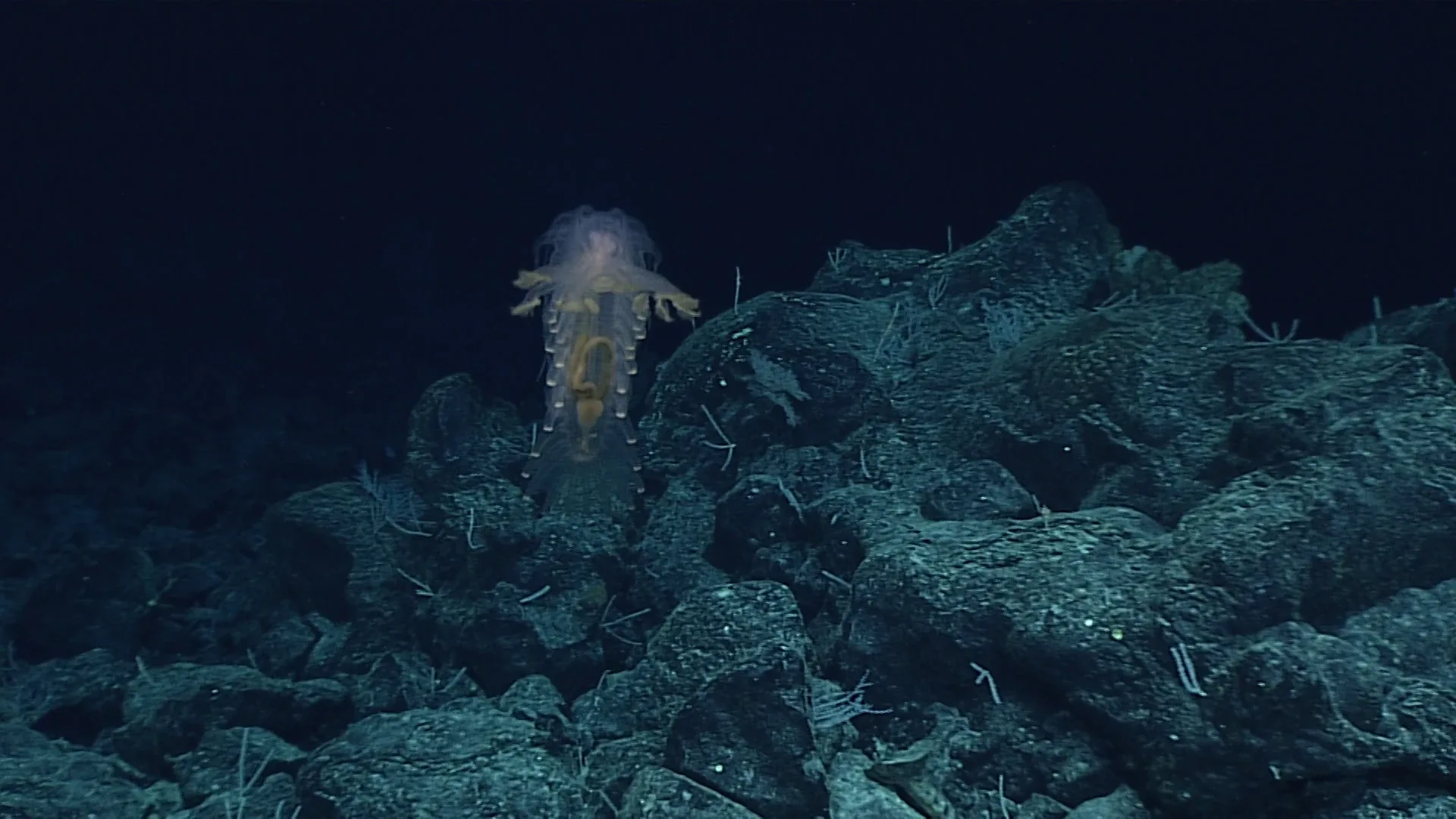
Predation in dark water is often illustrated as a large fish pursuing a smaller one through blackness. That is only one possibility. Some predators search; some wait; some detect vibrations, chemical signals, or bioluminescent flashes; others feed on gelatinous prey that drift into reach. The deep sea contains a diversity of feeding modes, and the evidence is uneven because observations in the natural habitat are hard to collect.
The deep-pelagic environment can have large distances between potential prey. A review of deep-sea fish feeding ecology describes sit-and-wait predation as one strategy among several, while also emphasizing prey types that are often overlooked, such as gelatinous animals (review in Annual Review of Marine Science). A predator’s body, sensory system, and depth range provide clues, but a behavioral claim should be grounded in video, diet, or experiment.
Detecting a meal in moving water
Vision is useful when there is enough light—whether residual sunlight or bioluminescence—to reveal a prey item. In the twilight zone, a fish may look upward for a silhouette; another may detect flashes against darkness. Some predators have large, light-sensitive eyes, while others rely more heavily on smell, touch, or lateral-line sensing. The right combination depends on where the animal hunts and what its prey does.
Sound and vibration can also matter. A moving animal disturbs water, and sensory structures can detect those changes. The lateral line of fishes senses local water movement; other animals respond to chemical cues carried by currents. These systems are not interchangeable: an odor plume may help locate a source over distance but provide limited directional information, while a vibration can signal a nearby moving object.
Bioluminescence can function both as signal and as information for a predator. Some species may use emitted light to attract prey; others detect a glowing target. A luminous flash can also expose the emitter. The same signal therefore creates opportunities and risk. NOAA’s deep-sea light overview describes several ways light is produced in marine organisms, while experiments are needed to establish the role of a particular glow in a particular interaction.
The advantage of waiting
For some midwater predators, remaining in one area may be more efficient than searching continuously. A fish can orient its body toward a likely approach path or hold position within a layer where prey pass. If prey are sparse, a short burst of speed might be preferable to constant swimming. This is not a universal law; an animal’s actual movement and energetic cost must be measured.
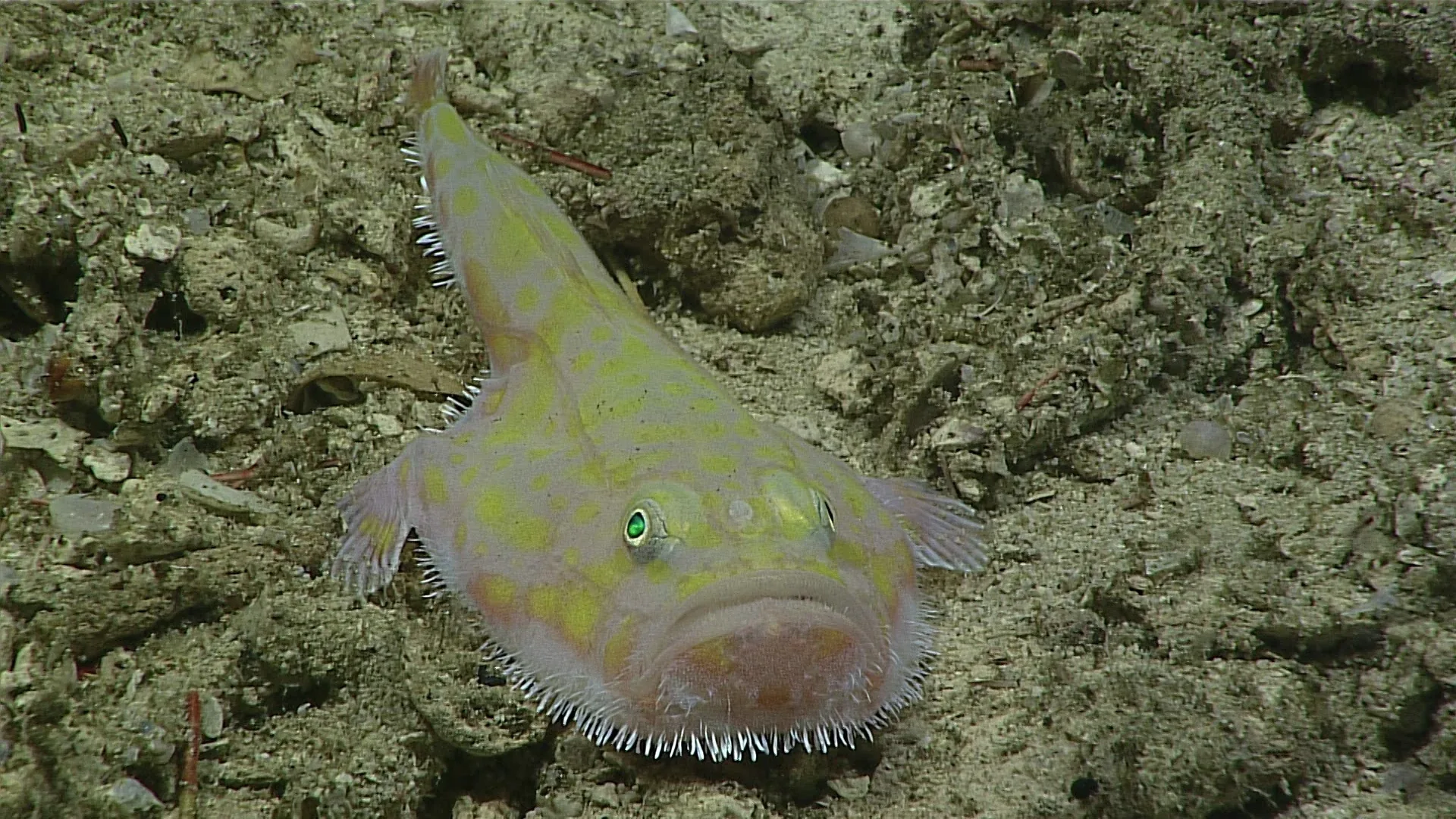
Ambush predators on the seafloor face a different geometry. They may use camouflage against sediment or rock, then strike when prey comes near. A photograph of a still animal does not prove that it hunts by ambush, and a mouth shape alone does not establish its diet. Researchers examine stomach contents, capture behavior on video, and compare anatomical traits with known feeding mechanics.
Deep-sea toadfishes in the genus Chaunax are often described as sit-and-wait predators, but a source should specify which species and observation supports the claim. This article’s NOAA image record identifies a Chaunax in one place and time; the record is not itself a behavioral experiment. That separation keeps a vivid photograph from being asked to prove the entire natural history of the fish.
Prey can be larger than expected
Some deep-sea predators consume prey that is large relative to their own bodies. A wide gape or expandable stomach can help them use an infrequent opportunity. But body proportions do not mean that an animal can swallow any prey. Constraints such as jaw mechanics, prey shape, and digestion still matter.
Diet studies reveal the food animals have eaten, yet they can undercount soft-bodied prey. Gelatinous remains may be digested quickly or become difficult to identify. Fishes recovered by nets may regurgitate or have altered stomach contents. Researchers can supplement dissection with DNA metabarcoding of gut contents, stable-isotope analysis of tissues, and in-situ video. Each method captures a different time scale and level of detail.
The result can challenge expectations. A predator that appears specialized for fish may also consume squid, crustaceans, or gelatinous zooplankton. Prey composition can change with size, location, and season. A single specimen is a clue, not a complete diet profile.
A food web of close encounters
In the open ocean, predators and prey interact within layers that shift over a day. Vertical migrants can bring prey into a depth range at night and carry energy back downward during daylight. A predator may follow those movements or remain within its own preferred layer. Sound-scattering records show where many organisms concentrate, but they do not name every predator and prey relationship inside that layer.
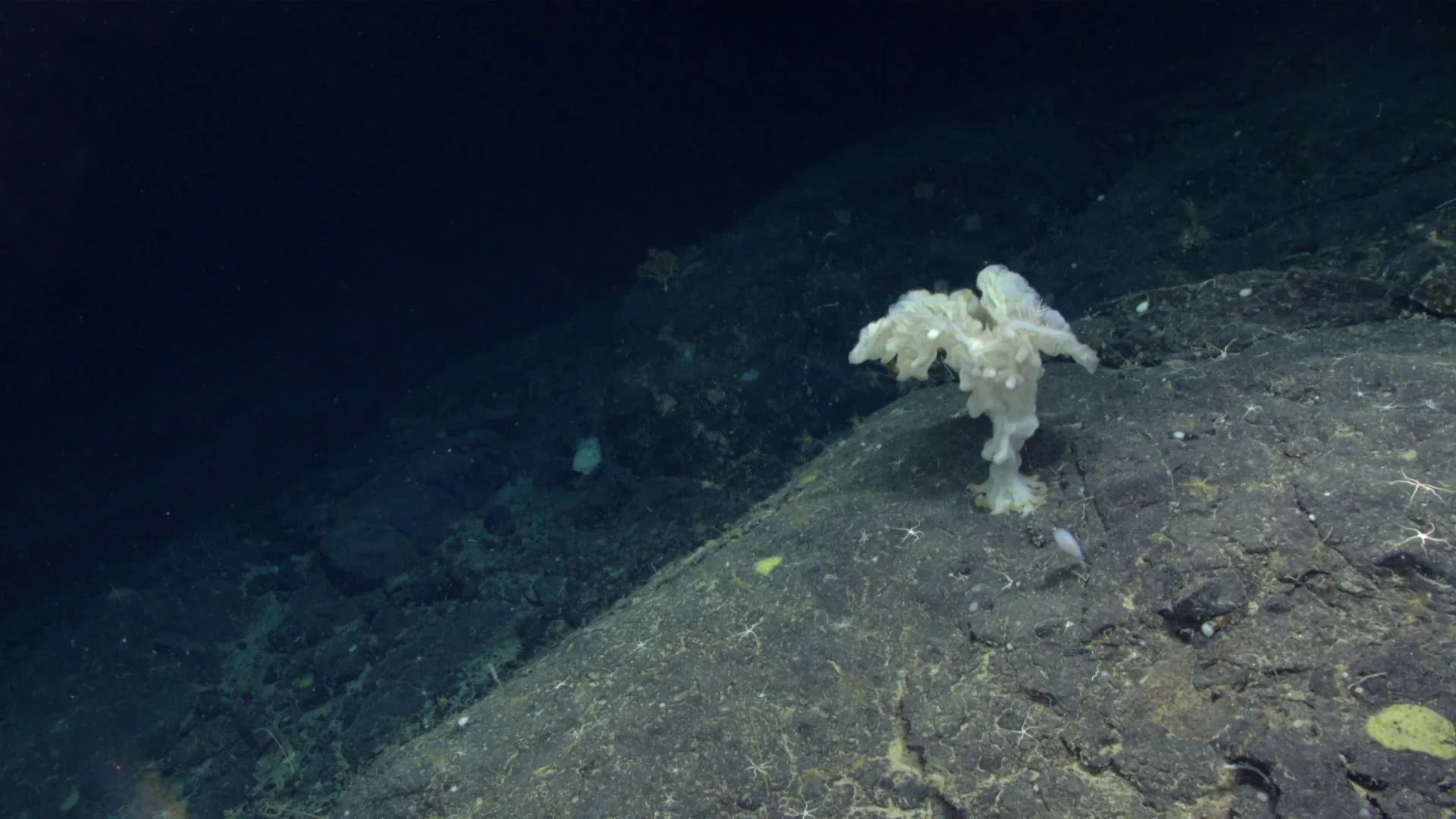
In benthic habitats, structure can create encounter zones. Corals and sponges offer surfaces for prey to settle, while nearby predators can use branches and crevices. Canyons funnel currents and particles, potentially concentrating both food and animals. Habitat changes the odds of a meeting even when the species themselves do not change.
Measuring an invisible interaction
ROVs and submersibles can record rare feeding behavior directly, but the event may happen outside the camera’s view. A vehicle’s lights may alter behavior, and a short dive samples only a small window. Baited cameras attract scavengers but can distort the interaction by creating an artificial food source. Laboratory experiments reveal sensory mechanisms but may not reproduce natural pressure and temperature.