Article · Field note 35
A slow fall through the water column
Marine snow is a name for the particles that drift downward from the upper ocean: dead plankton, fragments of plants and animals, mucus, fecal pellets, and bits of other organic matter. Under an ROV lamp, the particles can look like flakes moving across a dark screen. Their ecological importance is easy to miss because each piece is small and the descent is often slow. Together, they connect surface production to animals living hundreds or thousands of meters below.
The NOAA marine snow explainer describes how particles are consumed and transformed on the way down. Some are eaten by zooplankton or bacteria near the surface; others aggregate into larger pieces or sink in fecal pellets. The material that reaches the seabed is only a fraction of what began higher in the water column. How much arrives depends on depth, temperature, particle size, currents, and biological activity.
Not every snowflake is alike
Marine snow is not a single substance. A sticky mucus aggregate can trap smaller particles. A fecal pellet can sink faster than the loose material from which it was produced. A dead plankton fragment can be colonized by microbes. Each particle has its own density, shape, and organic content, which influence how quickly it settles and how long it remains available to animals.
The descending material is processed on the way. Bacteria decompose organic matter and release dissolved compounds; grazers consume particles; animals repackage food into new fecal material. This “repackaging” can accelerate sinking while changing the particle’s chemistry. Marine snow is therefore a moving food web, not an inert rain of edible flakes.
Sediment traps help researchers collect particles at different depths. They can estimate flux and analyze the material, but a trap samples a small area over a limited period. Currents can move particles horizontally, and a short deployment may not capture seasonal pulses. Optical instruments and cameras provide another view, while sediment cores show what eventually accumulates at the bottom. No single measurement fully describes the route from surface plankton to deep seafloor.
Who eats the particles?
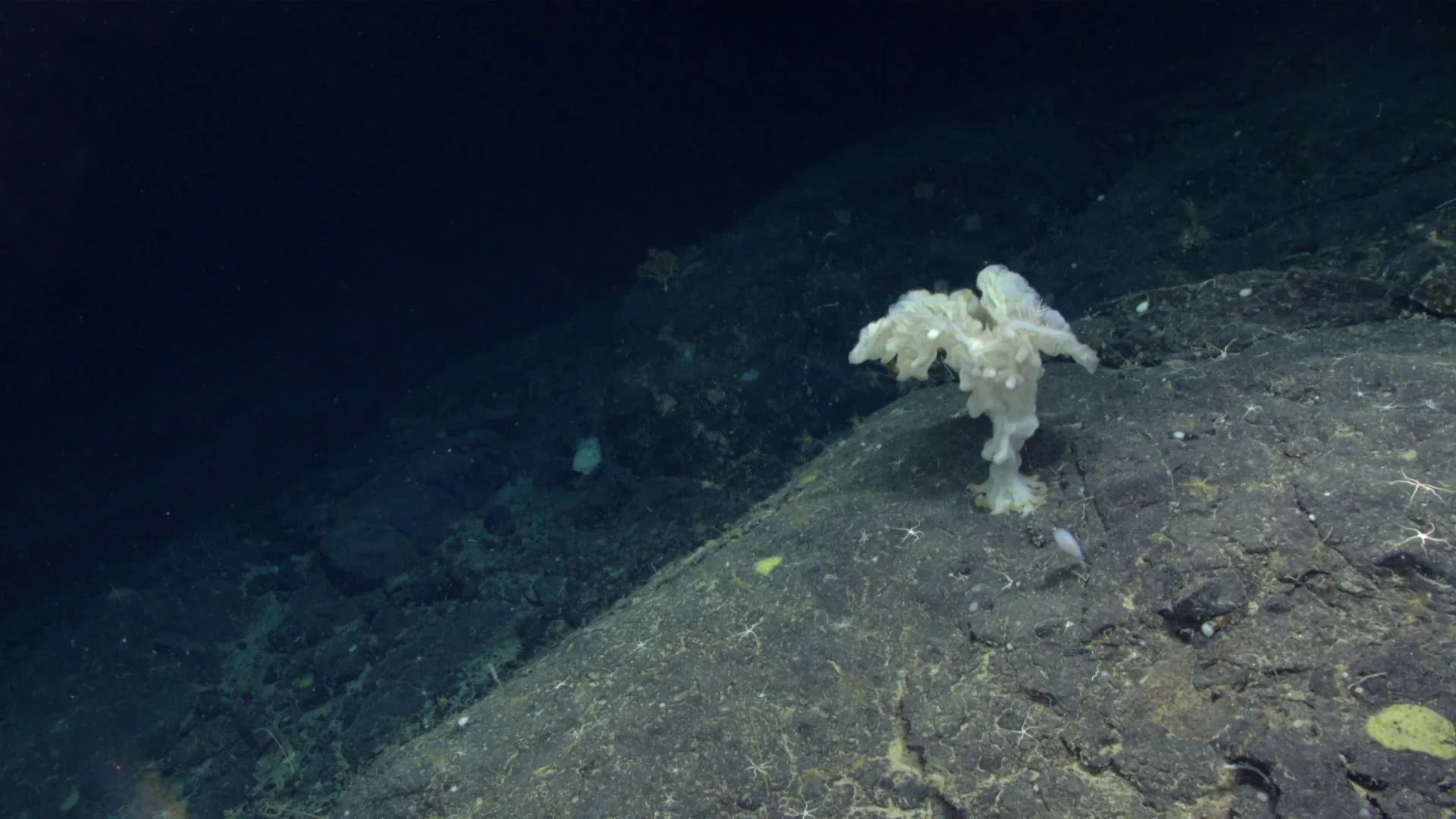
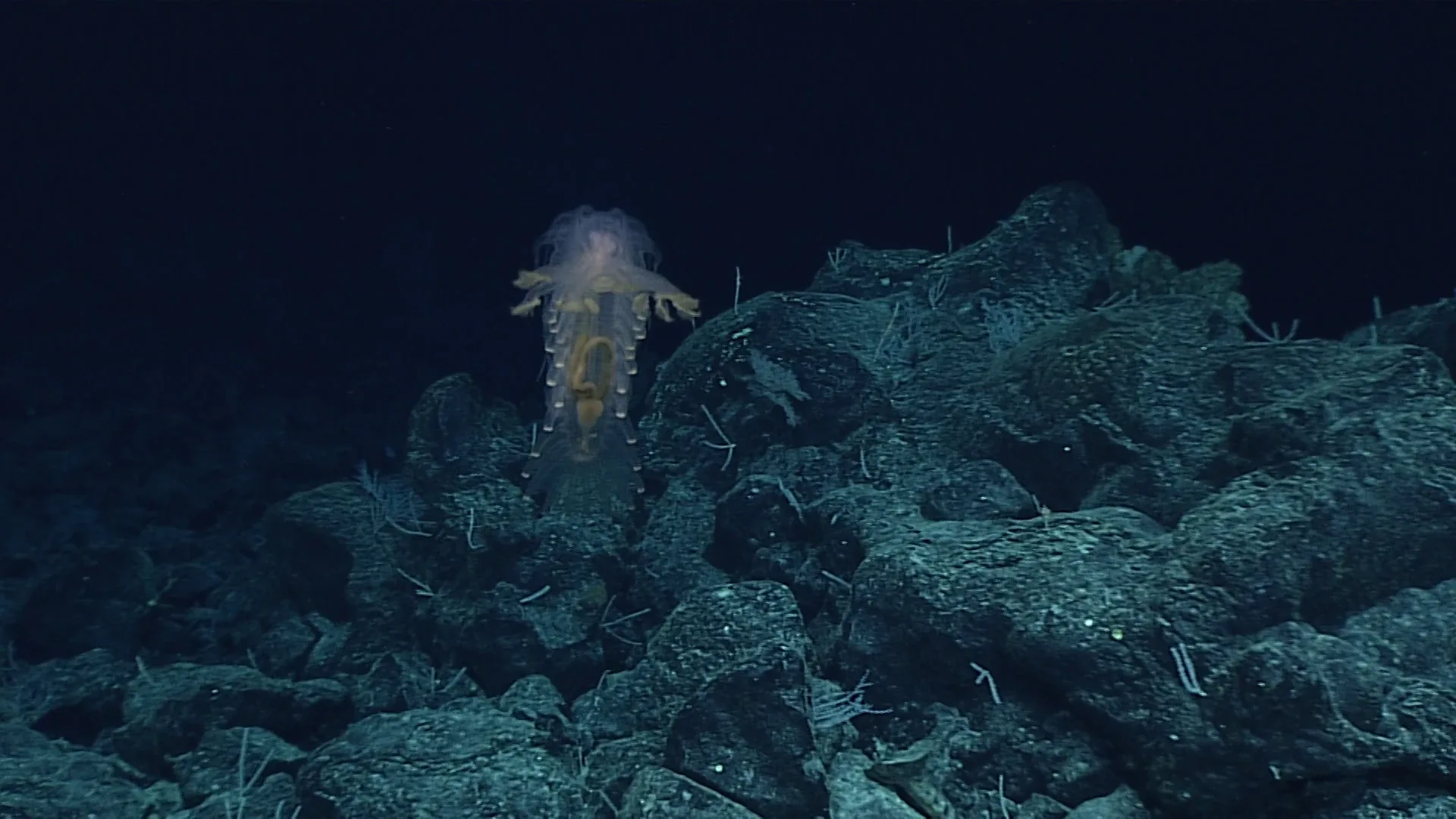
Suspension feeders intercept organic matter as it moves through water. Corals and sponges can filter particles carried by currents. Some gelatinous animals use mucus structures that collect material; discarded larvacean houses can sink as nutrient-rich packages. At the bottom, sea cucumbers and other deposit feeders process sediment containing organic particles. Microbes decompose what remains.
These feeding roles overlap. A piece of marine snow might be eaten in the water column, settle to the seabed, or be incorporated into a larger aggregate. One consumer’s waste can become another organism’s food. That recycling means the same carbon atom may pass through several organisms before it is buried or returned to the water as dissolved inorganic carbon.
NOAA describes marine snow as an important source of deep-sea food, but the amount varies between places. A basin under productive surface water may receive a different supply from one with low surface productivity. Even within a region, blooms and currents can create uneven delivery. A photograph of particles in one dive cannot establish the annual food supply for a whole seafloor plain.
The particles that reach the bottom
As depth increases, many particles are consumed or decomposed. Some remain in suspension; others settle into fine sediments. The small share that reaches the abyss can still support a community, because animals have evolved to use a dispersed and variable resource. The sediment itself stores organic material, and burrowing animals mix it into layers where microbes continue to break it down.
When a particle-rich pulse arrives after a bloom, the food web may respond. Microbes can become more active; deposit feeders may encounter new material; predators may follow prey. The timing and strength of these responses vary. Long-term moorings, repeated sediment traps, and benthic experiments help researchers connect surface events with deep-seafloor changes.
Marine snow is also part of the biological carbon pump. Photosynthetic organisms fix carbon near the surface; some carbon leaves the upper ocean when organic particles sink. Much of it is remineralized before reaching the bottom, returning carbon dioxide and nutrients to the water at depth. A smaller portion can be buried in sediment for longer periods. NOAA’s sediment-trap work describes how carbon is transformed and repackaged as it sinks (NOAA Atlantic Oceanographic and Meteorological Laboratory). Estimating long-term storage requires measurements of particle flux and the depth where decomposition occurs.
A pathway with gaps
Particle flux is difficult to measure because the deep ocean is vast and instruments sample only limited tracks or points. The amount of material at one depth may change within hours. A trap can over- or under-collect in strong currents, and cameras may be unable to distinguish particle types. Studies therefore use complementary tools and report their assumptions.
Reading the snow in a camera frame
When particles cross an ROV image, some are close to the lens and some much farther away. Their apparent size and speed depend on distance, camera motion, focus, and current. “A lot of snow” in one frame is not a quantitative measurement of particle flux. Researchers need calibrated instruments and known sampling intervals to estimate concentration or sinking rates.
The deep ocean’s daily delivery
The most useful picture is not a straight arrow from plankton to abyss. It is a branching path of sinking, grazing, decomposition, repackaging, and burial. The particles are small, but the processes they connect span the full water column. Following them reveals how an ecosystem can remain active far below the reach of sunlight.