Article · Field note 38
Eating what the current brings
On a deep seamount, a coral or sponge cannot chase each particle that passes. It feeds by placing its body where moving water carries small organisms and organic matter within reach. This is suspension feeding: the animal removes material from water rather than grazing across the sediment or pursuing prey. Currents are therefore part of the habitat, delivering food as well as shaping where animals can live.
NOAA’s deep-sea coral habitat overview describes deep corals and sponges as consumers of microscopic organisms carried by ocean currents. Unlike many shallow tropical corals, deep-water corals do not depend on sunlight for nutrition. They capture food in the water column, and the size and type of particles available can vary with place, current, and depth.
A sponge pumps water through living architecture
Sponges move water through pores into an internal canal system. Specialized collar cells called choanocytes beat flagella to generate flow and trap particles. Water exits through larger openings after passing through chambers. The body is therefore not a passive filter held in the current; its internal structure actively shapes water movement.
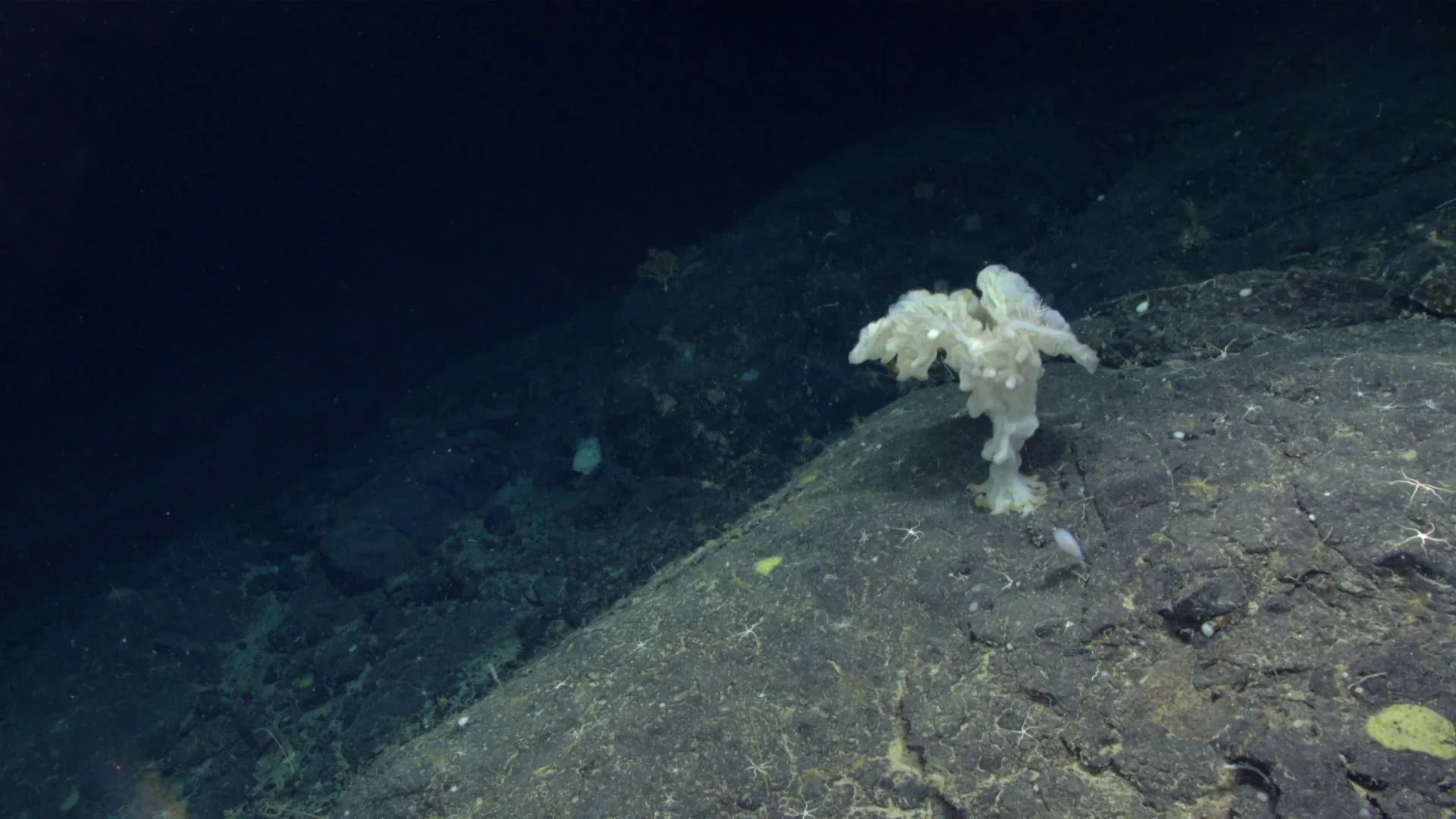
The glass sponge Aphrocallistes beatrix in this article’s cover record was photographed at Bear Seamount in the North Atlantic. Its skeleton is made of siliceous spicules, which can form a rigid framework. The image establishes a species identification and an encounter site; it does not show the flow rate through the sponge or what individual particles it consumed. Those questions require measurements, such as tracer studies, microscopy, or particle analysis.
Deep-sea sponge grounds can alter local habitat by adding three-dimensional structure to the bottom. The sponge’s body offers surfaces and spaces for other animals, and the skeleton can remain as structure after a sponge dies. That role depends on the species and the physical habitat. A single animal in a photograph cannot stand in for a dense sponge ground, just as one tree cannot describe a forest.
A coral colony meets the flow
Deep-sea corals are animals, often colonies of many small polyps connected by tissue and supported by skeletons of different materials. Individual polyps can extend tentacles to capture particles and small prey. The colony’s branching or fan-shaped form exposes more surface area to the flow, though the exact feeding benefit depends on current direction and polyp arrangement.
Some coral colonies are oriented in ways that place their branches across prevailing currents. This can increase the volume of water encountering the polyps, but excessive flow may also make feeding difficult or damage fragile tissue. A colony’s shape, location, and flexibility interact with the currents. Scientists use cameras, flow measurements, and laboratory experiments to understand how particular forms capture food.
The deep sea is not a uniform current. Seamounts, ridges, and canyon walls redirect water and can create local accelerations, turbulence, or retention zones. A filter feeder situated on an exposed ridge may encounter a different food supply from one lower on a sheltered slope. Mapping an animal’s location helps explain the physical setting; a direct particle measurement is needed to quantify what reaches it.
Particle size determines what can be captured
Filter feeders do not collect every type of material equally. A sponge’s canals and choanocyte chambers capture a range of small particles; coral polyps can catch larger items and suspended material; some animals use mucus to trap particles that would otherwise pass by. Dissolved organic matter may also be available to certain organisms. Each feeding system has a different size spectrum and energy cost.
Particles themselves change as they sink. A microbial film may coat an aggregate; a fecal pellet may carry compacted organic matter; a fragment can break into smaller pieces. The same water current can therefore supply chemically different food at different depths. “Filter feeding” names a method, not a fixed diet.
Why currents create habitat
Deep-sea corals and sponges often grow on hard surfaces and in places where flow brings food. Their presence then changes the habitat for other species. Attached anemones, barnacles, brittle stars, and small crustaceans can use the structures as a home base. Some animals feed on or around the colonies; others simply perch there. NOAA’s foundation-species fact sheet describes the vertical structure and small spaces that coral and sponge communities provide.
This creates a feedback between physical conditions and biological structure. Currents support suspension feeders, and the animals build or maintain structures that provide new surfaces. A colony can influence local flow and particle interception. In the case of a coral garden, many colonies create a patchwork habitat larger than any one animal.
How feeding is measured in place
Observing an animal extend its tentacles is a clue, not a complete account of feeding. Researchers may measure particle concentrations before and after water passes a colony, track flow with dye or particles, inspect gut contents, or use imaging to see material captured by the animal. Long-term cameras can show feeding responses over time. Each method tackles a different part of the process.
Collection can change the behavior being studied. A sponge removed from its depth loses pressure; a coral placed in a tank experiences different currents and temperature. Some species remain alive in laboratory systems, but keeping them under representative conditions can be difficult. In-situ techniques therefore play an important role, even though instrumentation at great depth is costly and can disturb a small area.