Article · Field note 30
Softness is a working body plan
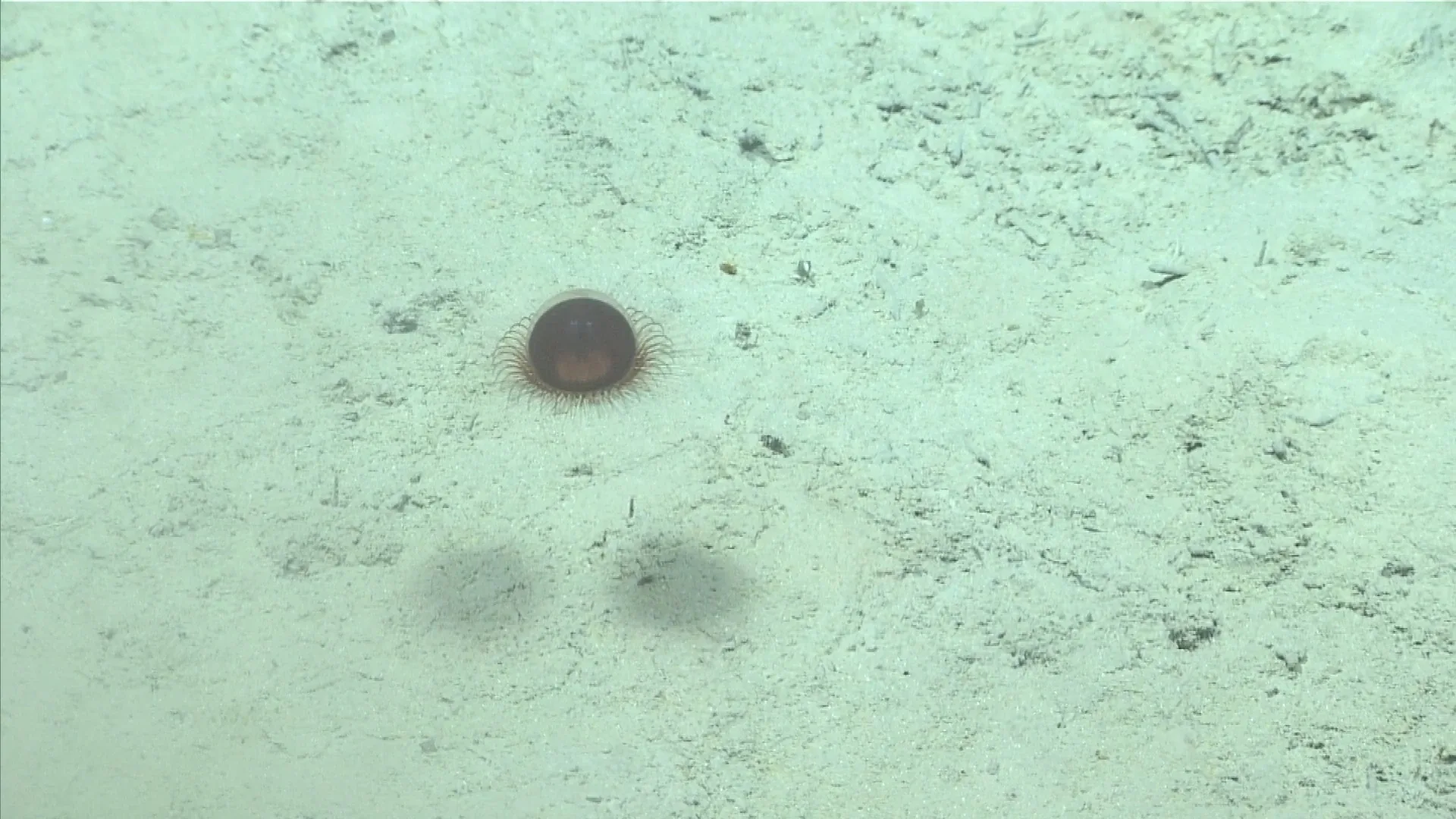
Some deep-sea animals look as if they are made of jelly. That appearance can invite a simplistic explanation: a soft body must be a weak body, and pressure must somehow make animals gelatinous. In reality, gelatinous forms occur in many marine groups and across several depths. Their tissues can support buoyancy, locomotion, feeding, and a low-cost way of occupying the water column. The body plan is varied, and a photograph alone cannot tell us exactly how it functions.
Comb jellies, salps, siphonophores, and larvaceans are all gelatinous, but they are not interchangeable animals. They belong to different groups and feed in different ways. Some swim through the water column; some drift; some build elaborate mucus structures for collecting food. A useful account starts with the organism, then asks what its tissues and behavior allow it to do.
Supported by water, not free from gravity
Buoyancy reduces the work required to remain in the water column. Many marine animals have bodies with a density close to the surrounding seawater, so they can move without constantly fighting gravity in the way a land animal would. This does not mean the ocean is literally a zero-gravity environment. Animals still face drag, currents, sinking, and the cost of propulsion. A flexible body can respond to these conditions in ways that a rigid structure cannot.
The soft tissues of gelatinous animals often contain a large proportion of water. This can reduce the amount of dense material needed for support, but it is not a universal “pressure shield.” An organism still has cellular structures and biochemical processes that must function at its depth. Gelatinous body composition may be useful in a habitat where an animal must stay suspended, capture small particles, or avoid spending much energy on hard tissues. The exact advantages vary with the animal’s ecology.
Larvaceans build a feeding structure around themselves
Giant larvaceans are small, transparent tunicates that make large mucus “houses” around their bodies. By beating a tail, an animal moves water through an inner filter; fine particles can be concentrated as water passes through the structure. When the house becomes clogged, the larvacean can leave it and build another. The discarded filter does not simply vanish. It sinks as a compact packet of organic material that other deep-sea organisms may consume.
MBARI researchers have used a laser-based instrument called DeepPIV to visualize water movement and reconstruct the three-dimensional form of larvacean filters. Their report on the technique describes how the team observed transparent bodies and mucus structures in the water column. Another MBARI account discusses how discarded larvacean houses, or “sinkers,” can transport food to deeper habitats (MBARI research report). These observations connect a delicate-looking animal to a substantial ecological process.
The filter also shows why softness should not be confused with passivity. A larvacean actively generates water flow and maintains a complicated structure. Its house acts as a feeding apparatus, yet it is temporary and replaceable. The design makes sense in a habitat where particles are dispersed and filtering a large volume of water can improve the chance of collecting enough food.
Gelatinous does not mean fragile
“Fragile” is a human judgment based on handling. A jelly-like body may be damaged by a net, a rough tank, or a specimen jar, but in its own environment it can be well suited to movement and feeding. A soft animal can pulse, contract, or flex. Some species have structures that are robust relative to their function, even if those structures are hard to preserve after collection.
Sampling bias matters here. Trawls and nets can tear gelatinous animals, making them harder to identify or count. ROV video can show a living animal in context but may not resolve fine structures or distinguish similar species. Researchers may use close-up cameras, gentle collection methods, genetic analysis, or laboratory imaging. Each method changes what kinds of questions can be answered.
One appearance, many strategies
The label “gelatinous zooplankton” includes animals with very different diets and movement. A ctenophore may use sticky cells on its tentacles to capture prey; a salp filters particles through a mucus net; a larvacean builds an external house; a siphonophore is a colony whose components perform specialized roles. These are examples rather than a complete list. The common feature is a soft, water-rich body, not a shared lifestyle.
A pathway for particles
Gelatinous organisms are not only consumers. Their discarded mucus houses, fecal material, and carcasses can become food for other animals or sink toward the seabed. This export is part of the movement of carbon and nutrients through the ocean. The magnitude of a contribution depends on species, depth, abundance, and conditions; one spectacular larvacean image cannot establish a global carbon budget.
Read the animal, not the adjective
Calling a creature “gelatinous” describes a broad physical quality, but it does not explain how the animal survives. Ask what supports its body, how it moves, what it eats, and whether it builds a structure beyond its skin. Ask how researchers observed it and whether the method preserves its form. Those questions reveal several different solutions hiding under one adjective.