Article · Field note 40
A brittle star on a living branch
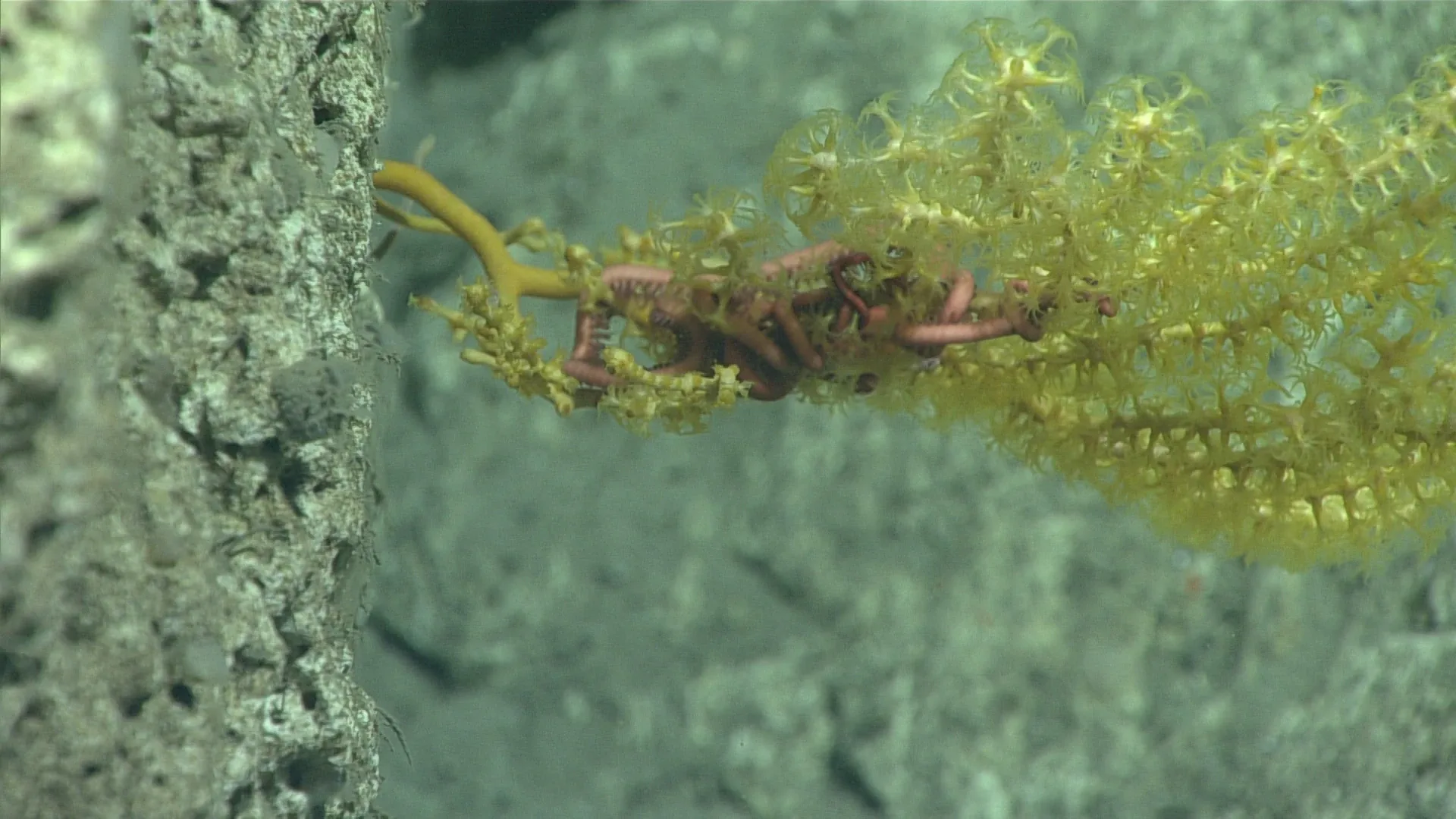
The cover image for this article shows the brittle star Asteroschema clavigerum on a branching coral in an unnamed North American canyon. The NOAA image record places the encounter at 1,168 meters during a remotely operated vehicle dive. In the frame, the brittle star’s slender arms wrap across the coral’s branches. That is a direct observation of position and contact. It does not, by itself, show what the brittle star eats, whether the coral benefits, or how long the animal remains there.
This distinction is central to studying epifauna: animals that live on the surface of another organism or substrate. A coral branch can be home base, feeding station, shelter, or simply a surface to grip. Some relationships are close and persistent; others are temporary. Scientists must observe behavior and compare repeated samples before assigning a function to a particular association.
A branch adds a vertical world
On an otherwise open seafloor, a coral lifts habitat above the sediment. Its branches provide attachment points, alter local currents, and create small spaces with different exposure to particles and predators. A small animal perched higher in the water may encounter a different flow than one on the bottom. The coral’s architecture therefore changes the animal’s immediate environment.
NOAA’s overview of deep-sea corals and sponges as foundation species describes how these structures create places for other organisms to attach, shelter, and feed. Brittle stars are among the many invertebrates that can occur in coral habitats. The broad ecological role is supported across surveys; the specific benefit to one Asteroschema individual requires closer observation.
Brittle stars, or ophiuroids, are echinoderms with a central disc and long flexible arms. They can use their arms to hold on, move, and interact with surrounding water. Species differ in how they feed: some collect particles, some scavenge, and some prey on small organisms. The genus Asteroschema includes species associated with corals and sea pens, but behavior should be described at the species level when reliable observations exist.
What the posture might mean
An arm wrapped around a branch could stabilize the brittle star in current. It could also position the animal near suspended food or a route used by small prey. A stationary frame cannot choose between these explanations. Time-lapse or video can show whether the arms move to intercept particles, whether the animal changes position, and whether it feeds. Gut or tissue analyses can add information about diet.
Researchers have recorded brittle stars associated with corals in deep-water surveys, and ecological studies compare epifaunal assemblages across host species and regions. A coral is a surface with its own shape and flow; two neighboring colonies can support different animals because their branches, height, and orientation differ. The association also changes with the depth and current regime.
There is a temptation to treat every animal sitting on a coral as a mutualist. “Mutualism” means both partners benefit. The image does not show that. The brittle star might use the coral while having no effect on it, or it may feed on material without damaging the colony. Demonstrating a benefit to both organisms requires evidence for each side, not just proximity.
A small-scale food web
Coral branches hold more than the animals visible in a wide-angle image. Small crustaceans, worms, hydroids, and other invertebrates may live on or among the branches. Some feed on the coral’s tissues; others filter particles or prey on neighboring organisms. This creates a microhabitat with multiple trophic roles. A brittle star may interact with one part of that web while using the coral as structure.
The direction of flow matters. A branch facing into a current may intercept particles; an animal on the downstream side may experience different food delivery. ROV video can show approximate orientation but usually lacks calibrated current measurements. Researchers add instruments or model flow around coral shapes to infer how a colony structures its habitat.
Some brittle stars can extend their arms into moving water to capture food. That behavior has been described for several ophiuroid species, but the exact feeding strategy should not be transferred automatically to Asteroschema clavigerum. The NOAA record identifies the photographed species and site; a behavioral claim needs a source specifically about this species or a well-marked comparison with relatives.
The survey problem
Epifauna are difficult to inventory because many organisms are small, hidden, or camouflaged against the coral. A moving ROV may not resolve the underside of every branch. Sampling coral can damage the colony, so scientists may prefer high-resolution video and non-destructive methods. Those choices preserve habitat but can leave some animals unidentified.
To compare communities, researchers need consistent sampling units. Counting animals per coral colony, branch length, or area produces different values. A survey that only records visible organisms may miss cryptic species. Replicate colonies at different sites and depths help establish whether an observed pattern is general or local.
Identifying the host can also be difficult. Coral branches may appear similar in a frame, and species-level identification can require skeletal features or genetic data. If the host is uncertain, researchers should say so rather than writing a precise association from an ambiguous photograph. The brittle star might be correctly identified even if the coral is not.