Article · Field note 19
Flatness is a map description
An abyssal plain is a broad, relatively level region of deep seafloor, usually placed between about 3,000 and 6,000 meters. NOAA describes these plains as sediment-covered areas with hills, ridges, and other prominent features excluded from the plain itself. The name can make the habitat sound empty, but flat terrain is not the same as lifeless terrain. Animals burrow through sediment, crawl across it, or swim just above it. Their food supply and distribution can vary across surprisingly short distances.
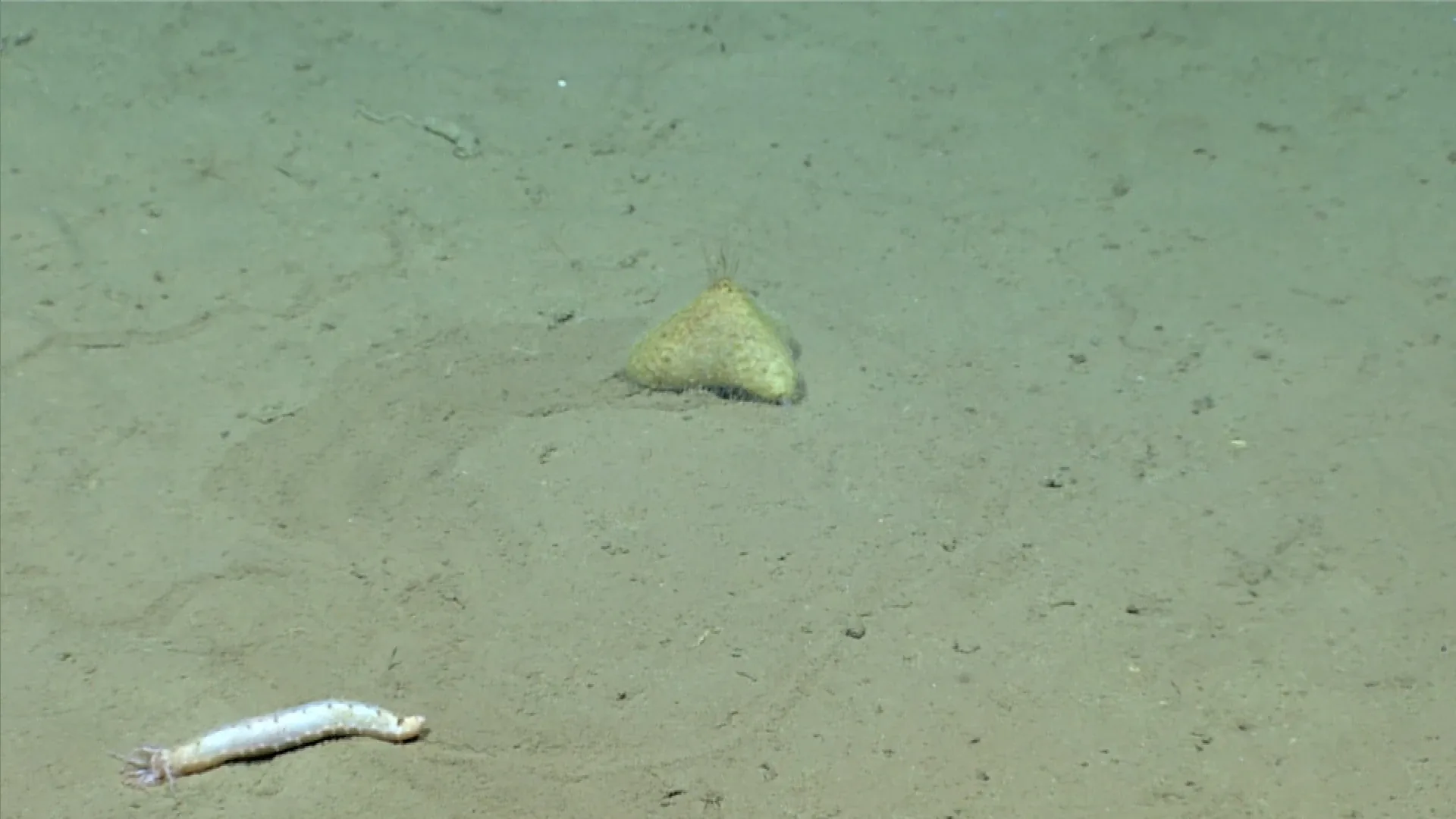
The NOAA image used for this article records the sea cucumber Abyssocucumis abyssorum at 3,952 meters on Mendocino Flats. The depth is inside the abyssal range, and the locality gives the reader a real seafloor place rather than a generalized “deep.” The image shows an animal on a broad bottom, but it does not map the entire plain or quantify how many sea cucumbers live there. A photograph provides a window, not a census.
A food web fed from above
On many abyssal plains, much of the available food originates in surface waters. Phytoplankton and other organisms use sunlight near the surface; their remains, fecal material, and other organic particles gradually sink. NOAA calls this moving mixture marine snow. Some particles are eaten or decomposed before reaching the bottom, while some arrive as a slow supply of organic matter. The result is not a steady meal of equal size. Supply can change with blooms, currents, and the depth to the seafloor.
Animals use that material in different ways. Sea cucumbers can feed on organic particles associated with sediment. Other animals scavenge larger remains or filter particles from water. Microbes decompose what is left. A carcass can create a temporary food-rich patch amid a broader landscape where food arrives sparsely. These pathways mean that a plain is connected to the surface ocean even though sunlight does not reach the bottom.
There is no single “abyssal food chain.” A sea cucumber on sediment, a fish arriving at carrion, and a sponge filtering water occupy different feeding roles. Their interactions depend on the local supply, particle size, and current. NOAA notes that food can be scarce on abyssal plains, but “scarce” does not mean absent. It describes the average challenge; a bloom-driven particle pulse or a large food fall can temporarily change the local budget.
Sediment is habitat, not just background
To a camera, a plain may look like an uninterrupted expanse of mud. At smaller scales the sediment contains particles of different sizes, buried organisms, burrows, and traces of past feeding. Chemistry can vary with depth into the sediment. Oxygen and organic matter are not distributed evenly. A surface image cannot show the full vertical structure beneath the animal; core samples and in-situ instruments are needed to examine it.
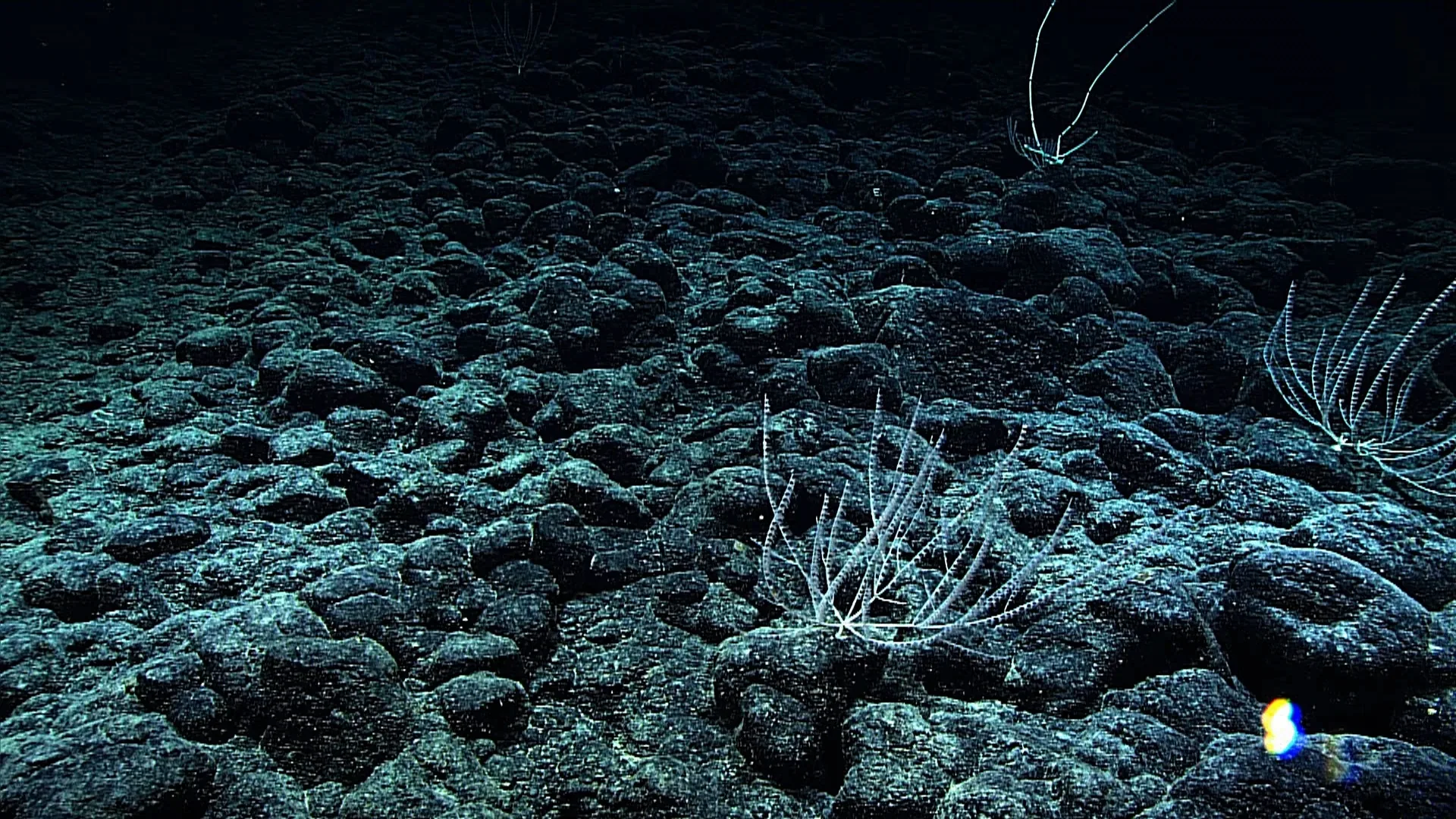
The physical landscape also includes nodules, low hills, and gentle slopes. Polymetallic nodules can form over geological time in some abyssal regions. Their presence changes the surface on which animals settle, and they are one reason abyssal plains are relevant to deep-sea mining discussions. The nodules are not universal across all plains, and their distribution depends on geology. A reader should not assume that every flat abyssal image contains mineral deposits.
How flat a plain is also depends on definition. NOAA points out that sources use different criteria, which helps explain why published estimates of the area covered by abyssal plains can vary widely. Some definitions are broad; others require very low relief within a specified area. As seafloor maps improve, scientists can refine both the boundaries and the ecological interpretation of these regions.
What a sea cucumber tells us
The species in the cover image is one example of animal life on an abyssal plain. It is useful because its body sits directly against the sediment, making the connection between benthic animal and bottom visible. The image does not show what the animal has eaten, how long it remained at that site, or whether other individuals were nearby. Those claims require diet studies, time-lapse observations, or standardized transects.
Sea cucumbers are echinoderms, relatives of sea stars and brittle stars. Their flexible bodies can make them look unlike the familiar five-armed forms of their relatives, but their internal biology places them in the same phylum. Species differ in how they feed and move. Broad statements about all sea cucumbers should therefore be checked against the particular genus or family. In a classroom, students can compare the visible body shape with a sea star, then learn why both belong to Echinodermata.
The sampling gap
The abyssal plain covers an enormous area, while ROV surveys visit only small paths through it. A dive can document an animal, a sediment texture, or an unexpected feature. It cannot represent the whole region without a survey design that samples multiple places and repeats measurements. The amount of footage available also reflects expedition priorities: weather, ship time, equipment, and science questions determine where the vehicle can go.
The abyssal plain is best understood as a large, quiet, variable habitat whose energy often arrives from above and whose life is still incompletely mapped. A sea cucumber on sediment is one visible participant in that system. The flatness, food supply, and mineral landscape all matter, but none of them is uniform across the global seafloor. The careful reader moves from the particular image to the broader ecology while keeping the boundary between observation and generalization in sight.