Article · Field note 24
Chemistry rising through a quiet seafloor
A cold seep is a place where fluids rich in chemicals move from beneath the seafloor into the ocean. Despite the name, “cold” does not mean the water is frozen; it means the fluid is close to the surrounding seawater temperature. NOAA describes seep fluids containing compounds such as methane and hydrogen sulfide. The seep’s energy source is chemical rather than sunlight, and microbes can use those compounds to produce organic matter that supports animals.
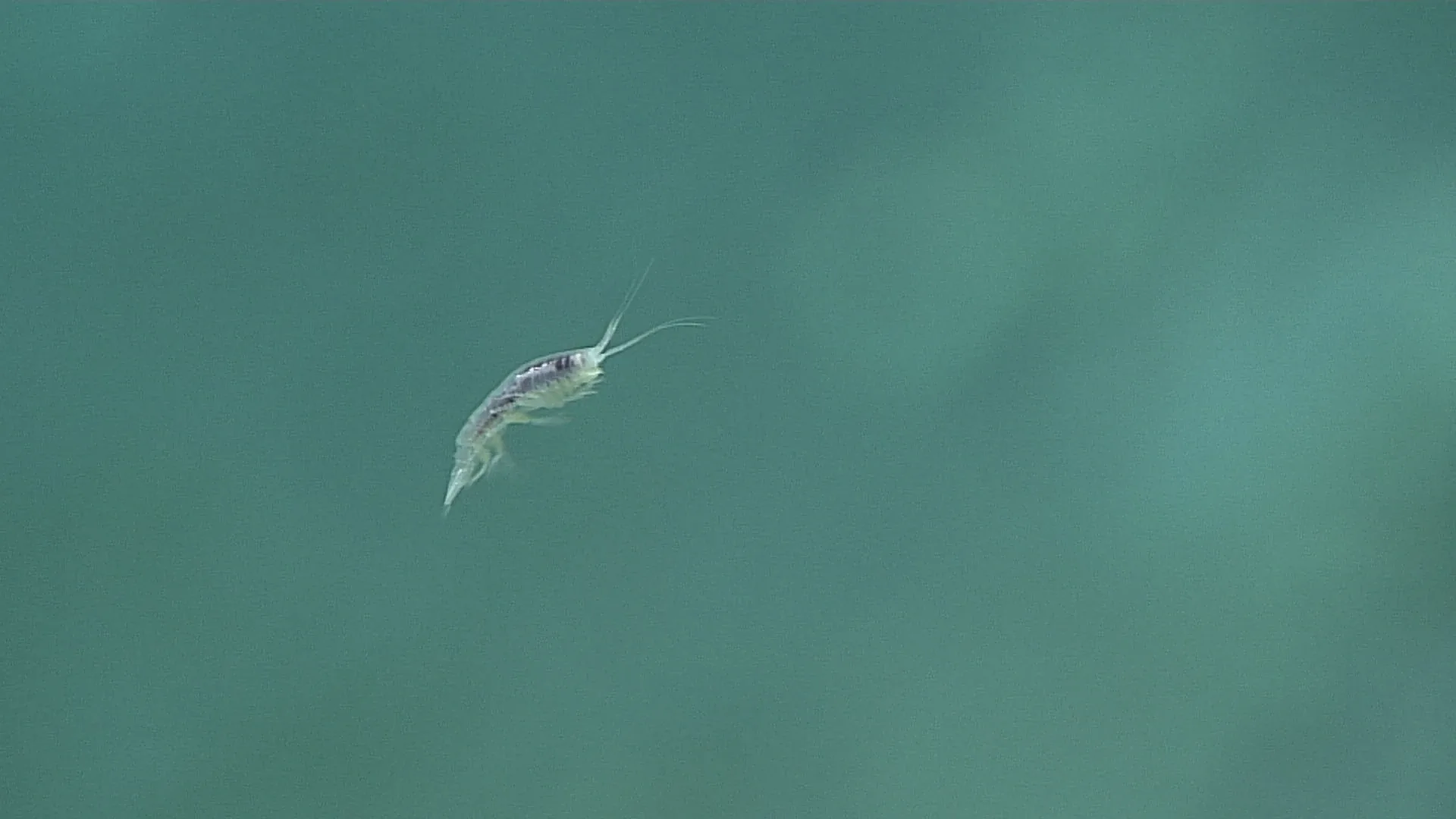
The NOAA guide records the jelly Ptychogastria polaris at 740 meters at Chatham Seep in the Gulf of Alaska. This cover image documents a jelly observed during a dive at a named seep locality. It does not prove that the species depends on seep chemistry or that the pictured individual was feeding on vent microbes. The broader ecosystem article uses the image as an encounter from the site, while the biology of chemosynthetic seep communities comes from separate research.
That distinction is useful because a seep dive can record many animals that are not seep specialists. An ROV travels across the seafloor and through water above it. A fish or jelly may pass near the seep without being physiologically adapted to methane-rich fluid. The guide’s locality links the image to the expedition setting; an ecological claim about specialization requires additional evidence such as repeated observations, distribution patterns, or experiments.
Microbes make the first meal
At many seeps, microbes oxidize methane or sulfide and use the resulting energy to fix carbon. Some live freely in sediment or mats; others live in symbiosis with animals such as clams and tubeworms. The organic material produced by microbes becomes food for other animals. A seep can therefore support a community even where sunlight does not reach.
The food web may include animals that graze on microbial mats, hosts that house symbionts, predators that feed on those animals, and scavengers that consume remains. The exact composition varies among seep sites. Fluid chemistry, sediment, depth, and connection to nearby habitats all matter. A seep on a continental margin does not automatically host the same species assemblage as a seep elsewhere.
Microbial processes also influence local chemistry. Methane can be consumed before reaching the water column; sulfide can be produced or consumed within sediment layers. Oxygen availability may be low in some zones, and the chemical gradients can shift over small distances. To understand the habitat, researchers collect sediment cores, water samples, and measurements alongside imagery. A visual survey reveals animals and structures, while chemical sampling tests what powers the system.
Long-lived seeps and shorter-lived vents
NOAA distinguishes seeps from hydrothermal vents partly by the source and temperature of their fluids. Vents are associated with magma-heated water emerging through the crust, and their fluid can be extremely hot. Seeps release hydrocarbon-rich fluids at roughly ambient temperature. Vent fields can change as geological activity shifts; seeps can be relatively stable and long-lasting. Neither category is uniform, but the contrast helps explain why their communities may have different timelines.
Some seep tubeworms grow slowly and can live for a long time. That longevity means a community can persist as a local habitat over years or decades, though the specific life span depends on species and site. The microbial food source may be patchy, and animals often cluster where fluid reaches the sediment. Researchers compare seep boundaries, animal density, and fluid pathways to understand how the community is organized.
A jelly at a seep does not define the seep
The Ptychogastria polaris record from Chatham Seep brings an important lesson about observation. The NOAA guide identifies the animal at 740 meters during the Seascape Alaska expedition. A jelly can appear in the camera’s field above a seep or along its edge, but the image cannot show whether seep-derived energy supports it. It may be a visitor from the surrounding water column. A single encounter is presence evidence, not an ecological dependency claim.
To test whether a species is a seep specialist, scientists need to compare its occurrence at seeps and nearby non-seep habitats. They might sample tissues for chemical signatures, examine diet, or analyze symbionts. If the animal appears only in a single video, the evidence is insufficient to identify its food source. The most precise story can still be compelling: a jelly was recorded at a seep site, and the site itself is powered in part by microbes using chemical energy.
What seeps reveal about ocean connections
Seep communities link geology to biology. Fluids move through sediment; microbes transform chemicals; animals consume microbes or host them; predators and scavengers use the resulting food. Currents then carry dissolved material and larvae beyond the seep boundary. The ecosystem is localized but not closed. The seep’s chemical footprint can extend beyond visible mats, and organisms can travel between seep and surrounding habitats.
For readers, cold seeps are a reminder that “deep-sea oasis” is a useful metaphor with boundaries. The seep can support concentrated life, but the surrounding ocean still matters. The microbes are not a magical substitute for every food source; they create organic material from chemical energy in a specific setting. The jelly observed at Chatham Seep is one image from that wider neighborhood, and the source record keeps its role appropriately open.