Article · Field note 26
A sponge ground is built by animals that filter water
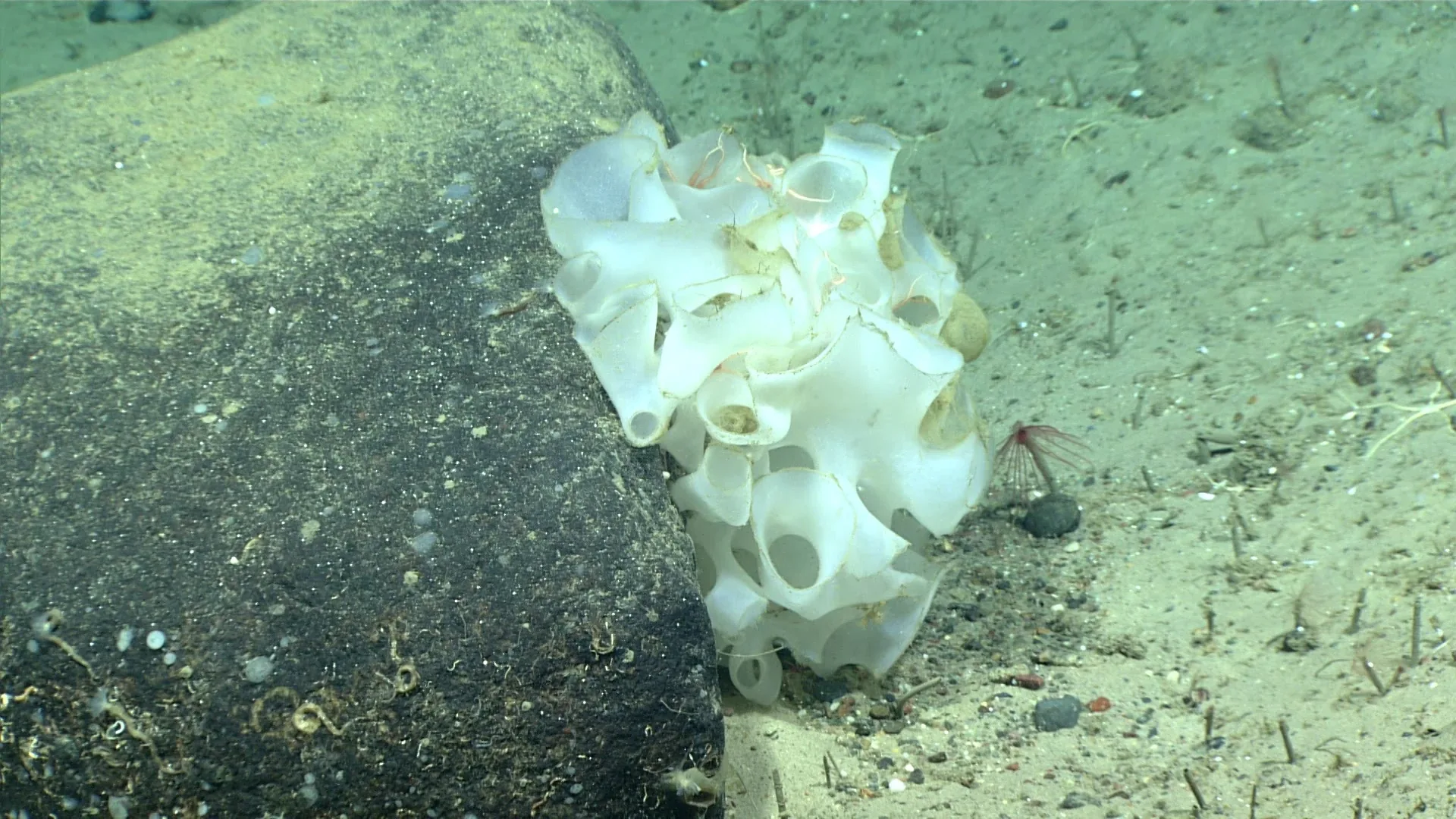
The NOAA animal guide records the glass sponge Asconema foliatum at 1,362 meters in the Northeast Channel. Its pale, vase-like body sits on the seafloor in the cover image. A sponge ground is not a forest of plants: it is a place where sponges occur in sufficient density to create a recognizable habitat. The animals filter water, capture suspended food, and contribute hard or flexible structure that other organisms can use.
Filtering is a feeding strategy and a habitat process
Some sponges grow into large, intricate structures that resemble a reef or garden. Glass sponges can form delicate skeletal frameworks; other groups have different skeletons and growth forms. The structure creates surfaces and spaces for small invertebrates and fish. A dense sponge ground can add topographic complexity to a bottom that would otherwise appear more uniform. The ecological benefit depends on the species, density, and neighboring community.
Slow structures and vulnerable habitats
Some deep-sea sponges grow slowly, and their skeletal structures can be fragile. When a trawl, cable, or other bottom-contact activity breaks a sponge, the damage may take a long time to reverse. NOAA’s deep-sea coral habitat program describes corals and sponges as habitat for fish, shrimp, crabs, and other organisms, and notes the vulnerability of complex structures to seafloor disturbance.
The term “sponge ground” can refer to different forms of aggregation. Some grounds consist of glass sponges; others are dominated by different sponge groups. Their distribution reflects substrate, current, food supply, and local history. Surveying only visually striking large individuals can miss smaller sponges and cryptic forms. Video transects help map visible structure, while samples and genetic tools can improve identification.
The NOAA guide’s observation of A. foliatum in the Northeast Channel is one point in that larger habitat. It does not establish how dense the ground is or how large an area it covers. Those questions require mapping and consistent counts over a measured transect. An observation archive can guide where to return, but it is not a substitute for a habitat survey.
The value of a specimen and a sequence
Sponge taxonomy can be difficult because outward forms may be similar while skeletal elements and microscopic structures differ. A single image may support a broad identification, but a specimen gives taxonomists material to examine. DNA sequences can help distinguish related taxa and connect visual records with verified samples. NOAA’s coral and sponge research program describes voucher collections and genetic tools as part of efforts to understand biodiversity and connectivity.
A sponge can also sample its neighborhood
A 2024 North Atlantic study recovered biodiversity information from DNA retained in sponge tissues. The researchers examined 97 samples from four sponge species across four biogeographic regions. This approach uses filtration for a second purpose: an animal collecting food can also retain traces of organisms in the surrounding environment. It connects sponge ecology with a practical monitoring method, rather than describing filtering only as water cleaning.
The study used demosponges, including Geodia species and Phakellia ventilabrum. It did not test the glass sponge Asconema foliatum in this article's cover. The distinction prevents a promising method from becoming an unsupported claim about every sponge. Different pumping behavior, tissue properties, and associated microbes can influence which DNA remains detectable. A monitoring program must evaluate the sampled species rather than assume that all sponge tissue offers the same environmental archive.
DNA detection also differs from a list of animals living on a sponge. Genetic material may originate from nearby organisms or arrive in water moving through the site. A sequence does not show whether an animal attached to a branch, passed through the current, or was represented by a small tissue fragment. Direct imagery and collected associates can address those relationships. The strength of the method is broader detection, while the ecological interpretation still depends on knowing how the sample formed.
Three measurements describe different habitat functions
A survey can separate the visible structure of a sponge ground, the organisms using that structure, and the biological material moving through its filtration system. Video transects describe the distribution and size of exposed bodies. Close examination records smaller associates. Genetic sampling detects additional traces that may be visually inaccessible. Disagreement among these measurements is informative because each samples a different part of the community, rather than because one necessarily gives the complete answer.
This distinction helps explain why counting only the tallest sponges can undervalue a site. Two grounds with similar visible cover might contain different species, different small associates, or different water-processing characteristics. A conservation comparison should identify the function being protected. Structural complexity is not a direct measurement of carbon processing, and DNA richness is not a direct estimate of local biomass. Combining them gives a more useful habitat description than replacing all three with the word biodiversity.
The Northeast Channel photograph gives this discussion a physical anchor: a glass sponge at 1,362 meters. It cannot establish the extent of a sponge ground, but it shows the kind of organism around which a habitat survey can be designed. The newer molecular research adds a second perspective on why these animals matter. Sponges build local structure while interacting with water from beyond their immediate outline, connecting an apparently stationary community to the wider moving ocean.