Article · Field note 23
Life where chemistry replaces sunlight
Hydrothermal vents form where seawater moves through cracks in ocean crust, is heated by underlying geology, and returns to the seafloor carrying dissolved chemicals and minerals. When the hot fluid meets cold seawater, minerals can precipitate and build chimneys. The temperature and chemistry vary across a vent field, sometimes over a few centimeters. The striking black-smoker plume is only one visible part of a complex system.
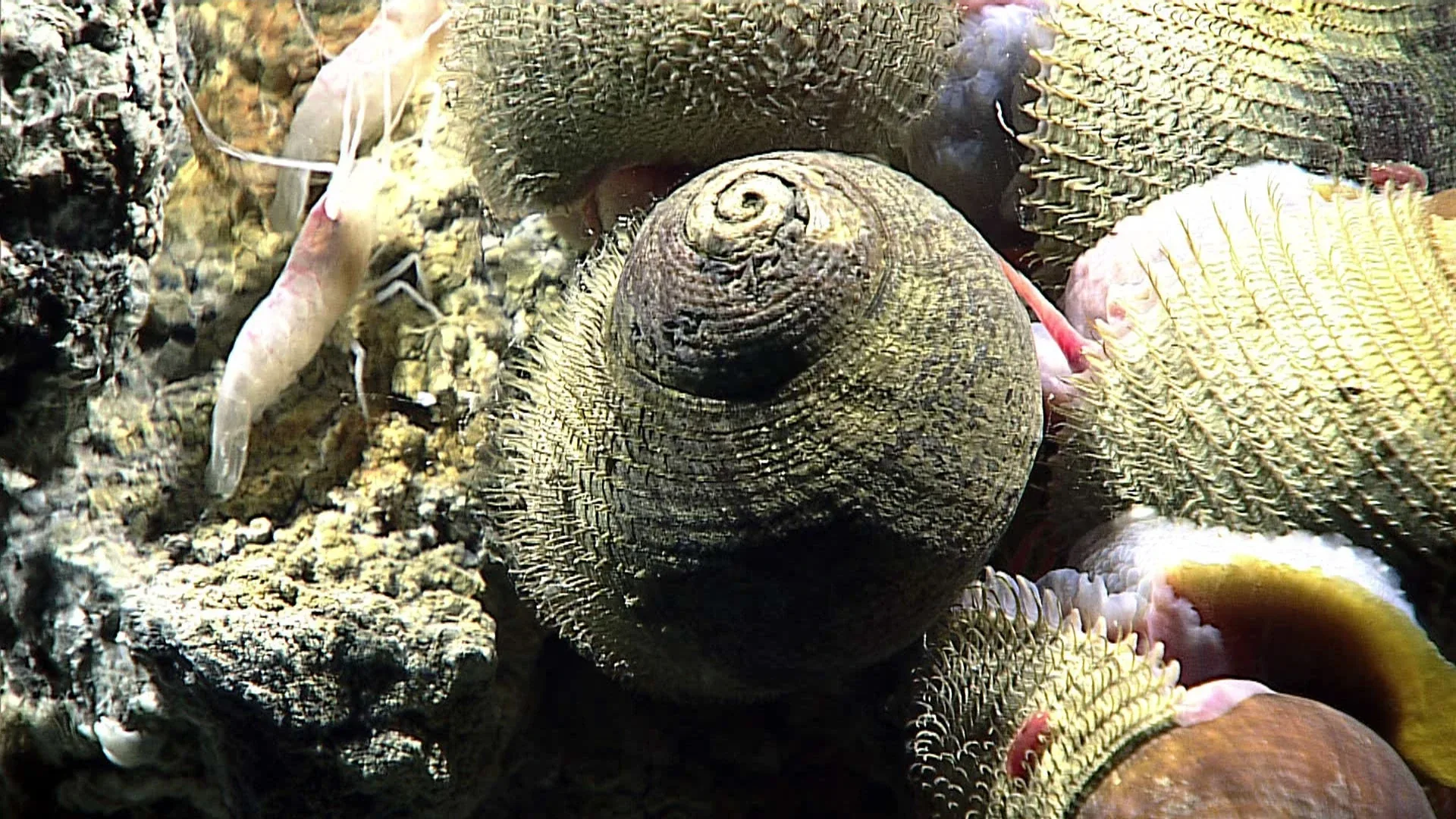
NOAA’s animal guide records Alviniconcha hessleri at 910 meters at Chamorro Seamount in the Mariana region. The snail is associated with vent communities, but the guide’s place label is a seamount and its record is an animal image; it does not claim that this specific frame shows a vent chimney. The distinction keeps the photo honest while allowing the species to serve as a doorway into chemosynthetic ecosystems.
The food web begins with microbes
At a hydrothermal vent, some bacteria use energy from chemical reactions to build organic material. This process is chemosynthesis. It can support animals that graze on microbial mats or host bacteria within their tissues. A. hessleri is a well-studied example of a vent snail with bacterial symbionts in its gills. The microbes supply organic nutrition derived from chemical energy, and the host provides a living environment in which the bacteria can access suitable compounds.
The vent food web is not a simple replacement diagram where “sun” is crossed out and “sulfur” is written in its place. Microbial communities differ; animals may feed directly on bacteria, host symbionts, or consume other organisms that depend on microbial production. Vent fluids also mix with seawater, and chemical gradients shape where microbes thrive. Different species occupy different parts of the field.
NOAA describes vent communities as often dominated by a smaller number of abundant organisms than some surrounding habitats, while still producing dense assemblages. This is not a contradiction. Abundance and diversity are different measures. A community may have very many individuals from a few successful species and fewer total species than a nearby region. New expeditions still discover taxa, showing that the inventory is incomplete.
Vents are dynamic, not permanent oases
Hydrothermal vent fields can change as geology changes. A chimney may grow, collapse, or become inactive; fluid chemistry and temperature can shift. Animals adapted to the vent environment may colonize new flows or disappear as local conditions change. A vent community therefore has a different time scale from a stable coral garden. Long-term monitoring can reveal succession after a disturbance, but one dive gives only a snapshot.
The spatial layout matters too. A high-temperature vent plume, diffuse flow, microbial mat, and surrounding seafloor can be close together but support different organisms. A camera image of an animal does not automatically reveal the fluid chemistry around it. Sensors, water sampling, and temperature measurements help link the animal to its environment. The biological landscape has to be mapped in relation to the chemical landscape.
Vents and cold seeps are not the same
Hydrothermal vents and cold seeps can both support chemosynthetic communities, but their geology and fluid conditions differ. NOAA describes vents as locations where magma-heated fluids emerge, often at high temperatures and with minerals that form chimneys. Cold seeps release hydrocarbon-rich fluids at temperatures close to surrounding seawater and can persist for longer periods. The shared role of chemical energy should not obscure the different physical settings.
Those differences affect the animals that live there. Vent species can be specialized for rapid changes in heat and chemical exposure, while seep communities may include slower-growing organisms associated with methane or sulfide. Some groups occur in both types of habitat, but the organisms and symbioses vary. A student comparing a vent and a seep should track the source of the chemicals, fluid temperature, stability, and dominant species rather than label both simply “underwater hot spots.”
What the snail’s observation can support
The NOAA image record gives a depth of 910 meters, a named seamount, and an expedition dive for A. hessleri. Research papers and NOAA vent material support the species’ association with chemosynthetic communities and its microbial partnership. The image does not show the bacteria in the snail’s gills, and it does not prove a specific chemical gradient at the camera’s position. A profile can connect these sources while making the difference explicit.
Vents are remarkable because they make the chemistry of Earth visible in a living community. Yet they are not magical islands detached from the planet. They connect crust, seawater, microbes, animals, and currents. Each expedition adds detail, and each new observation can revise the map. The snail at Chamorro Seamount gives readers a real animal and dive record; the broader vent research explains why its food web begins with chemical energy rather than sunlight.
Chemistry defines the useful habitat boundary
Mapping temperature alone does not map a vent animal's resources. An appropriate survey would pair the animal's position with concentrations of chemical energy sources and electron acceptors in the surrounding water. Mixing creates local combinations of those conditions. A snail may therefore occupy a narrow zone beside a hot outlet rather than the hottest visible feature in the field.