Article · Field note 25
A carcass that changes the bottom
When a whale dies at sea and its body sinks to the seafloor, it delivers an unusually large food pulse to a place where nutrition can be sparse. The event is called a whale fall. A carcass can support different animals over time as soft tissue is consumed, bones remain, and microbes transform chemical compounds. It is not a single feeding frenzy that ends when the visible meat disappears; it is a sequence of ecological stages.
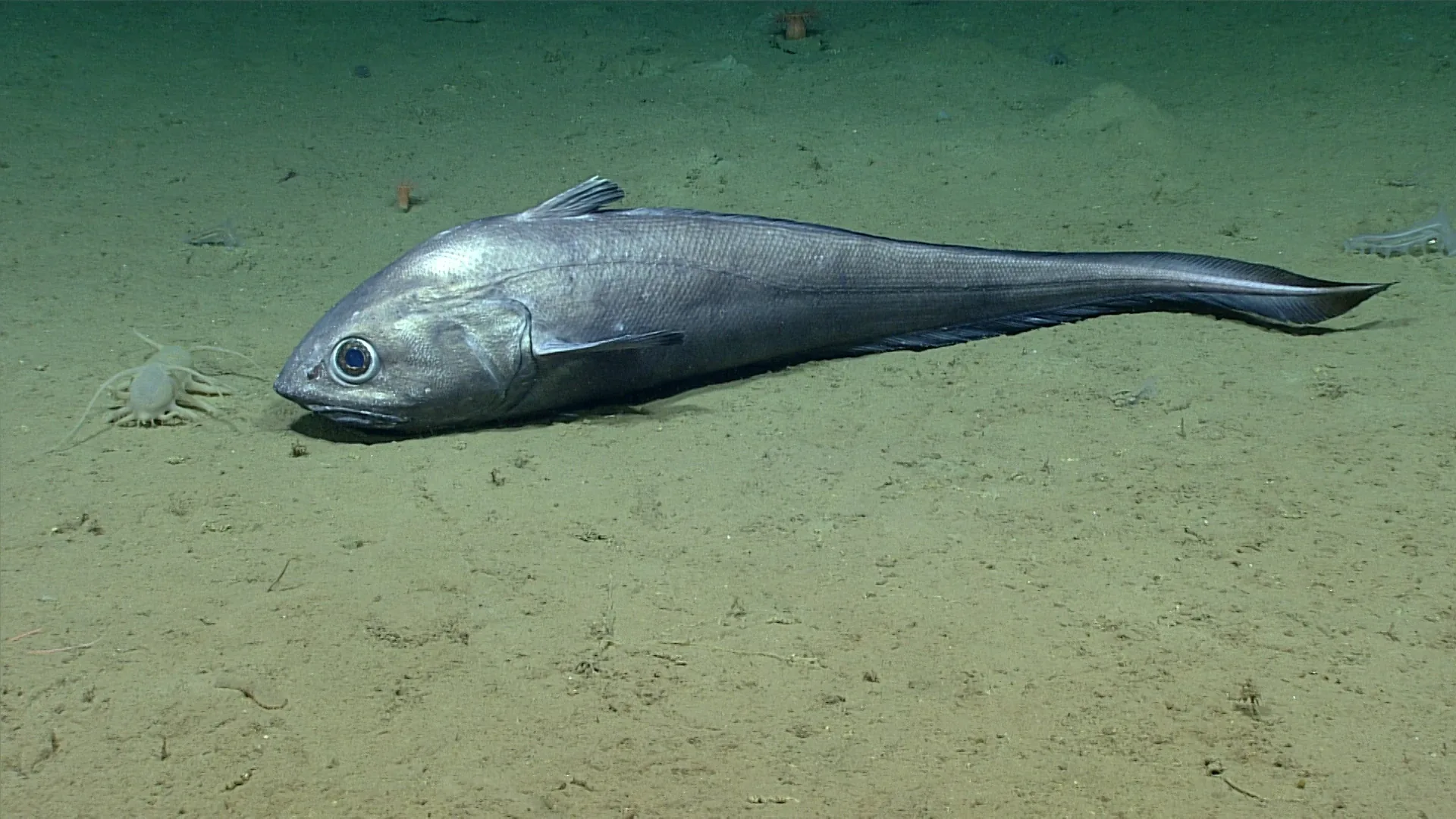
The cover image here is of Albatrossia pectoralis, a rattail fish recorded at 2,523 meters in North Astoria Canyon. NOAA did not photograph this fish at a whale carcass in that record. The connection to whale falls comes from broader observations of deep-sea scavengers, including rattails documented at carcasses. The caption will preserve the actual canyon locality so a reader does not mistake the photo for a whale-fall scene.
The first arrival
In the early stage, mobile scavengers can detect the carcass and arrive from the surrounding deep. Fish and hagfish may feed on the soft tissues, while crabs and other invertebrates move across the body. The odor plume can travel with local currents, but the distance and timing depend on the size of the carcass and oceanographic conditions. A whale fall is therefore a meeting point between a large resource and animals able to find it.
The crowd at the carcass can appear dramatic in a video, but its composition varies. Whale size, depth, location, and season affect what arrives and how quickly. A small cetacean body on a slope will not necessarily support the same community as a large whale skeleton on the abyssal plain. ROV discoveries provide snapshots, and researchers need repeated observations to follow the same carcass through time.
As soft tissue disappears, the remaining skeleton contains a concentrated store of lipids and nutrients. Bone-eating worms in the genus Osedax can colonize the exposed bones. Their tissues include rootlike structures that penetrate the bone, and associated bacteria help the worms access resources. Smithsonian Ocean describes this later phase and notes that researchers have found multiple Osedax species. These worms are not the first scavengers to arrive; they become part of a later community that uses a resource left behind.
A community changes with the resource
Whale-fall ecology is often divided into stages: mobile scavengers consume soft tissue; enrichment opportunists use the organically enriched sediment around the carcass; and a sulfophilic community can develop as microbial processes transform compounds from the skeleton. The boundaries between stages overlap. The sequence is a framework for comparing sites, not a clock that runs identically at every fall.
Each stage changes the habitat for the next. Feeding redistributes tissue and sediment. Bones create hard surfaces in a soft-bottom environment. Microbial activity changes local chemistry. Animals that were absent during the first visit may appear later. This is ecological succession compressed into a location that scientists can revisit, though the total duration may be years or longer depending on depth and carcass size.
Whale falls also connect ecosystems separated by distance. A whale that fed in surface waters carries carbon and nutrients downward when it dies. Currents influence where the body lands; scavengers move away with fragments or nutrients; larvae disperse to other habitats. The carcass is a resource transfer between the upper ocean and the seafloor, and its effects spread beyond the visible skeleton.
What a still image cannot provide
A photograph of scavengers at a carcass proves that those animals were present at the time of the observation. It does not reveal how long they took to arrive, what they consumed first, or how the community changed afterward. To answer those questions, researchers need time-lapse imagery, repeated ROV visits, or comparisons among multiple carcasses. A single encounter can show behavior, but a time series reveals succession.
The NOAA record of A. pectoralis in North Astoria Canyon is a different kind of evidence. It documents a rattail fish at a specific depth and canyon locality. It does not show carrion. Smithsonian’s deep-sea overview supplies the broader context that rattails and other scavengers use large food falls. Keeping these sources separate is part of accurate illustration: the fish is relevant to the article, while the photo’s actual setting is not a whale carcass.
Why large food falls matter
Most deep-sea animals do not encounter whale-sized meals often. Marine snow supplies a more diffuse flow of organic matter. A whale fall is a pulse large enough to support dense communities and specialized organisms. That contrast helps explain why deep-sea ecosystems can be both food-limited overall and locally productive around particular events.
It also explains why whale-fall discoveries are scientifically valuable. Natural carcasses are difficult to predict and find. When a vehicle encounters one, researchers may learn about an ecosystem that would otherwise be hidden. Some teams have placed whale remains on the seafloor deliberately to study colonization, but those experiments are not identical to natural falls. Size, position, and prior conditions can influence the community that develops.
Whale falls reveal how much ecological work can emerge from a single death. Mobile scavengers arrive, sediments are enriched, microbes change the chemistry, and bone specialists use material left behind. The deep ocean’s sparse background makes the pulse visible in unusually clear form. The NOAA rattail image is a related field observation, not a carcass scene; the distinction protects the article’s accuracy while keeping the focus on the scavenging guild that whale falls can attract.