Article · Field note 03
A fish built close to the bottom
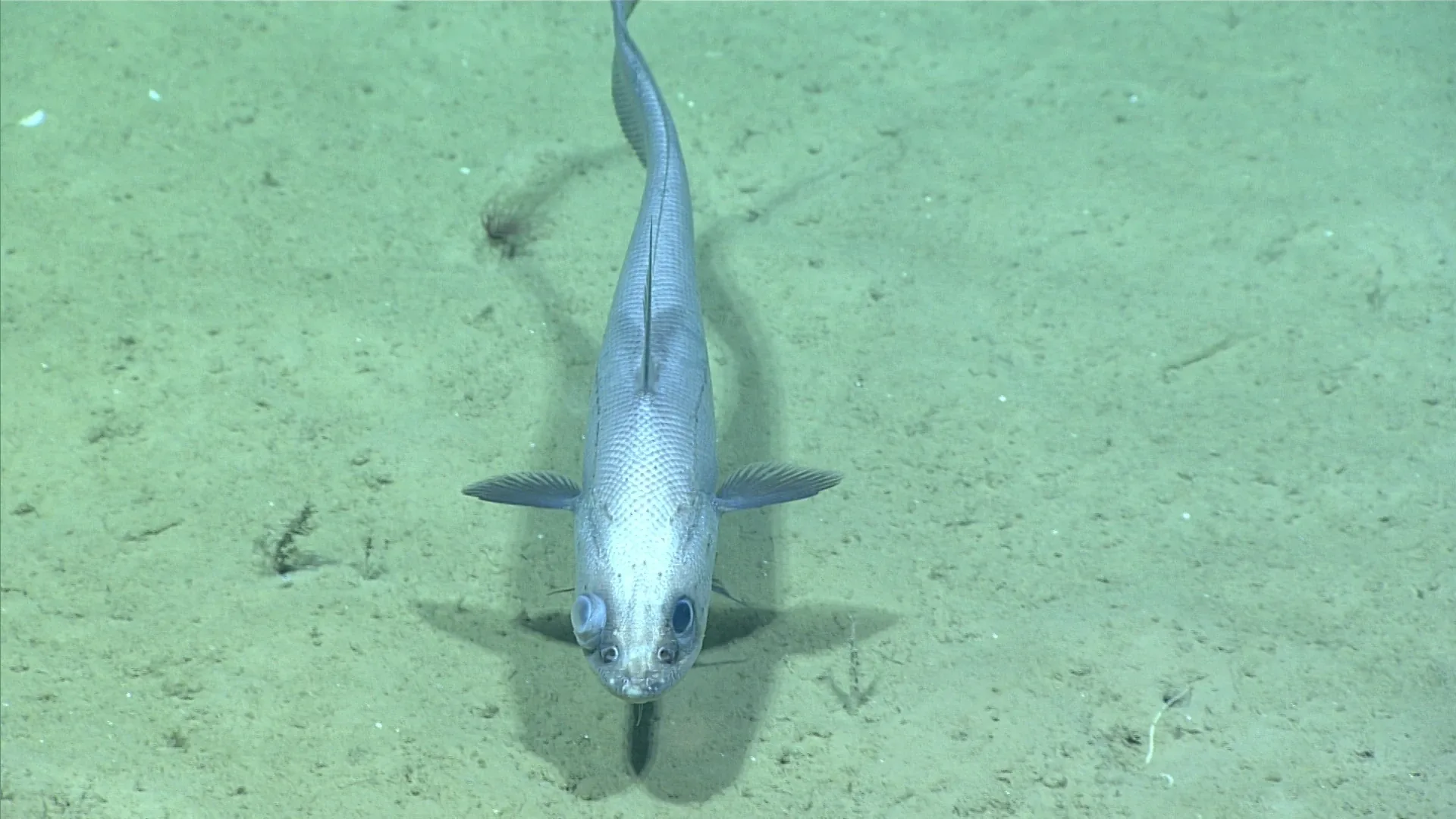
The abyssal grenadier, Coryphaenoides armatus, is a rattail in the family Macrouridae. The name “rattail” describes a body that narrows behind the head and trunk toward a long tapering tail region. It is a bottom-associated fish of deep water, not a tail-less creature or a member of the true eels. A NOAA survey-fish guide describes smooth abyssal grenadiers reaching about 62 centimeters in total length and reports a broad depth distribution that includes deep portions of the Pacific and North Atlantic. The NOAA Ocean Exploration animal guide adds an image from Verrill Canyon at 2,499 meters. That frame is one data point inside a much broader range.
The word “abyssal” can be confusing in a species name. Oceanographers often use abyssal for the seafloor zone around 3,000 to 6,000 meters, while this species has records above and below that boundary in different sources. Common names persist even when an animal uses more than one depth band. A species name does not guarantee that every individual lives in the same zone. When reading a record, use its measured depth and location rather than assuming the common name supplies the habitat.
Why a grenadier belongs in a food-web story
Food at depth rarely arrives on a predictable schedule. Organic particles sink from the surface, currents move material sideways, and larger food falls can create temporary concentrations. Fishes living close to the seafloor encounter a different menu from animals that remain in the midwater. Grenadiers are often discussed among deep-sea scavenging fishes because they can find carrion; the precise diet of any one species is established from observations, stomach contents, or other evidence, not from body shape alone. The fish’s position near the bottom makes it a useful subject for studying how a scarce resource is detected and shared.
Scavenging is not simply waiting beside a carcass. A mobile animal must encounter a chemical signal, orient toward it, and arrive while food remains. The distance over which a signal travels depends on water movement and the release rate from the source. A camera can show fish at a food fall, but a controlled experiment is needed to estimate detection distance or arrival time. In the open ocean, many food pulses are never filmed. Absence from the video archive is not evidence that no scavenger visited.
The long body of a grenadier also affects how it appears in images. A forward-facing camera may emphasize the head and hide the tapering posterior body. Sediment, light angle, and the vehicle’s approach change the apparent color. This is why taxonomic identification uses multiple features and, when available, collected specimens. A still image is excellent for showing that a fish was present, but fine distinctions among related grenadiers may require closer anatomical detail than the ROV camera supplies.
Canyon walls, survey paths, and the record
The cover image was catalogued at 2,499 meters in Verrill Canyon during dive 2 of the 2019 Atlantic expedition EX1905L2. A canyon is not a uniform trench in the continental margin. It has walls, ledges, sediment drifts, and changing currents. The fish in one frame may be on a sloping surface while another individual of the same species is found in a different terrain type. A precise locality helps readers connect the animal to the route, but it should not be generalized into a claim that every canyon contains this density of grenadiers.
NOAA’s fish survey guide is valuable for morphology and distribution, while the animal guide is valuable for traceable visual encounters. Those sources answer different questions. A survey guide can compare body proportions and reported range; a dive record can answer where an image was taken. Neither should be asked to establish the other’s facts. This separation is an easy habit for readers to adopt: ask whether a sentence is about what the animal looks like, what it eats, where it occurs, or what this specific camera saw, and then check the source that is suited to that claim.
What the picture does not prove
The grenadier in the frame is not evidence of a large population, a feeding event, or a stable preference for canyon terrain. It is an identified fish at a recorded depth and locality. The distinction may sound cautious, but it is the beginning of ecological reasoning. Researchers can combine repeated transects, baited cameras, trawls, and physical samples to estimate abundance and diet. Each method has its own biases: bait attracts some animals more than others; trawls can miss terrain; cameras cannot see through rock or sediment; specimen sampling is limited by time and permits.
A carcass attracts more than direct scavengers
The experimental study of cetacean carcasses illustrates an important distinction: grenadiers at the studied food falls consumed amphipods associated with the carcass, rather than simply removing whale tissue. Arrival at a carcass does not identify an animal's trophic role. A concentrated food pulse can support predators of scavengers as well as the scavengers themselves. This helps explain why counting fish around bait and identifying what they actually ate are separate research tasks.