Article · Field note 01
A shape that made people stop the ROV
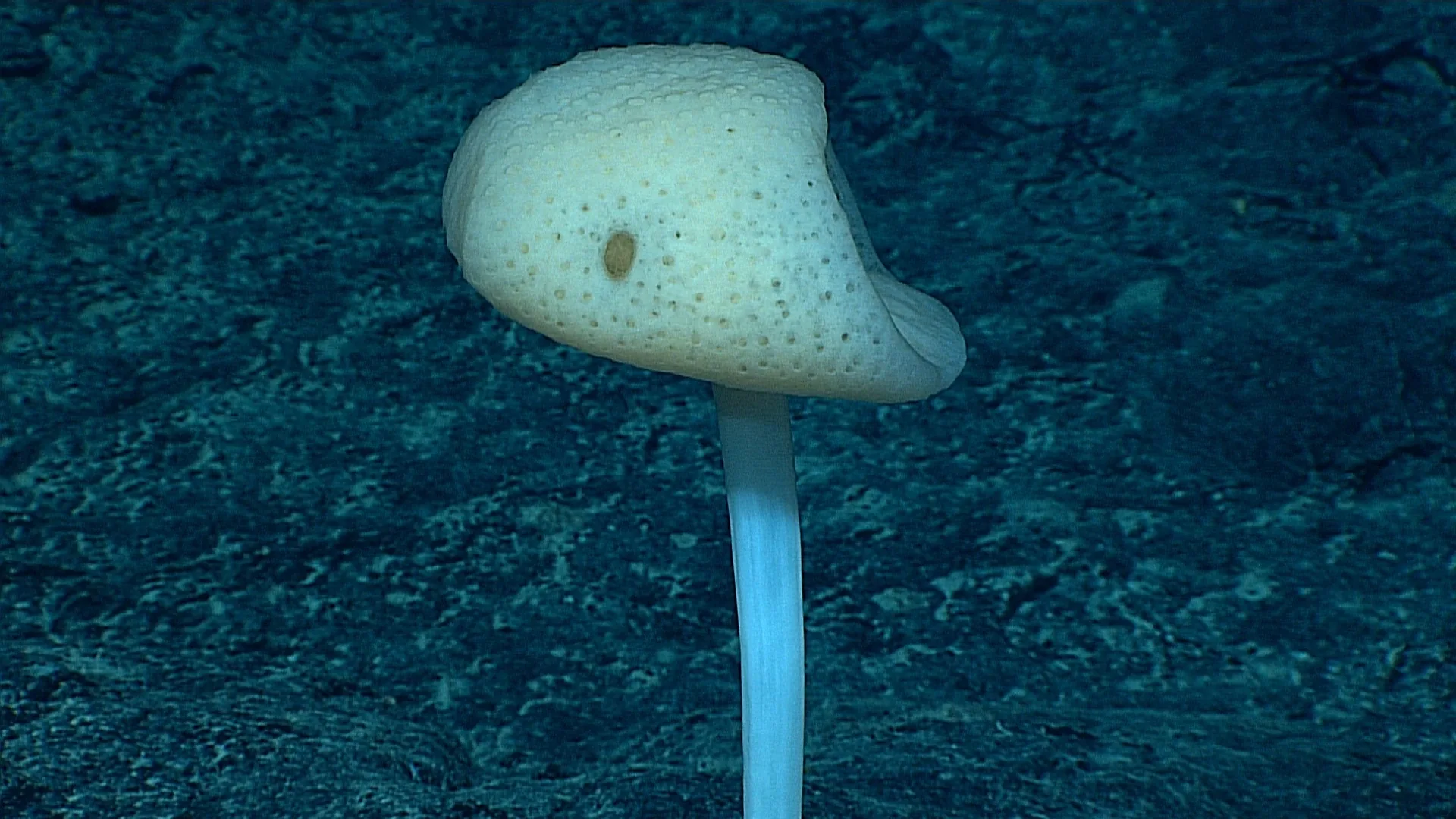
The first useful fact about Advhena magnifica is not that it resembles a movie alien. It is that several observers saw a living sponge whose outline was distinctive enough to remember, photograph, and eventually connect to a collected specimen. NOAA Ocean Exploration recounts that the sponge was seen in the central Pacific before scientists formally named it; a sample collected during the 2016 Deepwater Exploration of the Marianas made a closer examination possible. In 2020, the description of a new genus and species gave the organism a name that could be checked against a physical reference, published characters, and later observations.
The Latin name means “magnificent alien.” “E.T. sponge” is an informal label, not a second scientific name. The distinction matters because popular names are excellent memory devices but poor indexing systems. A school report, database record, and research paper need to point to the same taxon even when people use different nicknames. A Latin binomial also carries a history of revision: if new specimens show that a group needs to be divided or combined, taxonomists can explain which name applies and why. NOAA describes the discovery and specimen history in its account of the sponge.
The animal belongs to the glass sponges, a group whose skeleton is made of silica structures rather than the calcium-carbonate framework familiar from many shallow-water corals. The word “glass” describes those mineral elements; it does not mean the whole animal is a rigid glass vase. Sponge tissue grows around a framework, and the animal’s body is organized to move water through openings and chambers. Water carries suspended particles and oxygen through the sponge. Cells lining internal spaces capture some of that material. The outside silhouette is therefore only the visible edge of a water-processing body.
What the expedition actually saw
The NOAA image guide links this species to an observation at 2,142 meters in the North Pacific, listed at Bank 9 in the Northwestern Hawaiian Islands during dive 11 of expedition EX1504L2. That is the observation used for this article’s cover. It is not the 2016 specimen described in every detail, and it does not turn Bank 9 into the species’ entire range. An animal can occur at more than one seamount, and the guide itself includes records from multiple Pacific expeditions. The record gives a useful point on a map, not a boundary around a living population.
The discovery story also shows why repeat visits matter. NOAA reports that the sponge appeared in several Pacific observations, including a community on Ridge Seamount where many glass sponges were oriented in the direction of local current. Orientation can be a clue about water flow and food delivery. It is not, by itself, a controlled experiment proving that every individual grows toward a particular current speed or food concentration. A diver, a ship, or an ROV sees a scene at one moment. Researchers need multiple views, measurements, and samples to distinguish an animal’s usual growth pattern from a local accident of terrain or camera angle.
The surrounding “forest” metaphor is also worth using carefully. A dense patch of upright sponges can look like a forest because repeated stalks interrupt a broad, open seafloor. But the organisms are not plants, and they do not make food from sunlight. Their growth depends on the resources and conditions that reach the site. A field of glass sponges may add vertical surfaces and small-scale shelter to a rocky or sedimented bottom, but the exact animals that use a particular patch should be counted or observed rather than supplied by imagination. The frame can show a structure; it cannot automatically tell us who nests in it, how long it has existed, or what proportion of the nearby bottom it covers.
Why the skeleton is part of the story
Glass sponge architecture is a reminder that an animal can build with material dissolved in its surroundings. Silica is present in seawater at low concentrations. Sponge cells take it up and shape it into skeletal elements. In many glass sponges those elements are arranged in intricate patterns, and some spicules join into a lattice. Scientists study the structure because it connects biology with materials science, but an elegant lattice should not be mistaken for evidence that this species has a particular engineering function. For A. magnifica, the published taxonomic description and specimen are the right starting point; broader claims about all glass sponges must stay labeled as comparisons.
The visible stalk creates another useful question: what does it cost to stay elevated above the bottom? A raised body may encounter moving water and suspended food differently from an animal lying against sediment. It may also be more exposed to current or physical contact. Those are ecological questions, not conclusions that can be read off a photograph. A time series across currents, a record of particle flow, or measurements from living animals could test them. A single ROV image is valuable precisely because it narrows the next questions without pretending to answer all of them.
A name opens a record, not a finished story
The taxonomic paper gave Advhena magnifica a stable point of reference. The NOAA guide adds later visual observations and their dive context. Together they let readers move from an individual outline to a traceable natural-history record. They do not tell us everything about growth rate, reproduction, lifespan, food preferences, or geographic abundance. Those gaps are not defects in the guide. An image archive has a different job from a long-term ecological study.