Article · Field note 02
A deep record does not make a deep-sea specialist
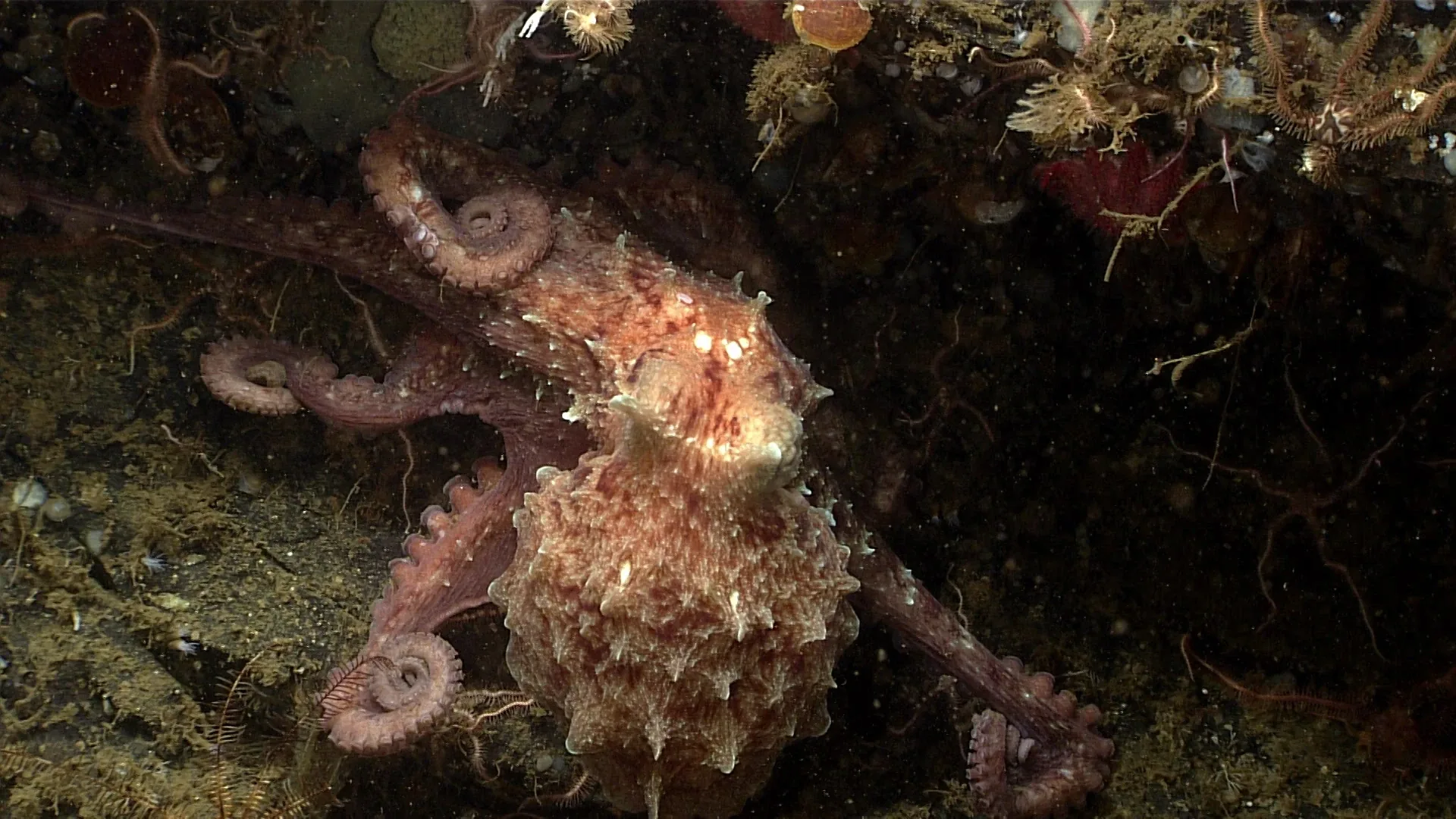
Giant Pacific octopuses are often introduced through tide pools, rocky reefs, aquarium exhibits, or stories about a clever animal opening a container. Those settings are real, but they can make the species seem shallower than its full range. The Monterey Bay Aquarium describes Enteroctopus dofleini as a cold-water North Pacific octopus found from nearshore habitats to depths of about 1,500 meters and beyond. The NOAA guide’s image used here was recorded at 401 meters in Ernest Sound in the Gulf of Alaska. That is well below ordinary recreational diving, yet it is not the abyssal plain. The depth is a reminder to be precise: “deep” is not a single habitat, and a deep observation does not erase the species’ coastal life.
The octopus is a cephalopod mollusk. Its soft body has no external shell, and eight arms carry rows of suckers. Those arms are not merely tentacles for grabbing. They explore surfaces, grip prey, and deliver a great deal of sensory information. An octopus does not experience its surroundings as a human with two hands and a forward-facing gaze. It can touch and taste through the suckers while the arm system moves independently around rock, shell, and crevice. The combination is useful in a habitat where prey can hide in cracks and where a body without a protective shell benefits from finding shelter quickly.
The animal behind the reputation
The species is known for flexible hunting. Monterey Bay Aquarium lists crustaceans and mollusks among its prey, with fish and other animals also taken. A den can become a clue to feeding: discarded shells may accumulate nearby, forming what researchers call a midden. The shells are a record of meals that have already happened, not a complete menu. Different sites can offer different prey, and an octopus can change its behavior with size, season, and local conditions. A useful natural-history account names the prey that has been observed or reported instead of turning a plausible meal into a universal rule.
Camouflage is often described as if the animal simply “changes color.” The actual process involves specialized pigment cells and muscular control of skin texture and pattern. Color, contrast, and surface shape can change quickly, helping the octopus blend with a background or create a startling display. The body language can be striking, but a photograph freezes one instant. It cannot tell whether the animal was hiding, signaling, startling prey, or reacting to an observer. For that, a sequence of video and context around the encounter are more informative than a single still frame.
The animal’s intelligence is another subject where useful restraint improves the story. Aquarium keepers and researchers have observed octopuses solving tasks and learning from experience. Such results support real cognitive flexibility. They do not mean that every human-like explanation of an octopus’s behavior is true. An octopus investigating an object may be exploring it for food, escape, or contact; a researcher must design observations that distinguish these possibilities. “Smart” is a broad label. A stronger account identifies the task, the animal’s response, and what the experiment can show.
A short life with a long juvenile chapter
For a large, famous animal, giant Pacific octopuses have a relatively brief life. Monterey Bay Aquarium gives a typical lifespan of roughly three to five years. Like other octopuses, adults reproduce once near the end of life. A female guards, cleans, and aerates a large clutch of eggs, and during this brooding period she stops feeding. She dies soon after the young hatch. These details are not just a dramatic ending. They shape the species’ life history: growth, maturation, mating, egg care, and recruitment all happen on a compressed schedule compared with many large vertebrates.
Young octopuses begin far smaller than their eventual size. The aquarium notes that the eggs are approximately rice-grain sized. Early development includes a drifting phase before juveniles settle into bottom habitats. That phase complicates survey work. A camera focused on a den may record an adult well, while tiny juveniles can be harder to see and identify. The adults’ large body and recognizable behavior make them easy to feature in a story; the less visible early stages are no less important to understanding where the population is replenished.
Temperature and place also matter. This is a northern Pacific animal associated with cold water, not a species restricted to one cove or one depth. “North Pacific” spans a large range of coastal conditions and habitats. An encounter in Ernest Sound adds evidence about presence at that place and depth. It does not show that all individuals in the species use the same den type, prey, or temperature. A map of sightings can suggest where to look next, but it must be combined with surveys that account for effort and detectability.
Reading the 401-meter encounter
The NOAA record attached to this portrait identifies E. dofleini at 401 meters in Ernest Sound during dive 9 of expedition EX2306. That information gives the photograph a place in an expedition. It does not establish that the octopus was living at the deepest part of its range, nor that Ernest Sound is unusual. It is one observation captured by a vehicle that was already sampling a chosen route. If the ROV had passed a few meters to the side, the animal might not appear in the image guide at all.