Article · Field note 04
A name anchored to a fish in a canyon
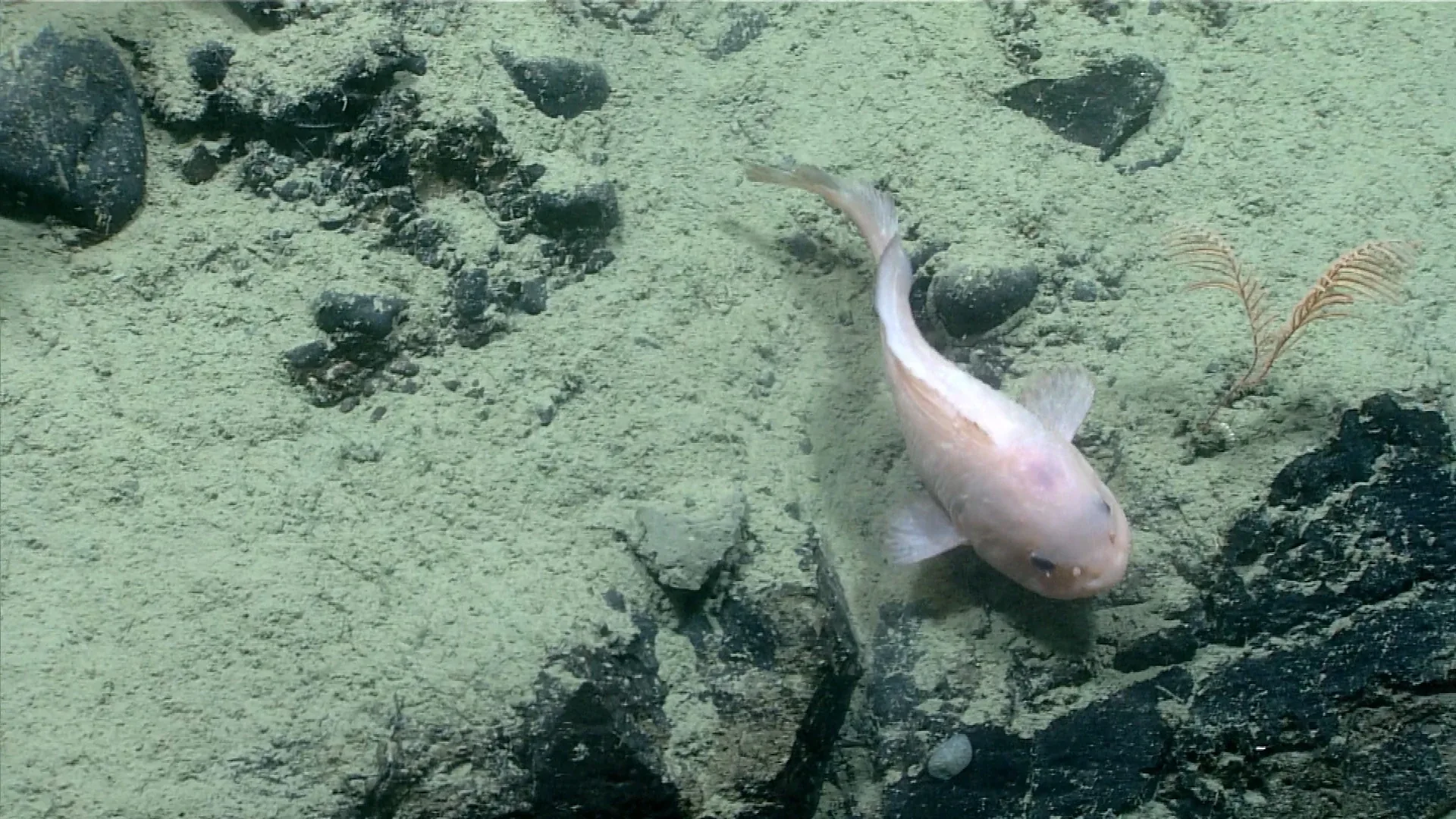
The blacktail snailfish, Careproctus melanurus, belongs to the liparid family. The NOAA guide records the species at 2,202 meters in Middleton Canyon in the Gulf of Alaska. It is easy to read that line as a tiny biography: a named fish, a deep place, a striking depth. It is better understood as the label for one encounter. The image tells us that an animal identified as this species was visible to a camera at a particular point during an expedition. It does not tell us whether the fish was resident, moving through, feeding, or resting.
Snailfish are not close relatives of land snails. The common name refers to a soft, often rounded body shape rather than a shell. Liparids are fishes with fins and a backbone, and the family includes species occupying a wide span of marine depths. The form that attracts attention in a deep-water image—soft-looking tissue, a large head, tapering body—has to be interpreted in relation to the fish’s environment. A familiar shallow-water fish often relies on a gas-filled swim bladder for buoyancy; many deep-water fishes have reduced or absent gas spaces, which can be advantageous where pressure is high. That family-level comparison should not be converted into a claim about every anatomical detail of C. melanurus without examining the species description.
A canyon is a moving landscape
Middleton Canyon cuts through the continental margin. Canyons can channel water and sediment downslope, while their walls and ledges create different surfaces over short distances. Current speed varies with terrain and time. The same canyon may contain soft sediment, exposed rock, and local accumulations of organic matter. A single depth reading therefore does not fully describe the fish’s microhabitat. The record’s locality and depth are useful coordinates, not a complete map of the water and substrate around the animal.
Scientists study canyon habitats because they can concentrate both organisms and material transported from shallower water. The process is not identical in every canyon. Geometry, sediment supply, currents, and nearby productivity matter. A broad statement such as “canyons funnel food” is an invitation to test a particular place, not proof that every canyon is a feeding hotspot at all times. For a snailfish, a canyon may provide a route, a resting surface, or simply the place where the ROV happened to meet it. The evidence in this guide supports the last wording most directly.
Liparids are an instructive family for comparing how fish body plans change with depth. Some snailfishes are known from shallow water, others from the deep sea, and the family includes forms adapted to very high pressure. That diversity prevents a single cartoon explanation from standing in for all snailfish. “Soft” does not mean weak, and a rounded outline does not tell us how the animal maintains buoyancy. To explain those features, researchers need anatomical measurements, tissue chemistry, and comparisons across species that occupy different depths.
A skeleton is a measurable structure
A comparative 2021 study in Frontiers in Zoology examined skeletal morphology and density across 50 snailfish species in 13 genera. Its value lies in comparing relatives with different habitats, rather than starting with the assumption that every deeper fish has less bone. The researchers used computed tomography to examine internal structures that a soft-looking external silhouette cannot describe. Habitat included more than depth: polar conditions and a pelagic lifestyle also contributed to the comparisons.
This changes the question asked about a blacktail snailfish. Instead of treating its appearance as an explanation, an anatomical study can measure the size, arrangement, and mineralization of skeletal elements. Those measurements can then be compared with related species. A low-density skeleton might influence the balance between support and buoyancy, while different swimming habits impose different mechanical demands. That is a set of testable relationships, not a single rule that depth dissolves bones or makes vertebrates boneless.
The broad family comparison also guards against a misleading association with record-breaking trench fishes. Some snailfishes occupy hadal depths, but the 2,202-meter blacktail record belongs to a different pressure environment and a different species. A biochemical result from a hadal snailfish is not automatically an explanation of this fish's physiology. Linking the correct species, measured trait, and habitat prevents the dramatic achievements of one relative from being silently assigned to every liparid.
From body structure to habitat use
The distinction between skeletal density and overall buoyancy is especially useful. A fish's position in water depends on all of its tissues, fluid spaces, and movement, not bone alone. CT measurements describe mineralized structures; they do not directly measure the energy required for an animal to hover or crawl along a canyon floor. Testing that connection would require living-animal observations and a description of the surrounding water. The two methods become complementary when their measurements are kept separate.
For the Middleton Canyon animal, a productive next comparison would join morphology with position above the substrate. Does it stay close to the bottom, move over ledges, or spend intervals suspended in the water? A calibrated sequence could describe those movements without requiring a speculative story about its motivation. The blacktail snailfish then becomes a case study in how researchers connect internal construction with a real habitat, rather than another example of a vaguely soft fish surviving an unspecified deep sea.