Article · Field note 11
A snail whose food web begins with bacteria
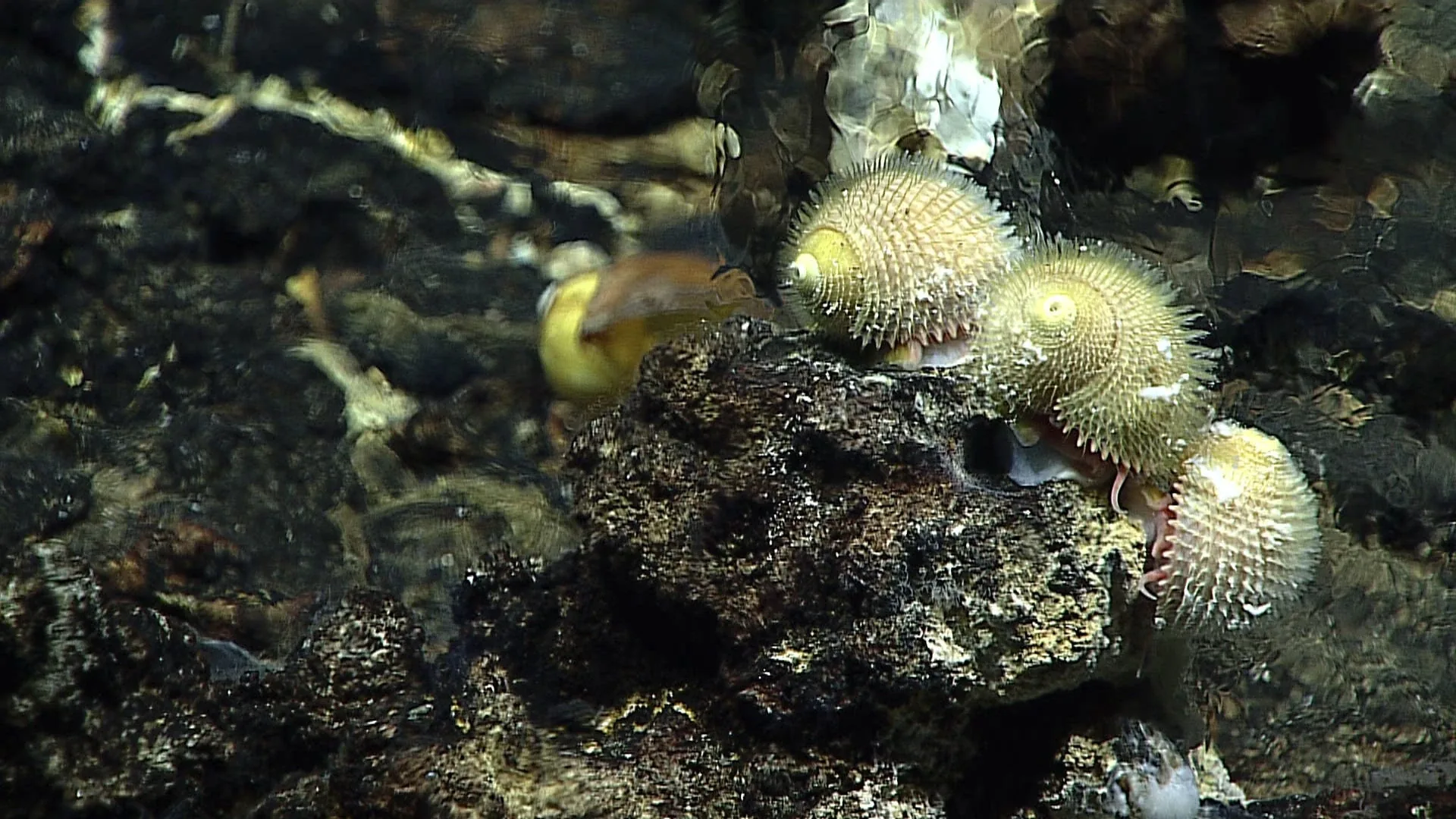
Alviniconcha hessleri is a gastropod associated with hydrothermal vents in the Mariana region. The NOAA guide image used here records the snail at 926 meters at Chamorro Seamount during dive 7 of expedition EX1605L3. That record identifies a particular animal and place; the broader vent association comes from scientific work on the species. Keeping those sources distinct avoids implying that every individual visible at the seamount was photographed directly on an active chimney.
The snail’s best-known feature is not its shell but its partnership with bacteria housed in specialized gill tissue. Research on A. hessleri has described chemoautotrophic bacterial symbionts associated with the gills. These microbes can use chemical energy from reduced compounds, including sulfide, to fix carbon dioxide into organic material. The relationship changes the usual energy story. On most familiar land ecosystems, sunlight captured by plants supports food webs. At hydrothermal vents, chemical reactions can provide the energy that microbes use to make food.
This does not mean that a vent is an isolated world with no connection to the rest of the ocean. Seawater, minerals, dissolved gases, and organic particles move through and around a vent field. The animals are embedded in a wider environment. But within the vent community, microbial production can support dense populations of specialized animals. NOAA’s discussion of Mariana vent sites notes A. hessleri among vent-associated species and describes bacterial symbiosis as a food source for the snail. The animal’s visible presence is therefore tied to a less visible metabolic process.
What the host contributes
A symbiosis is not simply “bacteria feed the snail.” It is an ongoing biological arrangement. The host provides a protected place for microbes in the gill; the bacteria gain access to chemical substrates and oxygen carried through the animal’s tissues. The snail may obtain organic products from the microbes or consume bacterial cells. The precise exchange can differ among species and symbiont types. Researchers examine gill tissue, bacteria, gene sequences, and chemistry to identify what the microbes do and how the host uses the result.
The story is more complex than one bacterium and one animal. Studies of Alviniconcha have found different bacterial lineages across hosts and vent locations. The genus can harbor different symbionts, and even a named host species may have a detailed microbial relationship that scientists continue to refine. That variability matters when the animal is used in a classroom diagram. A simplified arrow from “sulfur” to “bacteria” to “snail” is a starting model, not the complete mechanism.
Hydrothermal vent fluids are chemically and thermally variable. Hot vent fluid mixes with cold seawater over short distances, creating gradients. Microbes that use chemical energy operate where suitable substrates and oxidants meet; a plume or chimney is not uniformly habitable from end to end. An animal’s gill must function in a surrounding environment with changing oxygen and chemical exposure. Laboratory and field measurements help explain how the host tolerates those conditions. A photograph cannot reveal sulfide concentration or the snail’s internal chemistry.
A seamount observation is not a vent map
Chamorro Seamount is an underwater volcanic feature in the Mariana region. The NOAA guide places the pictured snail there at 926 meters, but that location record should not be expanded into a claim about a specific vent opening unless the dive notes identify it. Other research establishes the species’ hydrothermal association. Together, the sources support a careful sentence: a vent-associated snail was recorded at Chamorro Seamount during the expedition, and the species is known from chemosynthetic vent communities.
This distinction is useful because names like “vent snail” can sound like a complete habitat label. Vent fields include steep temperature gradients, altered fluids, mineral chimneys, microbial mats, and surrounding seafloor. Some animals live close to active discharge; others occupy adjacent areas. A guide record may name a seamount or dive locality rather than the exact distance from a vent. Readers should keep the spatial scale visible: the seamount is a place, the vent is a feature within the setting, and the recorded coordinate is the actual encounter.
What a snail says about energy
Chemosynthetic ecosystems correct a familiar misconception: sunlight is not the only energy source that can support a food web. The vent microbes use chemical reactions rather than photosynthesis to make organic molecules. Those molecules can enter the animal community through symbiosis, grazing, or other feeding links. It does not follow that all deep-sea ecosystems rely on chemosynthesis. On abyssal plains far from vents and seeps, much food arrives as falling organic material from surface waters. Different habitats have different energy budgets.
An image, a species, and a partnership
The NOAA cover is a direct image of A. hessleri from a named expedition dive. The microbial partnership is supported by published laboratory and field research, including studies of bacteria in the snail’s gills. These are different layers of evidence: one image record, one biological relationship. Linking them lets readers understand why the animal is notable without asking the photo to prove an invisible process.
The snail’s shell may carry hairlike projections, and its blood contains the oxygen-carrying pigment hemocyanin, details discussed in NOAA’s Mariana vent material. The function of some visible features remains uncertain. A responsible account can state what researchers have observed and what they have not yet explained. “Unknown purpose” is not a gap to fill with a plausible story; it is a real part of the animal’s current scientific profile.