Article · Field note 15
A brittle star that climbs
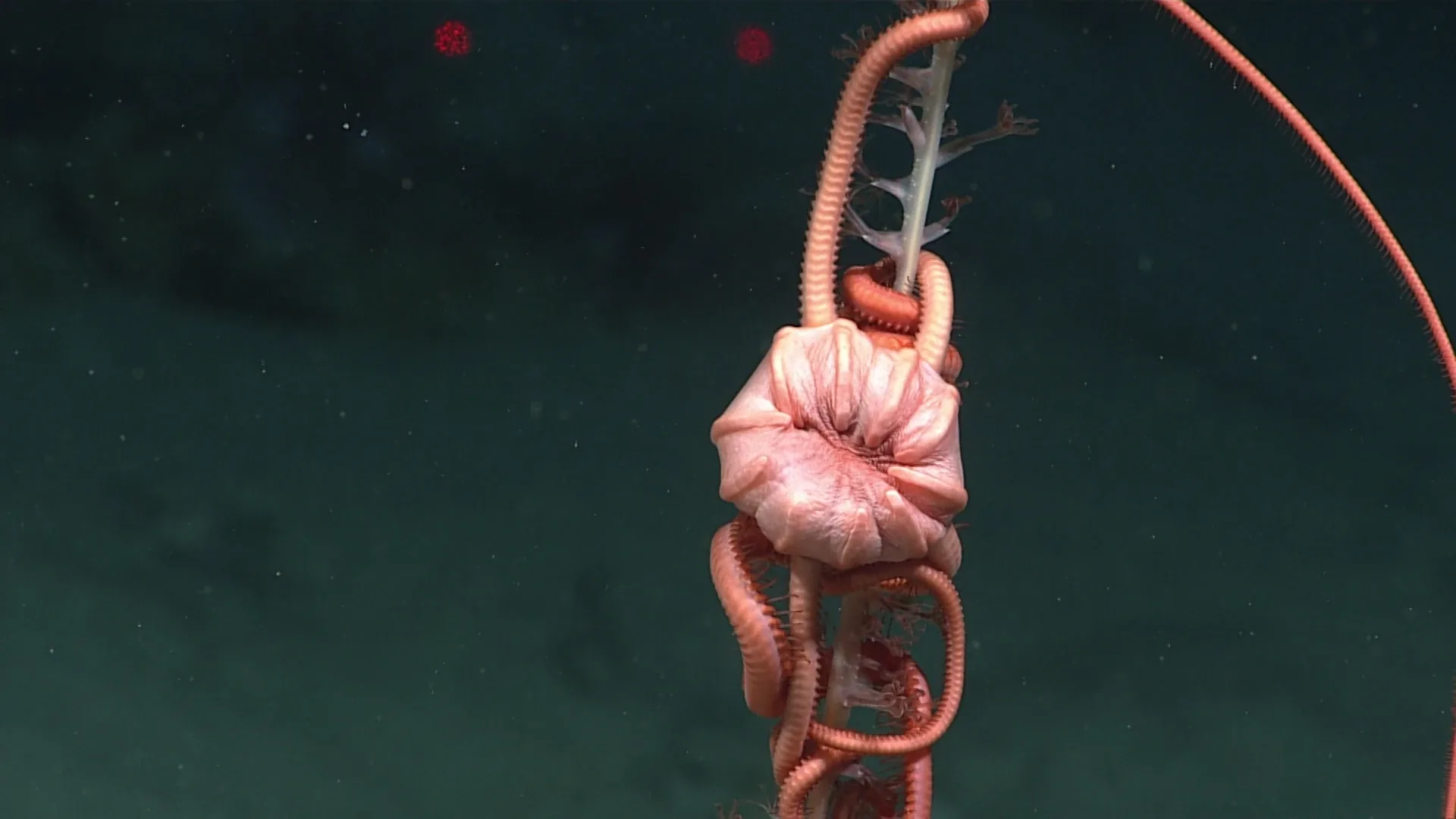
The brittle star Asteronyx loveni is unusual in where it spends time: it can climb onto slender sea-pen corals rather than remaining flat on the sediment. A historical review of brittle-star biology describes individuals clinging to pennatulid corals with a few arms while sweeping other arms through the surrounding water. Small planktonic and nektonic animals that pass within reach can then be intercepted. The NOAA image used here records A. loveni at 2,152 meters in Middleton Canyon, Alaska, a setting where deep coral structures and moving water meet.
That posture gives the animal a different feeding position from a brittle star lying on the bottom. Elevation above sediment can change which particles and prey are available. It also requires the animal to hold onto a flexible coral or sea pen while current passes. The arrangement is not a partnership in which the brittle star necessarily benefits the coral. It is an ecological association: one animal uses another’s structure as a place from which to feed.
A body organized around a disc and arms
Brittle stars belong to the echinoderms, but their body plan differs from that of sea stars. A central disc houses the mouth and major organs, while five articulated arms extend outward. Those arms can bend and coordinate with one another, helping the animal move or maintain contact with a surface. The word “brittle” evokes easy breakage, and some species can shed arms under stress, but the name should not be mistaken for a description of fragility in every situation.
In A. loveni, the arm positions visible in a still photo are clues to its perch, but not a complete record of feeding. The animal may be holding its place before it spreads the arms, or it may be adjusting after a current shift. A video sequence can reveal the movement pattern; a feeding experiment can test how prey are captured. The published description of sweeping arms gives a mechanism to investigate, while the NOAA image provides a separate individual encounter at a known place and depth.
Sea pens shape the opportunity
Pennatulid corals, often called sea pens, are colonial animals attached to soft seafloor. Their upright form places polyps above the sediment and into moving water. For a brittle star, the colony can act like a perch or platform. The same current that brings potential food can also challenge the brittle star’s grip. That creates a tradeoff between being positioned in the flow and remaining attached to the colony.
The available source describes Asteronyx clinging to a sea pen with two or three arms and sweeping the remaining arms. That description is more informative than simply calling the star a coral associate. It identifies the body parts involved and the direction of feeding. It also leaves important questions open: how often does the brittle star use a sea pen, what prey are most commonly captured, and does it select particular coral species? Those answers require observations across many colonies and conditions.
The relationship should not be inflated into mutualism without evidence. The sea pen may be unaffected, may experience small costs, or may be used in ways that vary by site. Proximity alone does not establish that the coral receives a benefit. In ecological writing, words such as “commensal,” “mutualist,” and “parasite” describe particular effects on both participants. If a study has only documented the brittle star’s perch and feeding behavior, “association” is the safer term.
Food moving through the water
An arm spread into current can act as an interception surface. Small animals and organic particles are transported by water motion, but not every flowing particle becomes food. The brittle star must make contact, hold the item, and move it toward the mouth. Tube feet and mucus can help capture or transport material in some ophiuroids. Species-specific observations determine which structures are used and how efficiently.
The prey’s movement also matters. A small planktonic animal may drift past passively, while a tiny nektonic animal can swim and evade capture. The current gives the brittle star opportunities, but it also changes the encounter rate from moment to moment. A camera can show one successful capture; a long sequence could estimate how often it happens. Researchers may compare current speed, arm posture, and prey availability to determine whether the animal adjusts its feeding surface.
The strategy links benthic structure to the water column. The brittle star lives on or near the seafloor, yet it feeds on animals passing above it. Sea pens provide vertical structure, while currents deliver prey from a larger volume of water. These connections are a reason deep-sea coral gardens support more than the organisms that build them. They create positions from which other animals can feed, rest, or move.
What the NOAA record adds
The NOAA guide’s 2,152-meter Middleton Canyon observation identifies A. loveni within a specific dive record. The locality tells a reader where the image was captured; it does not establish that the brittle star was clinging to a sea pen in this particular frame. The feeding association comes from a separate scientific description. Keeping the two pieces apart prevents the image from being used as proof of behavior it does not show.