Article · Field note 07
A North Atlantic octopus, correctly placed
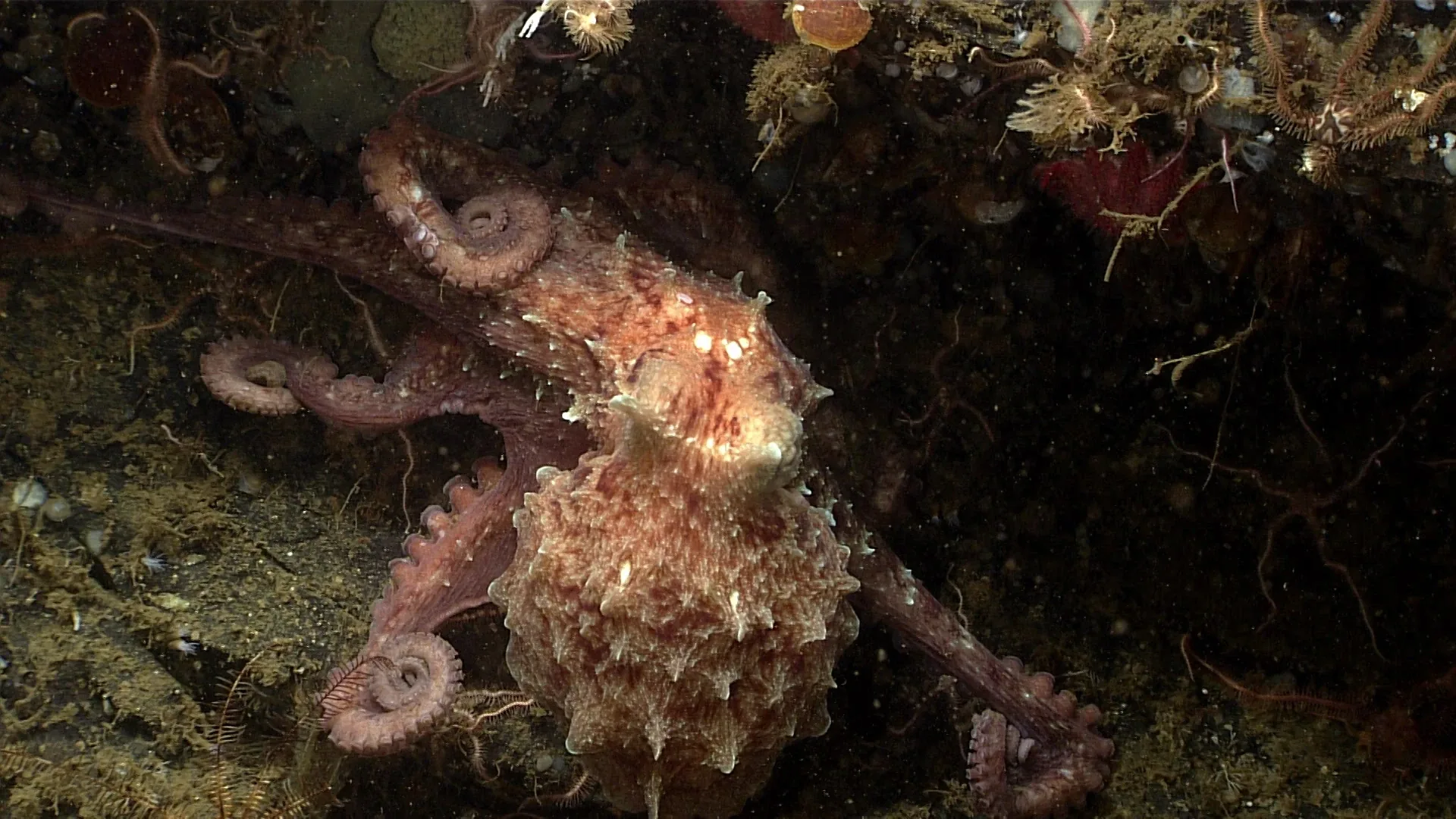
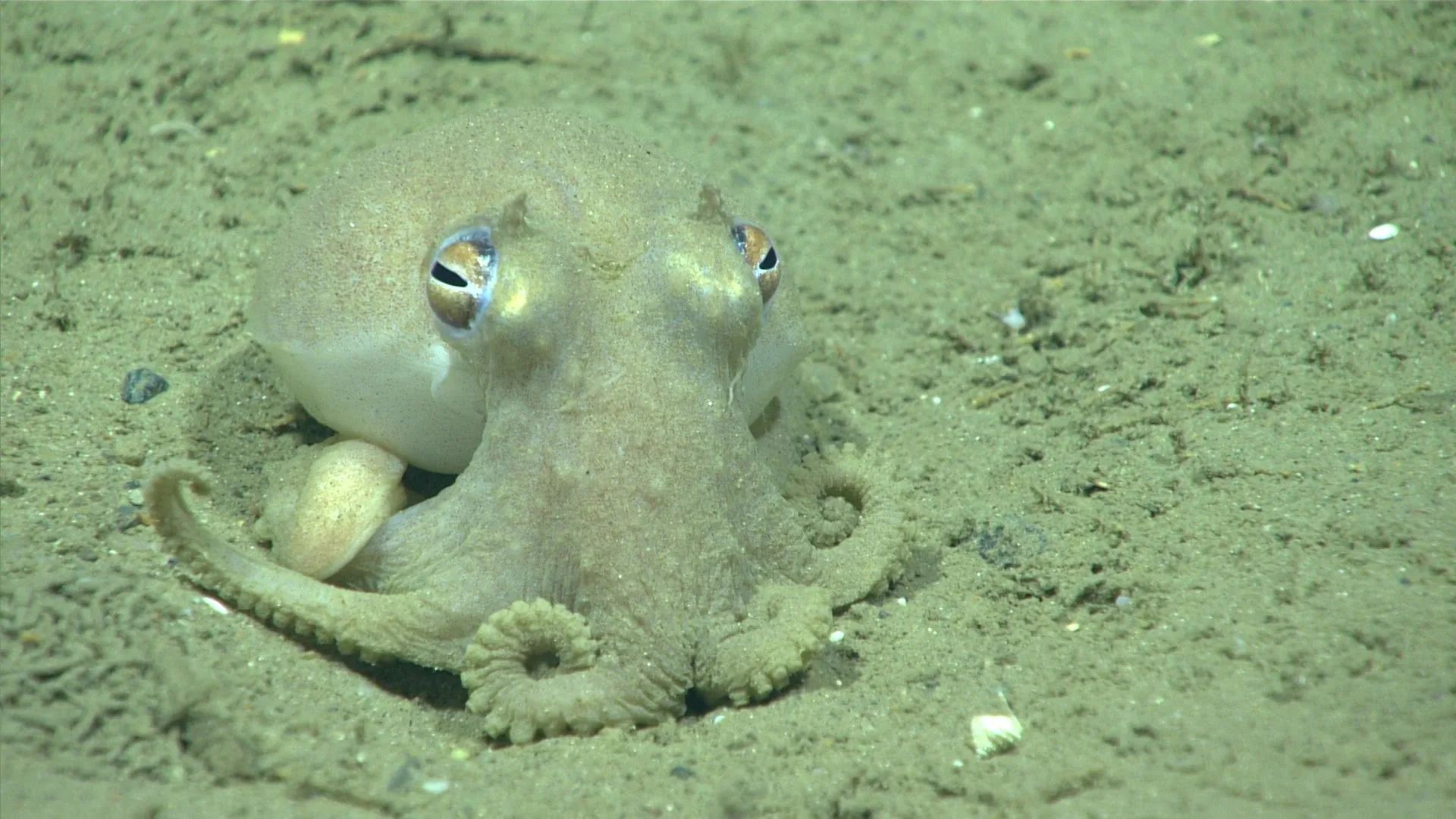
Bathypolypus bairdii is a small bottom-dwelling octopus of the low Arctic and North Atlantic. The cover photograph comes from a NOAA observation at 563 meters in an unnamed canyon on the North American continental margin. Its archived record belongs to expedition EX1905L2, dive 5, in September 2019. The location is Atlantic, not the Gulf of Alaska. Correcting that distinction changes the ecological setting of the profile and removes an unsupported suggestion that this image documents a Pacific population.
The Icelandic Institute of Natural History's species account describes confirmed mantle lengths of about 75 millimeters, while allowing that larger individuals may exist. Mantle length measures the main body, excluding the arms; it should not be reported as total stretched length. The account places the species mainly on shelves and upper slopes, with collections reaching 1,600 meters. Those records give context for the 563-meter photograph without turning one canyon encounter into the species' entire depth range.
Similar bodies, different species
Small deep-water octopuses can resemble one another closely. The Icelandic account emphasizes confusion between B. bairdii and Bathypolypus arcticus, particularly among females and juveniles. Identification is more than recognizing an octopus silhouette. Taxonomists compare anatomical characters, including features of the modified reproductive arm in males. A distant photograph may not expose those characters, even when a specialist can use a longer video sequence or comparison material to make a well-supported identification.
This matters when interpreting historical distributions. If two similar species were grouped under one name, an old locality list may mix their records. A later revision can change the apparent range without any animal moving. The practical response is to preserve the specimen or image, its original locality, and the identification history. Rechecking a name then improves a usable record rather than forcing researchers to discard an observation whose biological context has been lost.
Reading a canyon as habitat
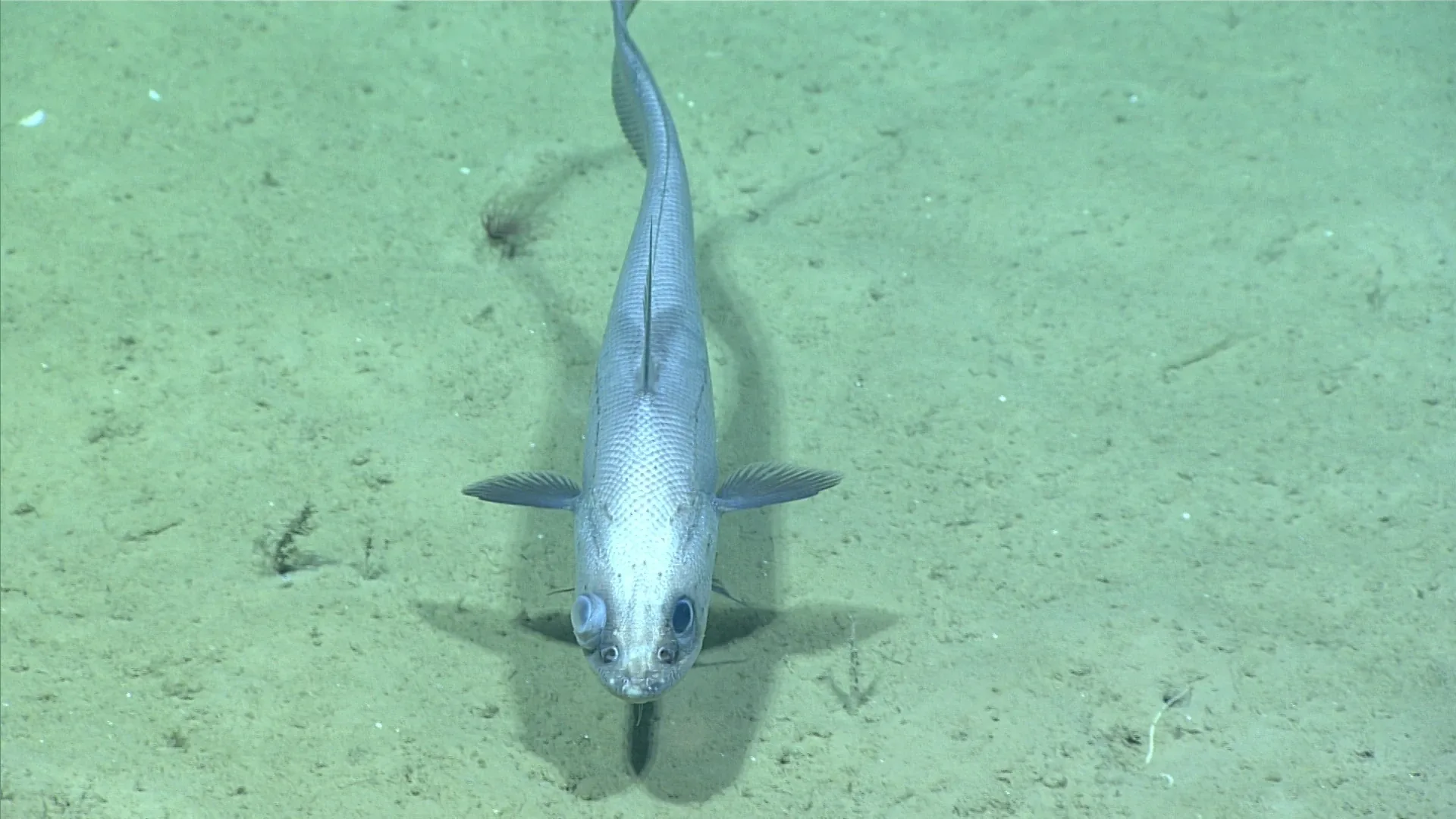
A submarine canyon provides a mosaic of sediment, rock, ledges, and relief. For a bottom octopus, that terrain creates different opportunities for contact, concealment, and movement. Flexible arms can grip uneven surfaces while other arms reach ahead. Unlike a fish held above the bottom by fins, an octopus can distribute contact across several limbs. The contrast suggests useful questions about locomotion, but it does not establish which particular surfaces this species prefers without comparisons across encounters.
A 2023 study of deep-octopod habitat in the western North Atlantic used video observations and an ecological classification framework to characterize habitat. Its subjects included B. bairdii and other deep octopods. Classifying the surrounding seafloor makes observations comparable: depth alone cannot distinguish a sediment-covered channel from an exposed wall at the same depth. Repeated environmental descriptions can reveal associations that an attractive isolated portrait would leave invisible.
Association is not necessarily dependence. An octopus repeatedly seen on a particular bottom may favor it, may find food there, or may simply be easier to detect against that background. Comparing available habitat with occupied habitat helps separate those possibilities. The strongest habitat claim identifies the sampling area and the alternative surfaces that were actually surveyed. It avoids implying that every canyon or every individual of a species behaves the same way.
A new way to measure soft movement
Recent imaging work provides a useful comparison with conventional video. In 2025, MBARI researchers described three-dimensional field imaging of octopus locomotion. Their study used the pearl octopus, Muusoctopus robustus, off California, not B. bairdii. A light-field camera recorded multiple views simultaneously, allowing researchers to reconstruct arm movement and track bending and strain as animals crawled over natural terrain.
The team found temporary muscular joints during crawling. That is a precise result about how flexible arms can produce organized motion without rigid bones. It should not be generalized into a claim that the Atlantic animal in this photograph was using the same measured control pattern. Instead, the study identifies a method that could test such a comparison. Ordinary footage records a visible path; calibrated three-dimensional imaging adds measurements of how the limb changes shape along that path.
What remains unknown about this species
The Icelandic account explicitly notes that the species' biology is poorly known. That leaves room for questions about diet, reproduction, and daily activity, but not for filling gaps with the better-known life history of the giant Pacific octopus. Even related octopuses can differ in egg size, developmental mode, and habitat. A familiar aquarium species is a useful introduction to the body plan, not a substitute for species-specific observations from a North Atlantic canyon.
Future work could connect habitat classification with movement measurements: compare crawling paths over rock and sediment, record shelter use, and revisit sites through time. Such a design would address a particular biological question rather than merely increase the number of photographs. For now, this portrait joins a correctly located Atlantic encounter, a taxonomic account that distinguishes similar species, and habitat research that gives the canyon a measurable ecological meaning. That combination explains more than an unsupported story about an octopus living anywhere that looks dark and deep.