Article · Field note 16
A lizardfish at abyssal depth
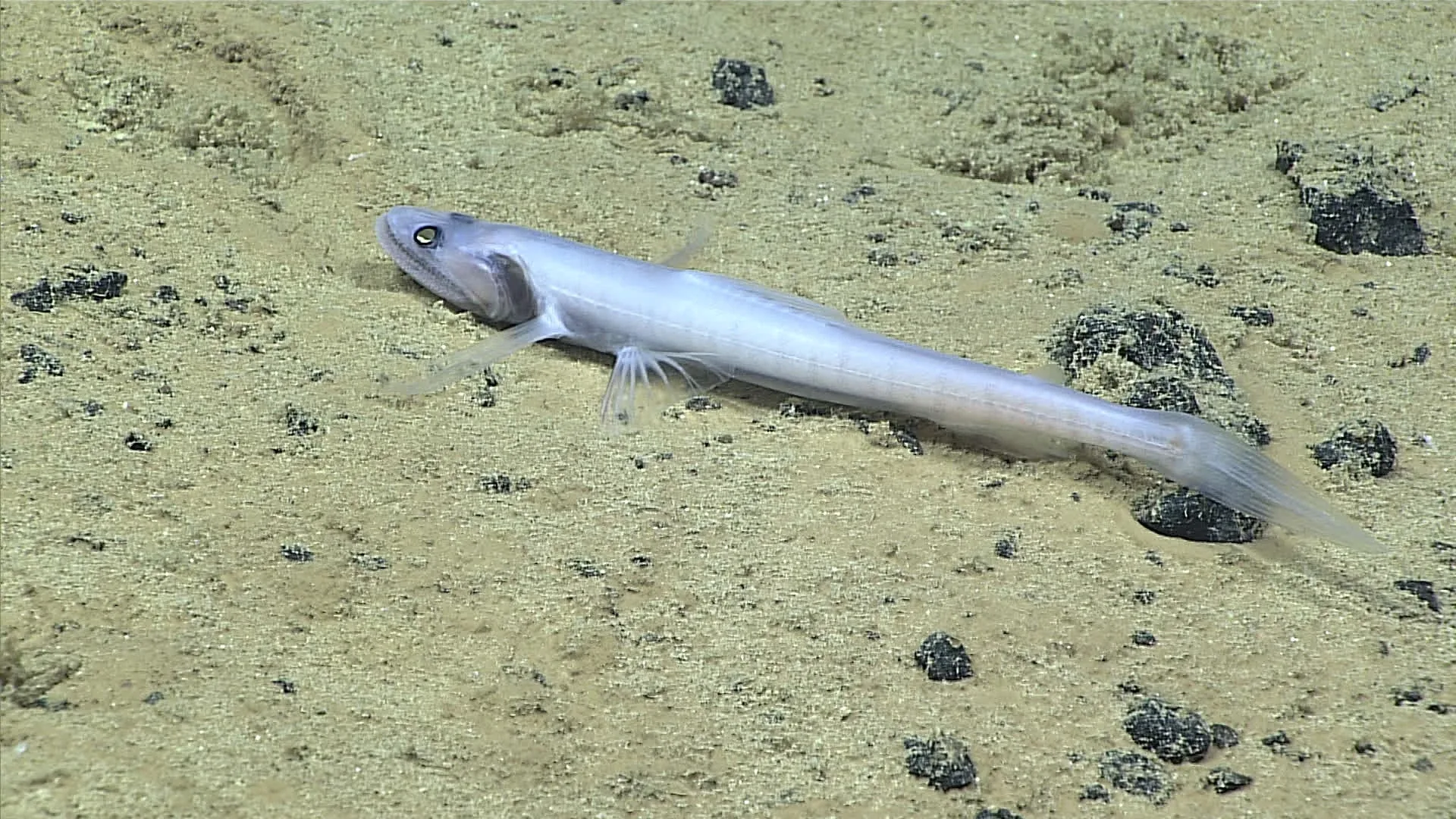
The highfin lizardfish, Bathysaurus mollis, is a deep-water fish in the order Aulopiformes. Its large mouth and elongated body distinguish it from many rounded, small-mouthed fishes encountered on the bottom. The NOAA image selected for this profile records it at 4,284 meters near Neker Island in the Pacific. That is an abyssal-depth observation, far below the continental shelf, and a useful counterexample to the idea that lizardfish are necessarily shallow-water reef predators.
The name “lizardfish” refers to a group with elongated bodies and prominent mouths, not to a relationship with reptiles. Bathysaurus is distinct from the coastal Synodus lizardfishes that anglers might know. Older references have examined the systematics and life history of deep-sea lizardfishes, including the placement of larval forms that were once treated as separate types. Deep-water animals often change appearance as they grow, which can complicate identification when larvae and adults are collected in different places.
What a mouth can suggest
Predatory fishes often have a body shape that helps them capture prey, but anatomy should not be turned into a complete feeding story without direct data. A wide mouth and sharp teeth can suggest that a fish can take relatively large prey. They do not reveal how often it feeds, how far it moves, or which prey dominate its diet. Stomach contents, baited-camera footage, and observations of live feeding each add different evidence.
The 4,284-meter record is especially important because it provides a depth and place rather than a general description of the species’ identity. It places one highfin lizardfish in an abyssal setting near Neker Island. It does not establish that the species is restricted to that depth or locality. Species distribution is assembled from many records collected by different methods, including trawls and expeditions. A ROV photo is one kind of evidence within that larger archive.
Larvae, names, and taxonomic history
Fish identification can become complicated when a larval body looks unlike its adult form. The NOAA reference trail for B. mollis includes literature on larval and juvenile fishes and on the relationship between larval forms and the deep-water genus. A mature fish may have a clear set of diagnostic characters, while a small larva may be assigned differently or tentatively until more evidence is available.
This is why taxonomic names should be treated as working scientific tools. A name points to a group of organisms defined by evidence; it does not guarantee that every life stage is immediately recognizable. DNA, reared specimens, and detailed morphology can connect early life stages to adults. Museum collections preserve these specimens for later comparison. When a database updates an identification, the old image or specimen remains useful because it documents what was actually observed at the time.
A predator occupies an interface
The 4,284-meter photograph places the fish where the seabed meets the water immediately above it. This boundary gives a predator a different geometry from the open midwater. Prey can approach along the bottom or pass overhead, while sediment and relief interrupt visibility. The broad mouth provides a way to take an encountered animal, but the surrounding habitat determines the directions from which such encounters are possible. A profile becomes more informative when it connects anatomy with that spatial problem.
The review Feeding ecology of deep-sea fishes examines how diet and feeding strategies differ among deep habitats. Its comparisons are useful context for Bathysaurus, rather than a species-specific feeding trial on the pictured individual. An important distinction is between ability and frequency: teeth can retain a struggling prey item, while only diet samples or observed meals can establish which animals are regularly eaten. A conspicuous jaw is evidence about capture mechanics, not a complete energy budget.
Waiting has a geometry
Remaining close to the bottom can reduce some movement costs, but it does not guarantee a successful ambush. Food must enter the predator's effective detection and capture zone. A small change in posture can alter that zone without producing obvious travel across the seafloor. Recording the angle of the head, the body's position relative to sediment, and movement before a strike would therefore be more useful than merely timing how long a fish appears motionless.
The alternative is to measure diet from collected animals. Stomach contents identify recent prey but can miss soft tissues that digest quickly and meals eaten long before collection. Molecular tools can add identification information, although they introduce their own reference-library limitations. Combining an anatomical description with these observations would distinguish a large-prey specialist from a predator that takes whatever suitable animals it encounters. The photograph alone does not settle that comparison.
Why life stages complicate the name
A striking adult can be easier to recognize than its larva. Deep-fish larvae may live in different water layers, have different proportions, and enter collections made with different gear. Connecting the stages requires morphological series or genetic evidence. That connection matters ecologically because an adult range on the seabed does not describe where its early development occurs. The species' life history can span more environments than its most familiar image suggests.
For this profile, the reliable starting point remains an abyssal adult observation near Neker Island. The useful next questions concern capture mechanics, prey identity, and the link between early and adult habitats. They are more specific than asking whether the animal is generally adapted to darkness. The highfin lizardfish illustrates how a conspicuous predator can be studied through several complementary measurements without assigning an unseen hunting sequence to a single encounter.