Article · Field note 06
A face that looks stranger in a photograph
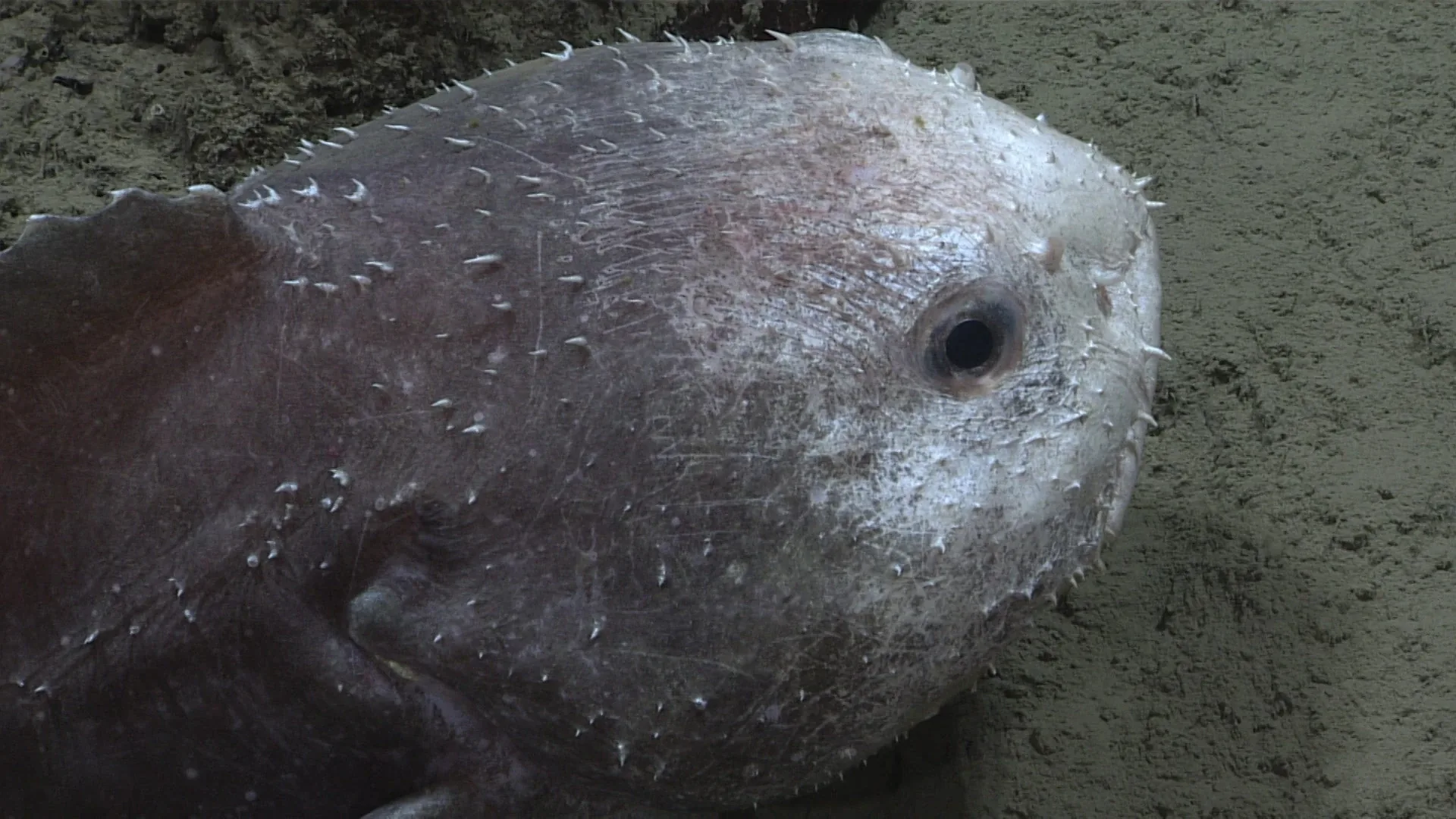
The blob sculpin, Psychrolutes phrictus, is a North Pacific fish of deep water. Monterey Bay Aquarium lists it from about 800 to 2,800 meters and describes a diet that includes cnidarians, sea pens, crabs, mollusks, and crinoids. The NOAA guide’s cover image for this profile comes from 2,016 meters in Middleton Canyon in the Gulf of Alaska, well inside that published range. The image is not a portrait made in an aquarium; it is a camera encounter in the habitat where the fish was recorded.
The species is sometimes confused online with the blobfish, Psychrolutes marcidus, whose famous “sad” appearance is often associated with decompression after capture. The blob sculpin is a different species. A photograph of P. phrictus at depth should not be captioned with a story about another fish unless the comparison is explained. Related species can look similar, but common names are not interchangeable labels. A clear scientific name prevents a memorable internet image from swallowing the identity of a different animal.
The body is not a joke about pressure
Monterey Bay Aquarium notes that the blob sculpin’s jellylike body is adapted to life under pressure. It is tempting to use that fact as a punchline: “the fish is a blob because the deep sea crushes it.” That is misleading. Water pressure rises gradually with depth and acts in every direction. A deep-living animal is not a surface fish being squeezed into a shape. Its tissues and body chemistry develop under the conditions in which the animal lives.
Soft tissue can be part of a successful design. It may reduce the need for heavy support structures, contribute to buoyancy, or provide a body that tolerates pressure without large gas spaces. Which functions apply to a particular fish needs evidence. A portrait cannot measure tissue density or explain how the fish maintains position. It shows a body form; anatomical studies and physiological tests address how that form works. The difference between “looks soft” and “uses soft tissue for a measured purpose” is an important boundary in natural-history writing.
Diet, encounter, and what a list means
The aquarium’s diet list spans very different prey: sea pens and other cnidarians, crabs, mollusks, and crinoids. That breadth suggests a flexible feeding role, but a list alone does not rank prey by importance. It may combine observations from multiple settings or records. To understand whether a species relies mostly on one food source, researchers need repeated stomach or feeding data, and they must account for location and body size. An animal can eat what is available at one site without showing the same preference across its whole range.
In deep water, a predator’s strategy cannot be explained only by the word “ambush” or “slow.” The fish may wait, move along bottom contours, or use nearby structure to encounter prey. Those behaviors need direct observation. An ROV image that shows the fish resting on sediment does not prove it is waiting for a crab. It may have just arrived, be moving between feeding sites, or be holding position during a brief disturbance. Scientists can use video sequences and environmental data to test such explanations.
Its prey list also links the blob sculpin to different parts of the seafloor community. Sea pens are attached animals that feed from the water column; crinoids and cnidarians include forms that are fixed or slow-moving; crabs and mollusks interact with sediment and hard surfaces. If the fish eats across this range, it may connect otherwise distinct feeding pathways. The evidence for the exact connections should remain tied to diet studies rather than inferred from the prey’s appearance in a nearby frame.
A depth range is a region, not a line
The reported range of 800 to 2,800 meters spans nearly two kilometers vertically. Temperature, light, food supply, and terrain all vary along that interval. A depth figure is an accessible summary, but it leaves out horizontal distance and local conditions. The 2,016-meter Middleton Canyon record helps place one encounter within the range; it does not show the fish’s complete habitat preferences or the limits of its distribution.
Canyons can contain ledges, sediment pockets, rock, and channels that redirect current. These features create a patchwork rather than a uniform slope. The same species may use more than one part of a canyon. To learn whether fish are more common on a particular substrate, researchers need a survey that compares habitats with consistent effort. One memorable individual is not an abundance estimate. The NOAA guide is especially useful because it keeps the image attached to the dive, depth, and locality, letting future comparisons use the same context.
The species’ maximum reported size, about 70 centimeters, also gives scale to the image. A large animal can look compact when the ROV camera has no ruler or familiar object in the same plane. Depth video often distorts size because the viewing distance is hard to judge. Measurements are therefore best reported from specimens or calibrated imagery, not estimated from the screen. A reader can enjoy the fish’s unusual proportions while leaving exact size to the measurement that supports it.