Article · Field note 08
A coral colony that looks like a shrub
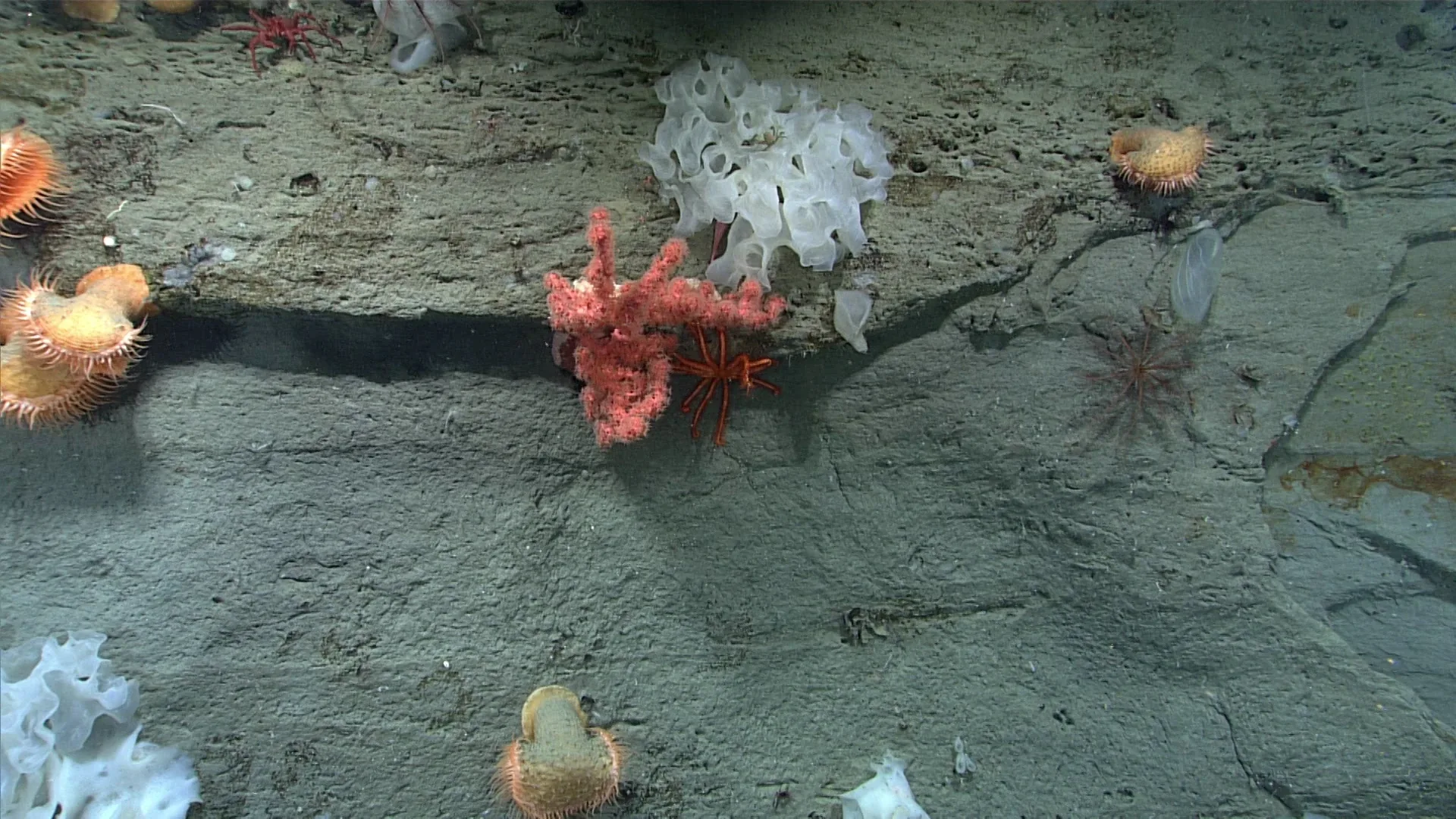
Paragorgia arborea is commonly called bubblegum coral because colonies can form large, branching structures in pink, red, or related colors. The NOAA image used for this profile shows the species in the Gulf of Alaska at Gumby Ridge, 1,819 meters deep. The branches are not plant stems. A coral colony is made of many small animals, called polyps, connected by living tissue and supported by a shared skeleton. A still frame may reveal the overall shape, but each branch is part of an animal-built structure.
“Coral” often brings tropical reefs to mind. Deep-sea corals are different from the reef-building corals familiar from warm, sunlit shallows. NOAA’s education material describes bubblegum coral at depths of 250 meters and deeper and notes that it can occur on rocky as well as soft bottom. The exact range and form vary across taxa and locations, so general explanations should stay tied to the species or group being discussed. Paragorgia is not a tropical reef wearing a darker color palette.
Branches in moving water
Many deep-water corals feed by capturing small organisms or particles from the water. Their branches expose polyps to flow, helping the colony meet food carried past it. That basic feeding picture does not mean that a coral can feed efficiently in every current or from every direction. Branch spacing, colony orientation, local flow, and particle concentration all matter. The specific mechanism has to be measured or directly observed, not guessed from the fact that a colony is branched.
NOAA research on seamount communities describes suspension feeders, including corals, growing on hard surfaces where the surrounding plains may be sediment-covered. A coral colony can add relief to that seafloor and create attachment points or shelter for other animals. It is reasonable to describe the colony as habitat structure; it is not reasonable to claim a specific fish or crab depends on this exact colony unless the interaction has been documented. “Can provide habitat” is often more accurate than “is home to” when evidence is general rather than site-specific.
The shape of Paragorgia makes it a useful place to discuss scale. A small image may show a single colony, while the ecological unit is a larger coral garden containing many colonies, sponges, rocks, and mobile animals. A camera view may crop the colony’s base or its neighbors. Without a mapped transect, a viewer cannot estimate how large the garden is or how continuous it may be. Surveying an ecosystem requires measurements over distance, not just one impressive portrait.
A long-lived structure in a changing place
Deep-sea coral colonies often grow slowly compared with fast-growing shallow-water organisms. Their branches can persist through long periods, creating structures that accumulate ecological history. But age estimates are species-specific and require appropriate sampling or growth analyses. A photograph cannot tell a reader whether a colony is decades or centuries old. For P. arborea, NOAA’s deep-sea coral program describes its role as habitat and documents its distribution; exact age claims should be tied to a study that measured age for the relevant specimen or population.
The NOAA guide includes repeated observations of Paragorgia across the Pacific and Atlantic records, with localities that include seamounts, canyons, and ridges. That spread helps show why no single image defines the species. The animal can occupy different terrain, and its visual appearance changes with camera distance, lighting, and background. A red colony may appear orange under ROV lights or pale when the exposure is high. Color in a video still is a clue, not a complete field mark.
What a branch can support
Coral branches create surfaces that other organisms can attach to, perch on, or move around. Some animals use the structure as refuge or as a place to feed. Others may simply be passing through. Deep-sea coral research examines these associations because they help explain why removing a colony can affect more than the coral itself. The ecological effects vary by habitat, but the structural role is well documented across many deep-water coral communities. NOAA’s deep-sea coral research overview describes corals and sponges as habitat for fish, shrimp, crabs, and other creatures.
This is also why the phrase “coral garden” can be helpful but should not be taken literally. Gardens are tended by people; these communities are assembled by environmental conditions and biological interactions. A colony might be a thousand small polyps cooperating through a shared skeleton, but it is not a single tree and does not grow from the seafloor like a plant. The language of landscape gives readers a sense of scale, while the biology clarifies what kind of organism they are seeing.
How to read the NOAA record
The image in this profile is linked to an EX2306 dive record at Gumby Ridge in the Gulf of Alaska. It identifies Paragorgia arborea at 1,819 meters. The source is valuable for the photographed animal, the locality, and the dive context. It does not tell us the colony’s age, growth rate, or full list of associates. Those questions require other observations and studies. Keeping those source roles separate helps prevent a well-labeled photo from becoming a substitute for ecological monitoring.