Article · Field note 05
Begin with the correct hagfish
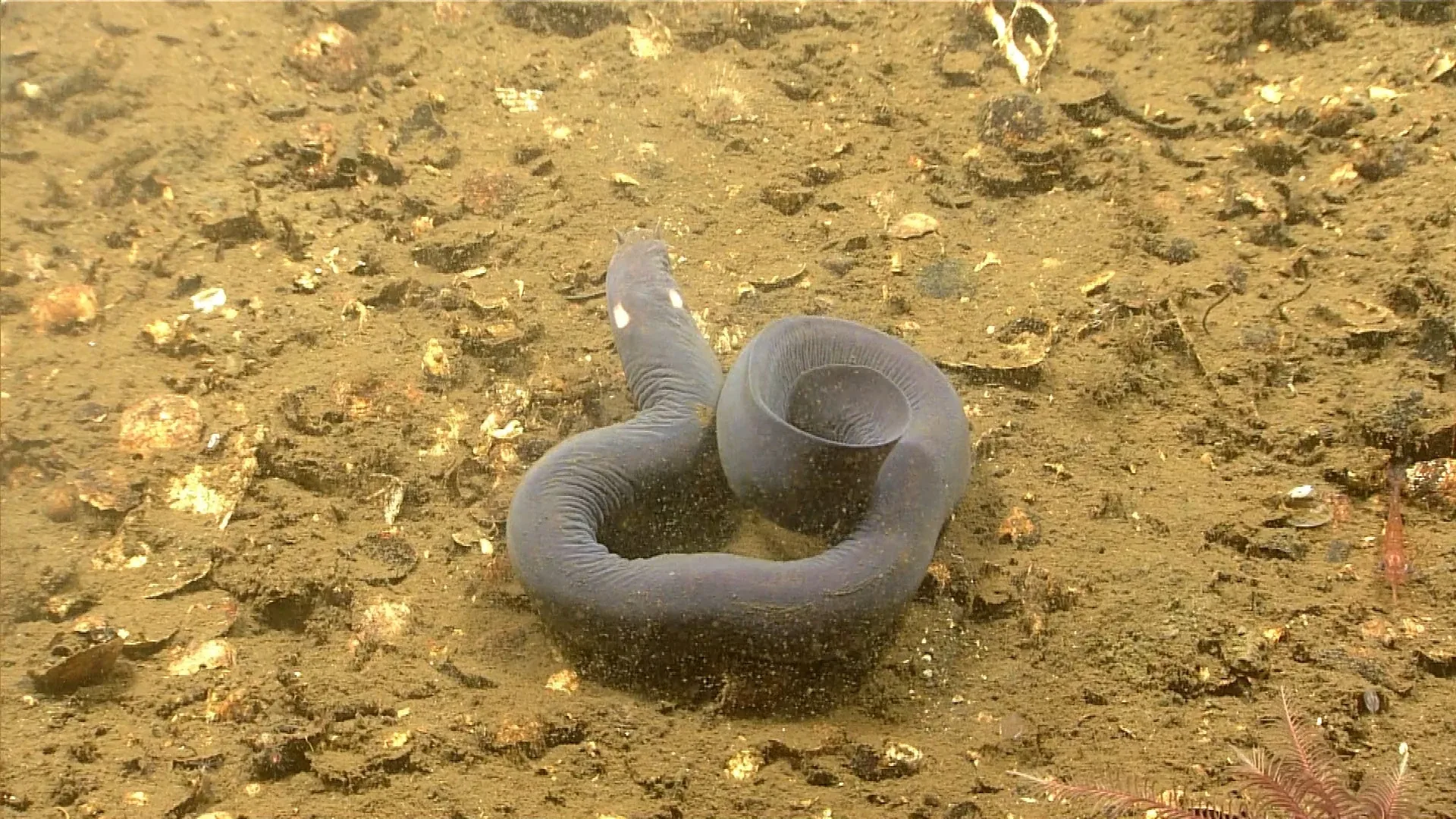
The black hagfish, Eptatretus deani, is a jawless vertebrate from the North Pacific. It should not be called the Pacific hagfish: that common name normally refers to Eptatretus stoutii. Confusing the two makes an article unreliable before the biology begins, especially because many experiments on hagfish slime use E. stoutii. The NOAA photograph accompanying this profile identifies E. deani at 527 meters in Ernest Sound, Alaska. It documents a black hagfish in deep coastal water, rather than an animal from an abyssal plain.
Its elongated body invites comparison with an eel, but the resemblance is superficial. True eels have jaws; hagfishes have a different feeding apparatus and belong to an ancient branch of living vertebrates. Calling hagfishes primitive can obscure their specialized biology. Their living bodies have continued evolving, including mechanisms for handling food and escaping predators. An old evolutionary separation does not mean that an animal has remained unchanged or represents an unfinished version of a modern fish.
A meal without jaws
Hagfishes use tooth-bearing plates to grip and rasp food. Body movements, including knotting in hagfishes, can provide leverage when removing tissue. This is a different mechanical solution from closing a pair of jaws around prey. The useful comparison is between ways of transmitting force: an articulated jaw concentrates force at a bite, while a rasping apparatus and a flexible body can work together to pull material away. These are general hagfish mechanisms, not behaviors documented in this cover photograph.
Scavenging connects that anatomy to the deep ocean's uneven food supply. A dead fish or larger carcass creates a concentrated resource in a habitat where edible material can be widely dispersed. Hagfishes are among the consumers described in the Smithsonian's account of deep-sea ecosystems and whale falls. A whale fall is one feeding opportunity, not a complete account of a hagfish's diet. Hagfishes can also consume living animals, and the balance between predation and scavenging depends on species and setting.
Food access and defense are linked. Entering or feeding near a carcass can place a hagfish among larger fishes and competing scavengers. A soft body permits access to confined spaces, but it lacks the obvious protection of a hard shell. Slime provides a rapidly deployed response to attack. Its effectiveness is best explained as an interaction with flowing water and breathing surfaces, rather than simply saying that the animal makes an enormous quantity of sticky material.
What the slime experiment actually tested
In a 2023 study of gill-clogging mechanisms, researchers separated the contributions of mucus and protein threads. The experimental animals were Pacific hagfish, E. stoutii, collected from British Columbia and California. The distinction matters: the study explains a mechanism in a related hagfish, while the NOAA image records E. deani. It does not establish identical performance, secretion volume, or predator responses for the black hagfish pictured here.
The researchers tested how slime impeded flow through experimental meshes. Mucus made the secretion highly resistant to water flow even at dilute concentrations. Threads alone did little clogging, but helped the mucus remain together during flushing. The combined material therefore had two useful properties: resistance to flow and persistence under disturbance. Thinking of the threads as a reinforcing framework explains their contribution more clearly than treating every component as equally responsible for making the mixture thick.
This difference also changes the engineering analogy. Ordinary thickening increases a liquid's resistance to deformation. Hagfish slime can instead form a watery network with very low permeability, meaning that water has difficulty passing through it. The laboratory apparatus isolated this physical behavior; it did not reproduce every feature of a struggling predator's gills. The interpretation is compelling because several measurements distinguish possible mechanisms, rather than because a dramatic video alone demonstrates exactly how the defense works.
Defense has a recovery phase
A secretion that interferes with another fish's breathing could also become a problem for the hagfish producing it. Water movement and body behavior help hagfishes clear slime. Defense is therefore a sequence: detect attack, release material, separate from the threat, and recover. That sequence helps explain why a short burst of slime can be useful without making the animal invulnerable. Replenishing secretions also requires biological resources; deployment cannot be treated as an unlimited, cost-free ability.
Biomaterials research draws interest from the strong protein threads and the rapid assembly of the secretion. Possible applications remain a separate question from biological function. Producing fibers consistently, controlling their properties, and integrating them into useful materials require engineering work. A laboratory result about permeability does not demonstrate a commercially available fabric or medical product. The organism offers mechanisms to investigate, while a successful manufactured material needs its own evidence of performance and practicality.
The Ernest Sound encounter
The cover record links the black hagfish to expedition EX2306, dive 9, and a measured depth of 527 meters. No carcass or slime deployment is documented by that still. Its contribution is geographic and visual: an identifiable animal occupying a particular stretch of Alaska seafloor. Read alongside the experimental research, it separates two complementary discoveries: where a black hagfish was encountered, and how a related species' defensive material resists water flow. The animal's story becomes more precise when neither source is asked to stand in for the other.