Article · Field note 10
A squid in a guide built from seafloor video
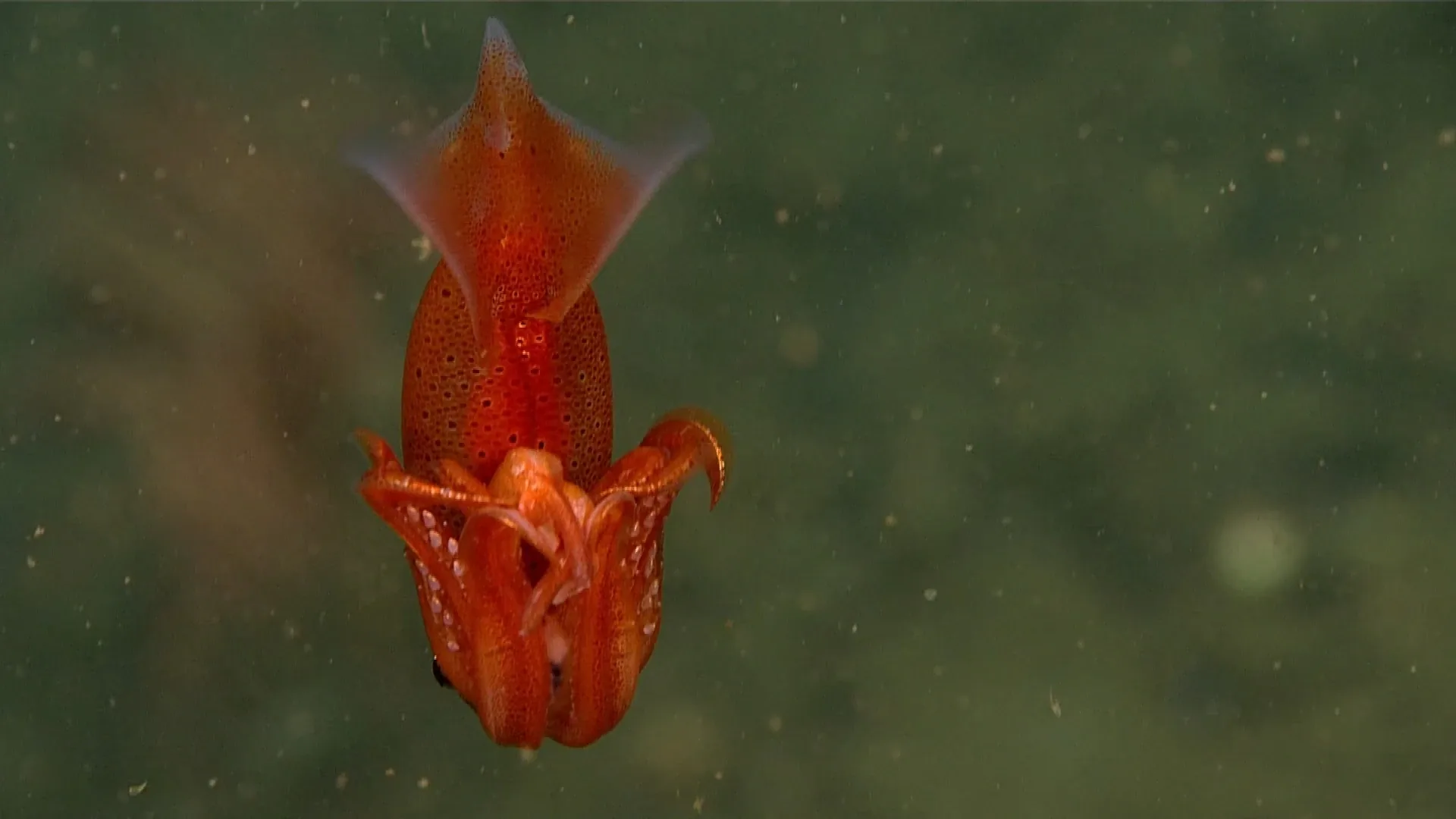
The NOAA animal guide records Gonatus pyros at 530 meters in Ernest Sound in Alaska. This squid is a pelagic animal, so the most useful question about its presence in a benthic image archive is not “Why was it on the seafloor?” but “Where in the water column was the camera looking, and what did the encounter show?” A vehicle tracking the bottom can still pass through open water, and a squid may cross the camera’s field without being a resident of the substrate below.
The family Gonatidae includes northern Pacific squids, and NOAA fisheries literature describes G. pyros from both demersal tows and midwater sampling. The species has been recorded at depths that overlap the 530-meter image, with midwater trawls also sampling it deeper. This is exactly the kind of context that prevents a reader from overreading one record. The animal guide confirms a visual encounter; survey literature helps explain that the species occupies the water column across multiple depths.
Reading a squid’s silhouette
A squid’s body plan includes a mantle, fins, a head, arms, and feeding tentacles. Gonatids are part of the larger cephalopod group, whose members move by drawing water into the mantle cavity and expelling it through a siphon. Fins and jet propulsion can contribute differently to movement depending on speed and behavior. A still image can show a body outline and perhaps the arm arrangement, but not the animal’s swimming rhythm, buoyancy control, or exact response to the ROV.
The common name “armhook squid” points toward hooks or hook-like structures on the arms in some members of the group. For species-level claims, descriptions should follow the taxonomic source and should not assume that every related squid has identical anatomy. The NOAA fisheries report provides a technical context for gonatids, while the animal guide supplies the pictured identification. A reader interested in arm morphology should check the species account rather than relying on a generalized silhouette.
Cephalopods can be difficult to identify from a single frame. Their arms may overlap, the body may be foreshortened by the camera angle, and pigment patterns can change quickly. Some records are based on features that are easiest to see in motion or from more than one viewpoint. When a guide gives a species name, the identification reflects the expertise and material available to its annotators. The thumbnail is not a do-it-yourself key that lets every viewer independently verify the answer.
Pelagic does not mean unobserved
The phrase “open ocean” can sound empty, but midwater habitats contain animals at many depths. Squids, fishes, crustaceans, jellies, and other organisms form food webs that shift across the day and across seasons. Some species migrate vertically; others remain deeper or use different layers at different life stages. A single squid encounter says little about how G. pyros moves over a full day. To study movement, researchers need repeated observations, acoustic surveys, tags where suitable, or depth-stratified trawls.
The distinction between pelagic and benthic life is a useful map, not a wall. The pelagic zone is the water column. The benthic zone is the seafloor and its immediate boundary. Animals can travel between them or be photographed while crossing from one visual context to another. A squid seen over the bottom may be hunting, migrating, avoiding a predator, or simply moving through. A camera frame does not distinguish those explanations without supporting behavior or environmental information.
The NOAA record links the animal to an expedition dive, locality, and depth. Those metadata make the image more than a specimen portrait. A researcher can revisit the dive video, look at frames before and after the still, and note the camera’s position. The record may reveal whether the squid was above sediment, near a slope, or in open water. That closer reading is more informative than assuming that every animal in a benthic guide lived on the seabed.
A careful account of a brief encounter
Gonatus pyros is memorable because a squid can bring motion and color to a quiet seafloor video. Its record at 530 meters in Ernest Sound is a specific observation. NOAA survey literature places the species in broader midwater and demersal sampling contexts. What the two sources do not establish is the behavior of the individual during the image, the animal’s exact depth range at that moment beyond the record, or its route through the sound.
That restraint is not a limitation of the story; it is the story’s useful point. The deep sea is not a collection of isolated boxes labeled “bottom” and “water.” Camera vehicles encounter animals as they move through connected habitats. A squid can appear in a benthic archive without becoming a bottom-dweller. Following the source trail helps readers tell the difference between an animal’s ecology, the survey’s route, and the moment the lens happened to meet it.
The important spatial comparison is between the squid's position in the water and the seafloor below it. A vehicle surveying benthic habitats can record a swimming cephalopod without showing that the animal lives permanently on the bottom. Retaining vehicle altitude alongside depth would help interpret that encounter more precisely.