Article · Field note 18
A soft coral on a seamount
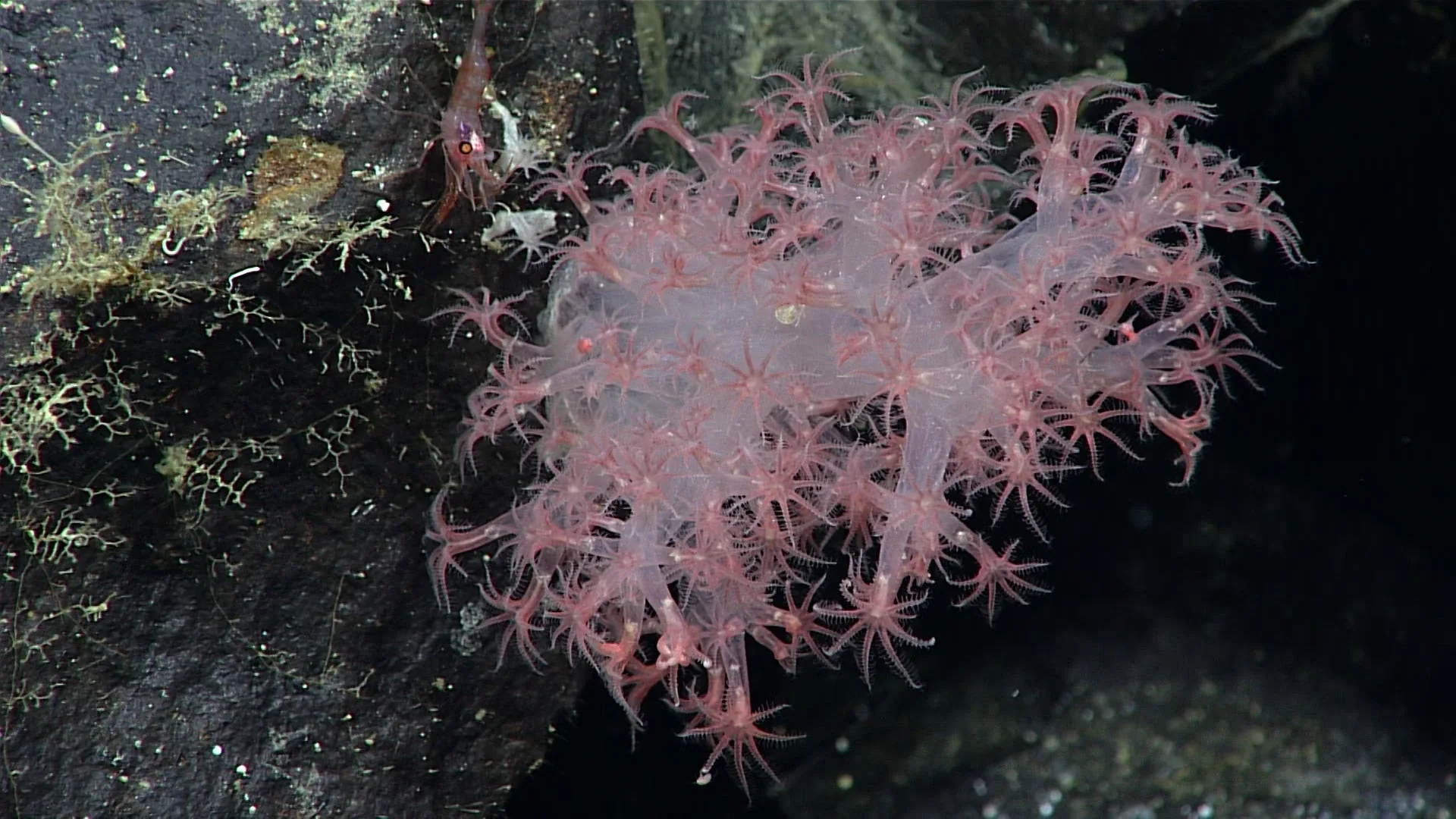
The NOAA guide identifies Gersemia fruticosa at 830 meters on Giacomini Seamount in the Gulf of Alaska. The colony in the cover image appears as a pale, branching tuft against darker seafloor. This is a soft coral, not a stony reef builder. Its polyps share living tissue and a flexible colony structure, adding texture to the bottom without constructing a massive calcium-carbonate reef.
Soft corals are less familiar to many readers than the hard corals of tropical reefs, but they are widespread in cold-water environments. NOAA’s image record gives a specific observation; a peer-reviewed study of G. fruticosa and Duva florida provides a rare look at the species’ reproductive biology. The researchers maintained live colonies under flow-through laboratory conditions and documented larval release, settlement, and early growth. These were controlled observations from collected material, not details that can be read from the ROV photograph.
Reproduction is hard to watch in the deep sea
Deep-water corals are difficult to observe through a complete reproductive cycle. Divers and ROVs may find adult colonies, but eggs, larvae, and newly settled juveniles are small and easily missed. The 2011 study describes planula larvae released by G. fruticosa in captivity between April and early June in the sampled year. Peak larval release coincided with high chlorophyll concentration and deposition of planktonic matter. That association is interesting, but it does not by itself prove that food deposition caused the timing.
In the study, settlement took 3–70 days. Gersemia primary polyps reached about 6–10 millimeters in height over 2–3 months; these values must not be confused with measurements for Duva in the same paper. These results provide rare life-history details for a soft coral, but laboratory conditions differ from the seamount. Temperature, water flow, food supply, and handling can influence development. It is more accurate to say “the study observed” than to treat the values as fixed constants for every wild colony.
The researchers found that primary polyps did not bud during the monitoring period. That result matters because coral growth can occur through both colony expansion and sexual reproduction. If a species recruits slowly, recovery after disturbance may also take time, but the chain of inference should be tested with field studies. A laboratory growth result is a reason to examine recovery, not a direct measurement of population recovery after a trawl or other impact.
A colony changes what is available nearby
Even a soft, flexible colony can create surfaces for other organisms. Tiny animals may attach to branches, shelter among polyps, or use the colony as a feeding position. The precise associates at Giacomini Seamount should be identified from the dive footage and ecological surveys rather than borrowed from another region. A coral’s shape suggests possible habitat functions, while the community record shows which functions actually occur.
The seamount setting is relevant because hard relief can support attached animals and expose them to currents. Water motion carries food particles and small plankton past coral polyps. A colony’s orientation may affect how much food it encounters, though one image cannot reveal flow direction or feeding rate. Researchers can place current meters, compare colony orientation with mapped flow, and sample the organisms living on or near the coral to understand the local ecology.
“Soft coral” describes a group with flexible skeletons or supportive structures, not a weak organism. Some colonies can persist in cold, dark settings by feeding on what the water brings. Their tissue and skeletal composition differ from reef-building hard corals, so they may respond differently to temperature, chemistry, and physical disturbance. A broad statement about all corals should not be applied to Gersemia without checking its own anatomy and habitat.
How a seamount photograph fits with a lab study
The NOAA image provides in-situ context: a colony identified as G. fruticosa at 830 meters on Giacomini Seamount. The 2011 reproductive study provides a closer view of larvae and early growth from northwest Atlantic animals maintained in the laboratory. The records are complementary but geographically and methodologically distinct. They should not be combined into a claim that the pictured Alaskan colony released larvae on the same schedule as the study population.
The study also illustrates why deep-sea taxonomy and life history interact. A precise species name allows observations of reproduction to be compared across laboratories and regions. If a colony is misidentified, a growth or spawning result may be attributed to the wrong animal. Voucher specimens, expert review, and genetic tools help keep the link between name and organism stable. The NOAA image archive preserves visual records that can be revisited if identifications change.
A small coral with an unusually useful record
The colony’s soft form is a reminder that deep-sea habitat does not have to be built from hard reef skeleton to matter. A small patch of living branches can alter the immediate seafloor and offer new surfaces for other organisms. To know which animals use this particular colony, the dive record and additional ecological observations are needed. That careful distinction preserves the real value of the image: a named soft coral, at a measured depth, in a place where its life history can be studied further.