Article · Field note 12
A deep-water relative among king crabs
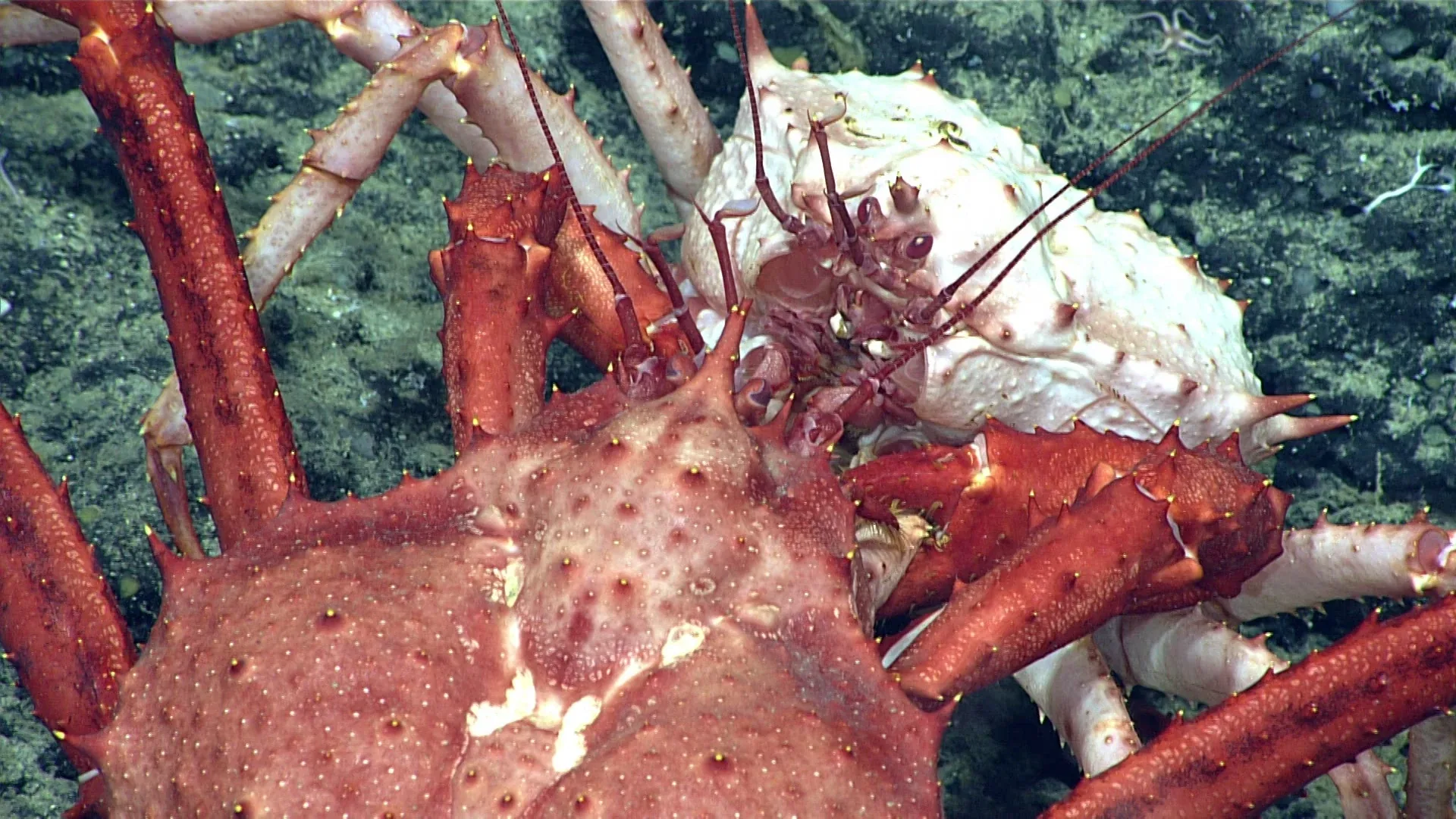
The crab Lithodes couesi is a deep-water relative of the better-known king crabs harvested on continental shelves. NOAA’s 1981 life-history study from the Gulf of Alaska describes features associated with slope life, including elongated legs, red coloration, inflated branchial chambers, asynchronous spawning, and large eggs. The animal guide’s image used here records the species at 891 meters near Giacomini Seamount. The paper and the image answer different questions: the study examines biology; the NOAA dive entry anchors one photographed encounter.
The comparison with commercial king crabs helps clarify a common-name trap. “King crab” can refer to a group of related anomuran crabs, but not every species shares the same depth range or fishery history. L. couesi is a deep-sea species associated with the continental slope, while other king crabs are more familiar from shallower fisheries. A picture of one Lithodes cannot stand in for the entire group. The scientific name is essential when discussing range, maturity, or harvest.
Legs, gills, and a slope habitat
The elongated legs described in the NOAA study provide a starting point for thinking about movement on the bottom. A crab’s walking legs can help it travel over uneven terrain, but a photograph does not measure how efficiently it moves or what substrate it prefers. The term “deep slope” also includes many surfaces: soft sediment, rocky ridges, and canyon walls. Observations across those settings are needed to learn whether body form predicts habitat use.
Crabs exchange gases using gills housed in chambers beneath the carapace. The 1981 paper notes inflated branchial chambers among traits that may be adaptations for deeper water. That is a comparative interpretation grounded in anatomy, not a visual diagnosis made from the NOAA image. The visible carapace and legs are only the outer surface of a physiological system that must obtain oxygen from cold water at depth. Studying the gills helps explain how the crab functions in that environment.
Red coloration can be another useful clue, though deep-water color is not always what a human sees under white light. At depth, ambient light changes with wavelength and becomes scarce. ROV lighting and camera balance can make a crab look more or less saturated. A red animal may appear dark or nearly black in natural deep water and bright red when illuminated. Color descriptions in field guides should be read as records made under specified lighting, not as a guarantee of how the animal looks to every observer.
Reproduction below the shelf
The NOAA study discusses asynchronous spawning and large eggs as characteristics of L. couesi. Reproductive timing can differ from shallow-water relatives. Large eggs may be associated with more developed larvae at hatching in some crabs, but a specific developmental sequence needs species-level evidence. This is why reproductive biology is not easily inferred from an adult image. Eggs, larvae, and settlement require different sampling methods, and many deep-water stages are rarely observed directly.
The size at which crabs mature is also a population-level question, not a trait that can be assigned to the individual in a photo. Researchers examine specimens across size classes and sex, then estimate maturity using anatomy or gonad condition. The 1981 paper reports maturity estimates for males and females from its study population. Those measurements should remain attached to that study rather than presented as universal values for every region or cohort. Later work may revise them as sampling improves.
Deep water can make reproduction difficult to study because the adults are spread across large areas and the young may drift away from the location where eggs were released. A seamount record can show an adult at one point. It cannot tell us where larvae develop or which current carries them. Tagging, plankton sampling, genetics, and repeated surveys can begin to connect those stages. Each method sees a different part of the life cycle.
The Giacomini Seamount observation
The NOAA guide places the pictured L. couesi at 891 meters near Giacomini Seamount in the Gulf of Alaska. The depth falls within the broader slope setting discussed in the life-history literature. The record does not indicate that the crab was caught, harvested, mating, or feeding. It is an in-situ image. A nearby seamount can create relief and alter local flow, but the image alone does not establish why this individual occupied the site.
Seamounts and slopes are not interchangeable habitat labels. A seamount rises from deeper surroundings and may concentrate hard surfaces and current-exposed features. A continental slope descends from the shelf toward the deep ocean. The same animal may use both types of terrain, but a record at a seamount does not prove a seamount-specific adaptation. The animal guide’s locality is useful because it points to the exact site; the species’ broader habitat comes from multiple sources.
A crab is also part of an ecosystem
Crabs can be predators, scavengers, prey, or sediment-disturbing foragers, depending on species and setting. It is a mistake to assign all roles to L. couesi simply because other crabs perform them. The available source for this profile documents body features, life history, and depth-related traits. Additional diet observations would be needed to describe the species’ food web confidently. A camera sequence of a crab feeding or a stomach-content study would provide different evidence.