Article · Field note 14
A sea cucumber in a canyon image
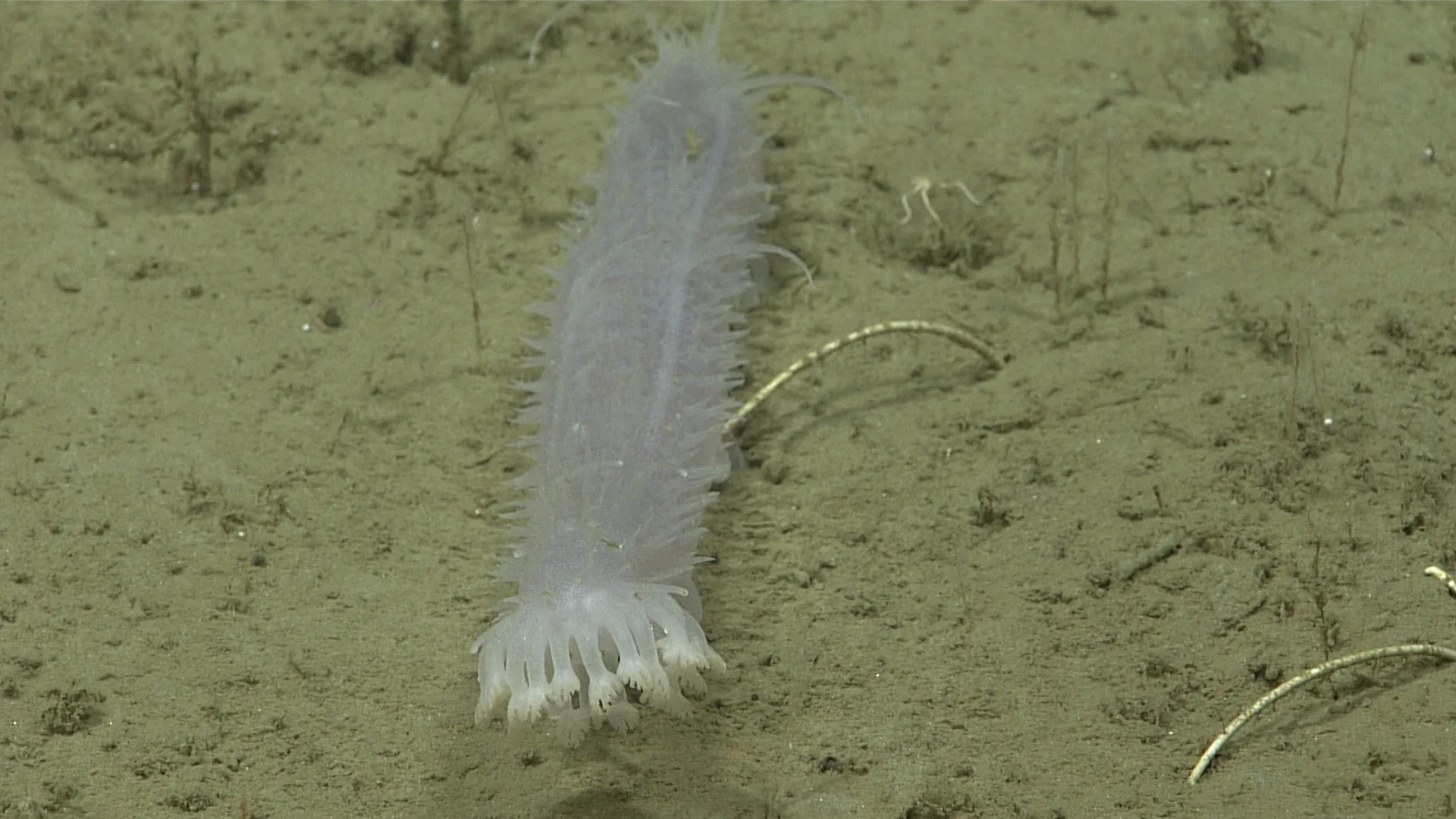
Moseley’s sea cucumber, Pannychia moseleyi, is a deep-water holothurian in the echinoderm group. The NOAA guide records the animal at 1,633 meters in Noyes Canyon in the Gulf of Alaska. The pale, elongated body may look like a drifting feather or a soft tube, but it is an animal living close to the seafloor. Monterey Bay Aquarium lists the species from the Pacific at depths that include this observation and notes a diet of detritus, organic material, bacteria, and plankton.
Sea cucumbers are not plants, vegetables, or simple bags of mud. They are echinoderms with a body plan that places the mouth at one end and the anus at the other, with internal systems adapted to life in water. Many species process sediment or particles, but the feeding method varies across the group. P. moseleyi belongs to a deep-sea lineage whose forms can be very different from the chunky intertidal cucumbers familiar on rocky shores.
The food that falls from above
The deep seafloor often receives organic material that originated in more productive surface layers. Dead plankton, fecal pellets, mucus, and other particles sink through the water. NOAA calls this mixture marine snow. Some material is consumed or decomposed before it reaches the bottom; some arrives as small particles that can be collected by animals living on the seafloor. The supply changes with surface productivity, current, and the time it takes particles to descend.
A sea cucumber feeding on detritus is one link in that transfer. Its body or mouthparts can take in food-bearing material, while sediment and organic particles pass through a digestive system. The animal’s role is not just “eating mud.” Fine sediment contains a mixture of mineral grains, microbes, and organic matter; extracting food from it is a way to use resources that are diffuse and low in concentration. The species-specific mechanics deserve careful wording, but the broader ecological role is clear: deposit feeders connect falling material to the benthic food web.
Food does not reach every part of a canyon uniformly. Currents can move particles sideways, topography can redirect sediment, and canyons can trap or export material. A sea cucumber at one point on a canyon floor is not automatically representative of the entire canyon. Researchers measure particle flux, sediment composition, and animal distribution to understand the local budget. An individual image tells us where one animal was visible; it does not quantify how much food arrived there.
A body that can also make light
Pannychia moseleyi has another remarkable trait: it can produce bioluminescence. MBARI researchers described pulsing blue bands moving along its body. Monterey Bay Aquarium notes that the species flashes spirals of blue light when threatened, with a possible role in discouraging predators. The mechanism is more than a visual flourish. Light can startle or confuse an attacker, attract a larger predator that might threaten the first one, or signal information to another animal. Which function applies depends on the animal and context.
The light seen in video is also shaped by the camera. ROV lamps may illuminate a luminescent response, but the camera can be too bright, too far away, or too slow to record the full flash. Some animals release glowing material; others emit light from tissues or symbiotic organisms. These strategies are not interchangeable. MBARI’s work compares which deep-sea animals bioluminesce and how often, finding that animals on the seafloor are less likely to produce light than midwater animals in the surveyed region. That regional result does not mean benthic animals never glow.
How an image becomes a record
The NOAA image attaches the species name to a depth and canyon locality, plus a cruise and dive number. A scientific name is a way to connect that frame to other records. If experts later revise an identification, the original image and observation context remain available for comparison. Without the context, a photo is harder to verify and easier to miscaption. That is why the guide’s metadata matters as much as the image’s unusual shape.
A single still cannot show whether the cucumber was feeding, moving, or reacting to light. The full video may offer a sequence, but even a sequence has limits if the vehicle appears only briefly. To measure feeding, scientists could track body orientation, particle availability, and sediment movement; to study bioluminescence, they need low-light recording with appropriate controls. The image is a starting point for those studies, not a substitute for them.
A small processor in a large system
Moseley’s sea cucumber joins the quiet work of deep-sea food processing with a dramatic capacity for light. One trait connects it to the flux of organic material; the other may help it respond to predators. Neither one makes the animal a universal model for all sea cucumbers. The group is diverse, and species differ in anatomy, diet, habitat, and behavior. A responsible field guide keeps the species name beside each generalization.
In an abyssal or canyon community, the arrival of food is rarely a meal on demand. Some material drifts past, some settles, and some is intercepted by animals before reaching the bottom. A sea cucumber can use the particles left behind. Its body is one way the ocean recycles energy across depth. Read alongside the NOAA observation, NOAA’s marine-snow explainer, and the aquarium’s species profile, the animal becomes both an individual in a real place and a participant in a much larger transfer of food.