Article · Field note 13
A central disc and five flexible arms
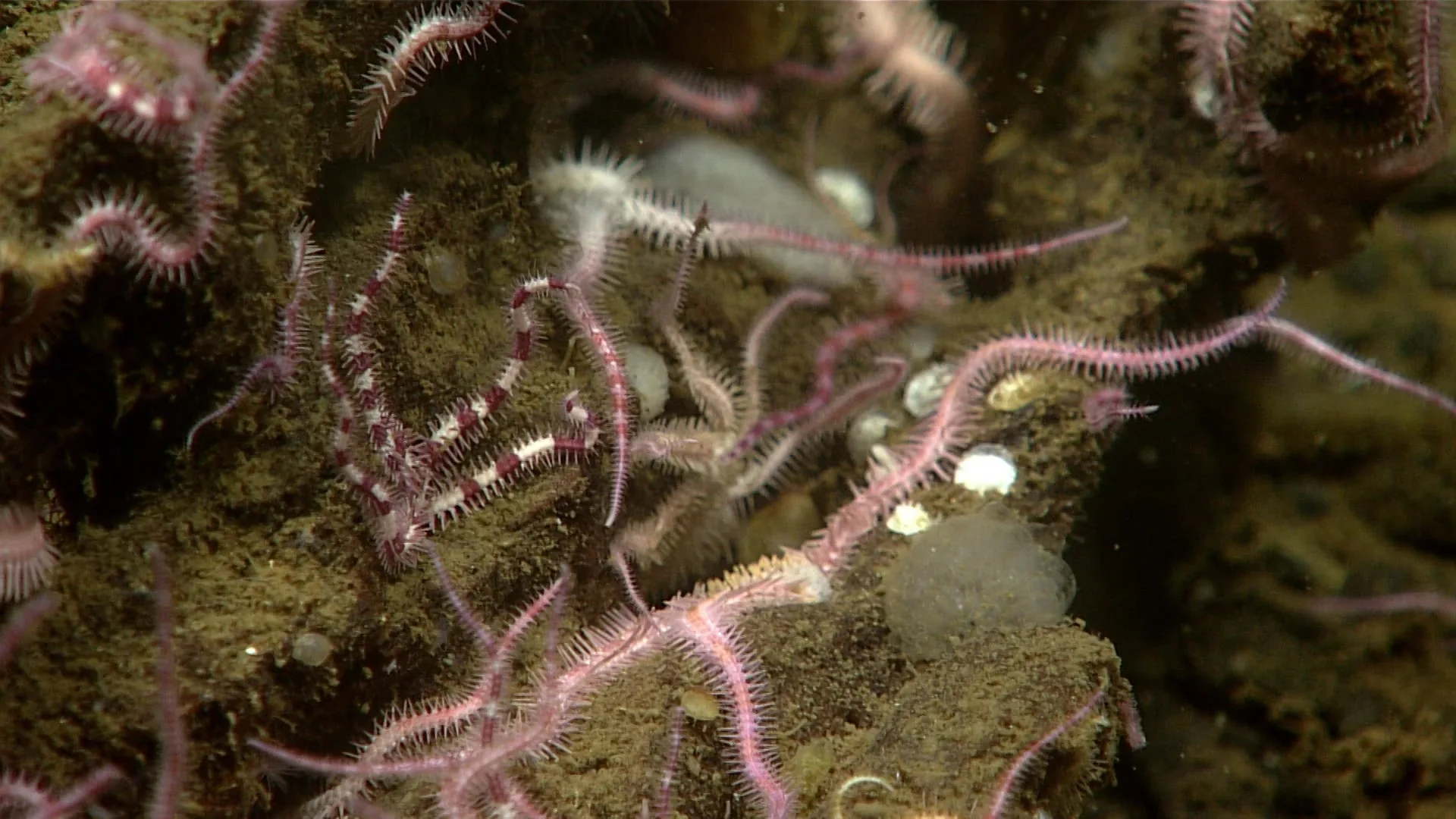
Ophiopholis aculeata is a brittle star, an echinoderm related to sea stars, sea urchins, and sea cucumbers. Its compact central disc is clearly separated from five long, jointed arms. The NOAA guide records the species at 543 meters in Ernest Sound, Alaska. At that depth, an ROV image reveals an animal whose fine arms can be hard to appreciate in a small thumbnail. The body plan is easier to read when the viewer notices the disc first and then follows each arm outward.
Brittle stars are not miniature sea stars. Their arms are distinct from the central disc and can bend sharply, which supports a different style of movement. Smithsonian Ocean describes many brittle stars as moving by rowing or dragging themselves with their arms. Tube feet and the water-vascular system also play roles in echinoderm function, but the arm-driven motion is a useful contrast with the slow, coordinated tube-foot movement often associated with sea stars.
Arms that do several jobs
An arm can help an animal move, hold position, gather food, and sense its surroundings. That does not mean one arm performs all jobs in the same way at every moment. Brittle-star arms are jointed and lined with small structures that can interact with the bottom or with moving water. A photograph can show their shape, but it cannot reveal which appendage was bearing weight or whether the animal had been disturbed before the frame was taken.
Some brittle stars feed on particles and small organisms. Food may be caught by tube feet or mucus and passed toward the mouth, which is located on the underside of the central disc. The specific diet of O. aculeata varies with habitat and evidence source. It would be too simple to say that every image shows a suspension feeder or a detritus eater. A feeding observation, a laboratory trial, and a stomach-content analysis each answer different questions.
Hidden in crevices or exposed to a current
Position can matter for feeding. An animal tucked into a crevice encounters different currents and predators from one with arms extended above the bottom. Some brittle stars spread arms into flow to intercept particles; others forage across sediment. The same species may change posture with current or food concentration. A time series is more revealing than a single still because it shows how an animal adjusts its arms as conditions change.
A body plan that reflects echinoderm history
Echinoderms are built around a water-vascular system, a network of fluid-filled canals connected to tube feet. That system assists movement and interaction with the environment. The animal’s five-part symmetry is visible in many adult forms, though the arms may make the symmetry look irregular in motion. Brittle stars belong to the class Ophiuroidea, whose members generally keep the central disc distinct and use their arms in a more flexible way than sea stars.
Articulations and mechanical loads
A jointed arm transmits force differently from a continuous, unsegmented extension. Brittle-star arms contain a series of articulated skeletal elements, with muscles and connective tissues coordinating bending. Several contact points can distribute the load as the animal holds position or moves. This construction makes flexibility compatible with support: an arm can bend locally without requiring the entire body to turn. The Smithsonian's echinoderm overview places both within the same larger evolutionary group without making their feeding and movement interchangeable.
For Ophiopholis aculeata, an arm projecting beyond a crevice creates a different exposure to current than the sheltered central disc. The useful ecological unit is therefore not simply the rock occupied by the animal, but the position of its feeding surfaces relative to moving water. The same current can deliver particles to an extended arm and impose a mechanical load that makes maintaining position more difficult. This tradeoff follows from the geometry of the animal; a measured feeding rate would still need an experiment.
Shelter and access can coexist
An animal does not have to choose between complete concealment and complete exposure. A crevice can protect the disc while leaving part of an arm outside. That arrangement suggests a way to examine habitat quality: measure both the availability of shelter and the flow across its opening. Counting bare rock area alone would miss a feature that can matter to a small, flexible invertebrate. Likewise, a large coral or sponge might offer narrow spaces that a wide-angle survey cannot resolve.
A comparison of brittle-star images should distinguish an arm laid along a surface from one lifted into the water. These postures need not represent the same activity. Successive frames can show whether food is moved toward the mouth, whether the animal relocates, or whether contact with another organism changes its position. Naming an action from the sequence is stronger than assigning the species an unchanging feeding strategy from one posture.
Scale changes the survey
A camera route suitable for large fishes may pass too high to reveal a brittle star hidden between stones. Lower, closer imagery improves detail but covers less ground and increases the importance of keeping a consistent viewing distance. A survey of this animal therefore has a practical design choice: maximize the area examined or maximize the chance of seeing concealed individuals. Recording image scale makes that choice explicit and permits comparisons among sites.