Article · Field note 09
A coral that does not need sunlight
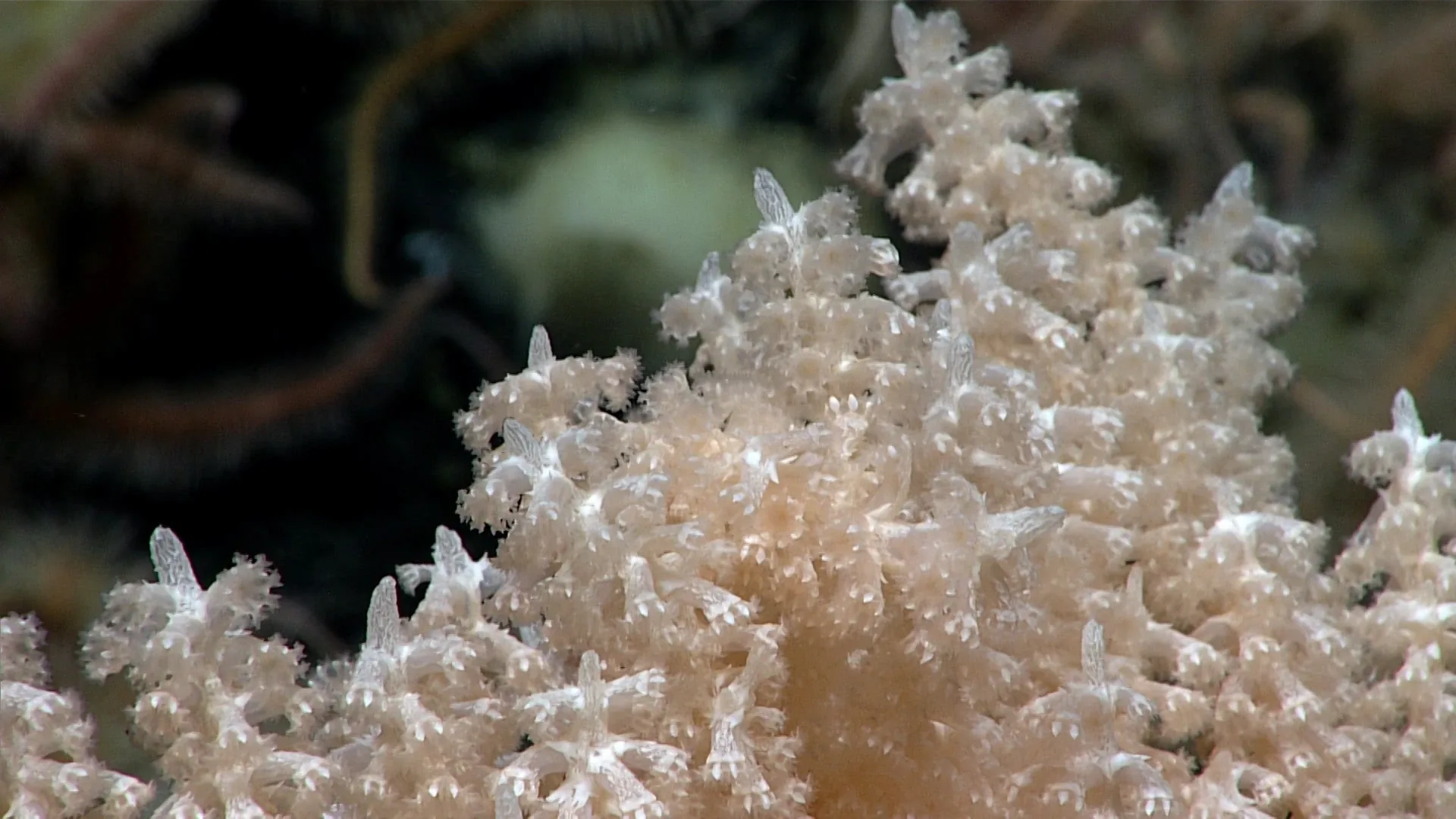
The Pacific red tree coral, Primnoa pacifica, is a cold-water octocoral found in the North Pacific. NOAA describes its range from Washington toward the Bering Sea and notes that large colonies can provide habitat for fish and crabs. The NOAA image selected for this profile is from Surveyor Seamount in the Gulf of Alaska at 497 meters. That record is relatively shallow compared with many deep-sea images, which is one reason it helps unsettle the idea that a “deep-sea coral” must be thousands of meters below the surface.
Unlike shallow reef-building corals that commonly rely on symbiotic algae, deep-sea corals can live without sunlight reaching them. Their food arrives from the surrounding water, and their branches intercept particles and small prey carried by currents. A coral colony is an animal community of polyps connected by living tissue and supported by a skeleton. The familiar tree shape is an architectural outcome of that colonial growth, not a plantlike body.
Size is only one part of the habitat story
NOAA reports that red tree coral colonies can grow to several meters in height and width. Large branching structures add relief to otherwise low-profile seafloor terrain. That relief can offer attachment surfaces and shelter to other organisms. It can also alter the local flow around the colony, affecting what food passes within reach. These are linked ecological possibilities, but not every benefit is measured at every site. A specific claim about the animal community should be based on surveys that compare coral and non-coral habitat.
Corals are sometimes described as “ecosystem engineers” because their bodies can create or modify habitat used by other species. The phrase is useful when it refers to a documented effect. It becomes vague if it is used to imply that every coral colony supports a large, distinct community. A lone colony, a patch of colonies, and a regional coral garden are different scales of organization. NOAA’s deep-sea coral studies often combine video, mapping, and physical samples to describe those scales and their biological connections.
The colony’s visible branches also create a tempting but incomplete measure of age. People see a large coral and infer that it must have grown for a very long time. Many cold-water corals are indeed slow-growing, but an exact age is not readable from size alone. Growth depends on species, environment, branch damage, and conditions over time. Researchers use skeletal samples, growth bands, radiometric methods, or other analyses to make age estimates. Unless a study measured the colony in question, a profile should avoid assigning it a number of years.
A surprising shallow-water record
Although P. pacifica is usually associated with deep waters, NOAA scientists have documented occurrences in shallow glacial fjords of Southeast Alaska. A NOAA professional report describes observations at depths as shallow as six to nine meters in some fjords. The authors discuss cold temperatures, salinity, and low light as conditions that may resemble the coral’s more typical deeper environment. This is a striking range extension, but it is not evidence that red tree coral generally lives in ordinary sunlit shallows. Local fjord conditions are unusual, and the report identifies them as a special context.
This example shows how broad ecological labels can hide complexity. “Deep-water coral” describes a usual habitat, not an inviolable depth boundary. A species can occur shallower when temperature, light, salinity, and other conditions align. The most useful question is not whether a coral is “really” deep sea after a shallow record is found. It is which environmental conditions make the species viable at both its typical and exceptional sites.
The 497-meter Surveyor Seamount image in the NOAA animal guide is a separate observation. It anchors the local cover to a particular expedition and place. The glacial fjord report supplies context on the species’ wider depth range. Readers should not conflate them. One record documents the pictured colony; the other describes a different set of field surveys. Together they show that the species’ distribution is more interesting than a single range line suggests.
Identifying a colony in a landscape
Deep-sea coral identification can be difficult from ROV video because several groups share branching forms. Experts use visible features, colony structure, specimen characters, and sometimes genetic markers. NOAA’s West Coast research program describes voucher collections and genetic tools, including barcoding and environmental DNA, as ways to strengthen coral identification and investigate connectivity. These methods are especially useful where the camera sees a species clearly enough to collect a sample but not well enough to resolve its identity on screen.
Why this coral matters beyond its appearance
Red tree coral is important because its structure can support habitat use and because its distribution can reveal where cold-water communities persist. Corals can be vulnerable to physical disturbance, including bottom-contact fishing gear, and slow recovery makes habitat protection a long-term concern. NOAA’s coral habitat materials describe how deep-sea corals and sponges support fish, shrimp, crabs, and other animals. The exact management implications vary by region and fishery; local maps and observations are necessary before applying a general statement to one site.